Reconstituting TB-500 takes bacteriostatic water, a clean syringe, and a seven-step process that takes under five minutes once you know what you're doing. Done wrong, though, you can damage the peptide before you ever inject it.
Why Bacteriostatic Water and Not Sterile Water for Peptide Reconstitution
You've got two options here: sterile water for injection (SWFI) and bacteriostatic water for injection (BWI).
Sterile water has no preservative in it. Once it's opened, contamination risk goes up with every use after that, so it should be used within 24 hours of opening.
Bacteriostatic water has 0.9% benzyl alcohol in it, which stops bacteria and fungus from growing. Since TB-500 protocols mean drawing multiple doses from the same vial over several weeks, BWI keeps the solution safe for those full 28 days in the fridge. For adults running a standard protocol, it's fine, and it's the standard choice.
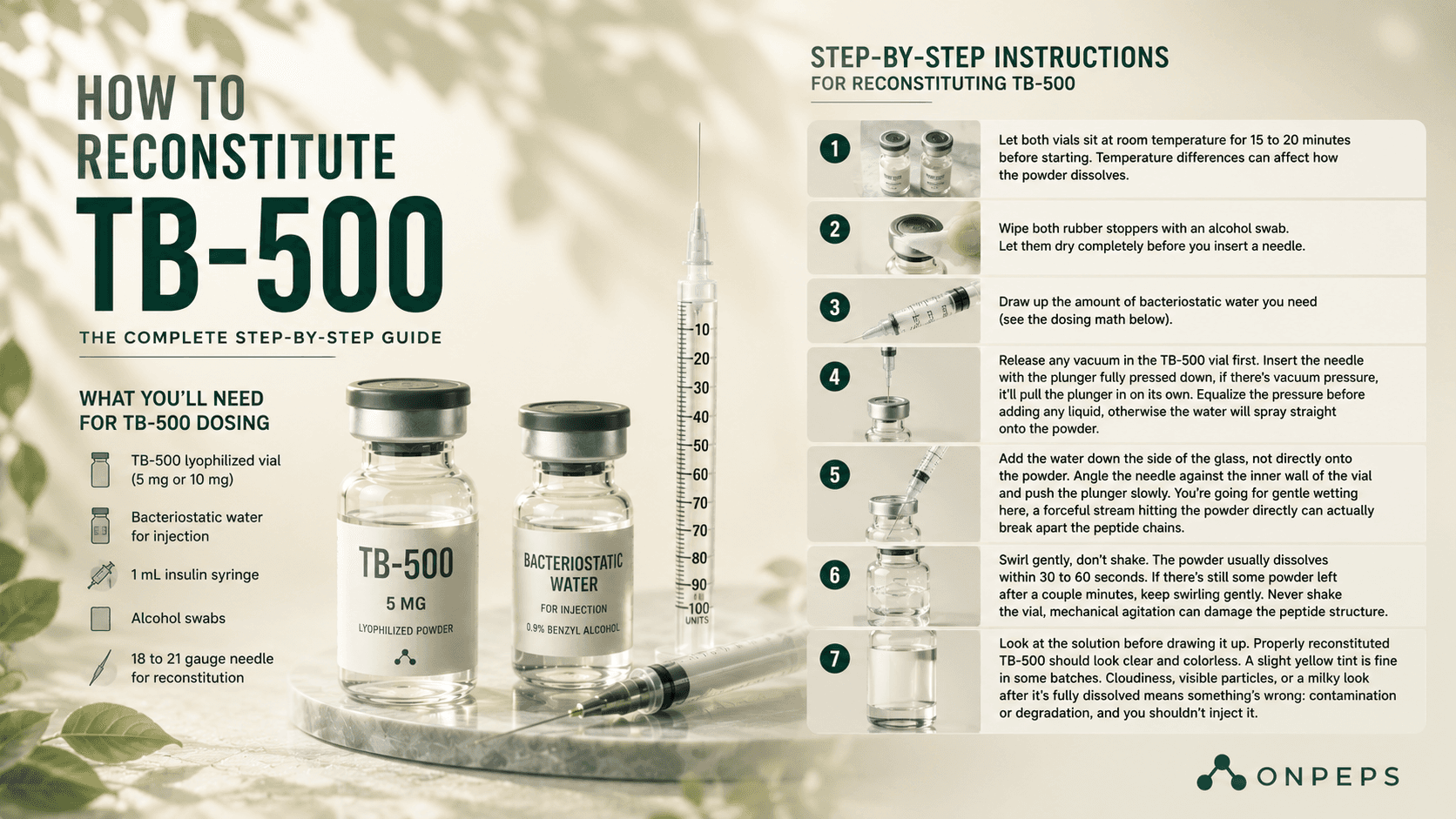
What You'll Need for TB-500 Dosing
TB-500 lyophilized vial (5 mg or 10 mg)
Bacteriostatic water for injection
1 mL insulin syringe
Alcohol swabs
18 to 21 gauge needle for reconstitution
Step-by-Step Instructions for Reconstituting TB-500
Step 1: Let both vials sit at room temperature for 15 to 20 minutes before starting. Temperature differences can affect how the powder dissolves.
Step 2: Wipe both rubber stoppers with an alcohol swab. Let them dry completely before you insert a needle.
Step 3: Draw up the amount of bacteriostatic water you need (see the dosing math below).
Step 4: Release any vacuum in the TB-500 vial first. Insert the needle with the plunger fully pressed down, if there's vacuum pressure, it'll pull the plunger in on its own. Equalize the pressure before adding any liquid, otherwise the water will spray straight onto the powder.
Step 5: Add the water down the side of the glass, not directly onto the powder. Angle the needle against the inner wall of the vial and push the plunger slowly. You're going for gentle wetting here, a forceful stream hitting the powder directly can actually break apart the peptide chains.
Step 6: Swirl gently, don't shake. The powder usually dissolves within 30 to 60 seconds. If there's still some powder left after a couple minutes, keep swirling gently. Never shake the vial, mechanical agitation can damage the peptide structure.
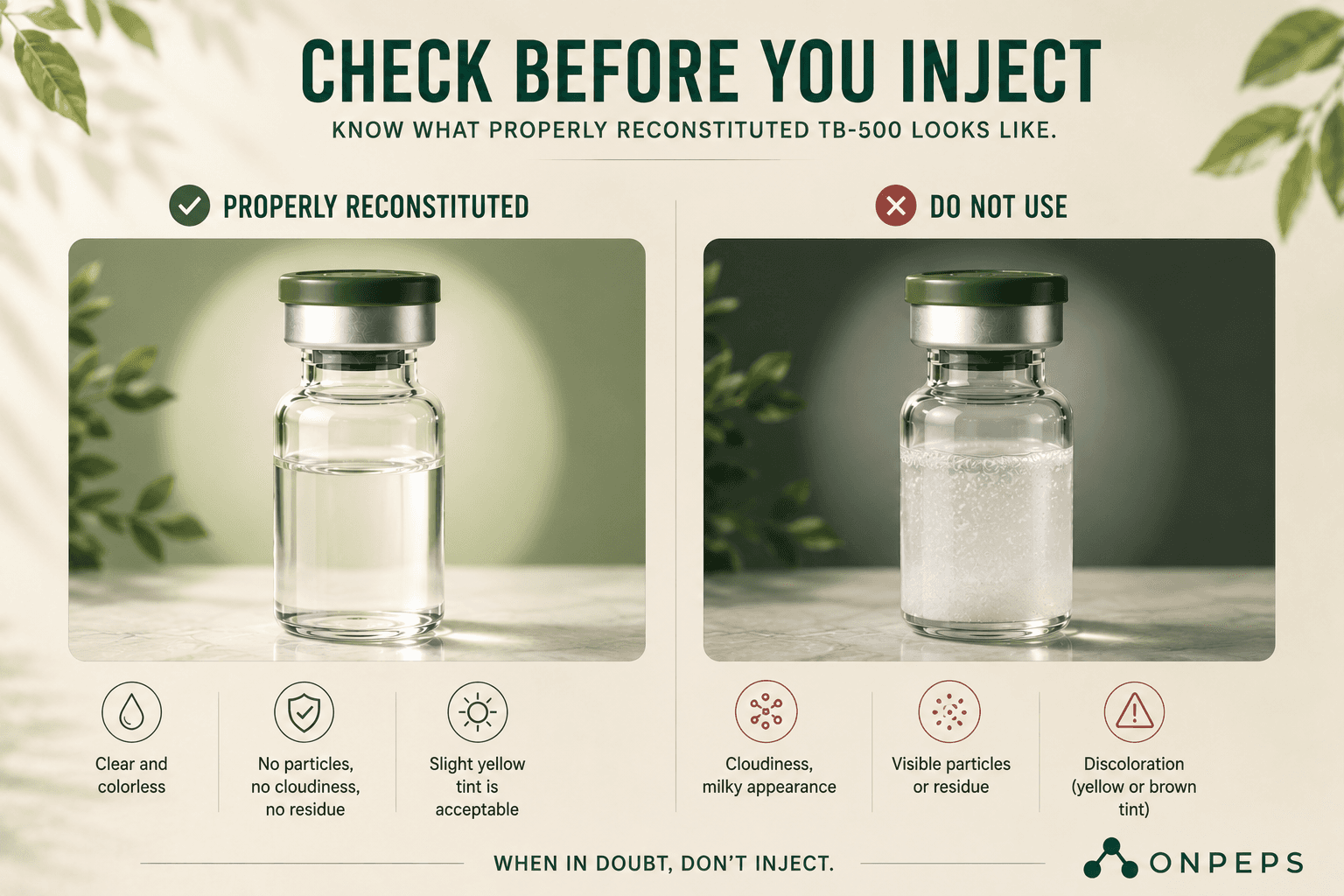
Step 7: Look at the solution before drawing it up. Properly reconstituted TB-500 should look clear and colorless. A slight yellow tint is fine in some batches.
Cloudiness, visible particles, or a milky look after it's fully dissolved means something's wrong: contamination or degradation, and you shouldn't inject it.
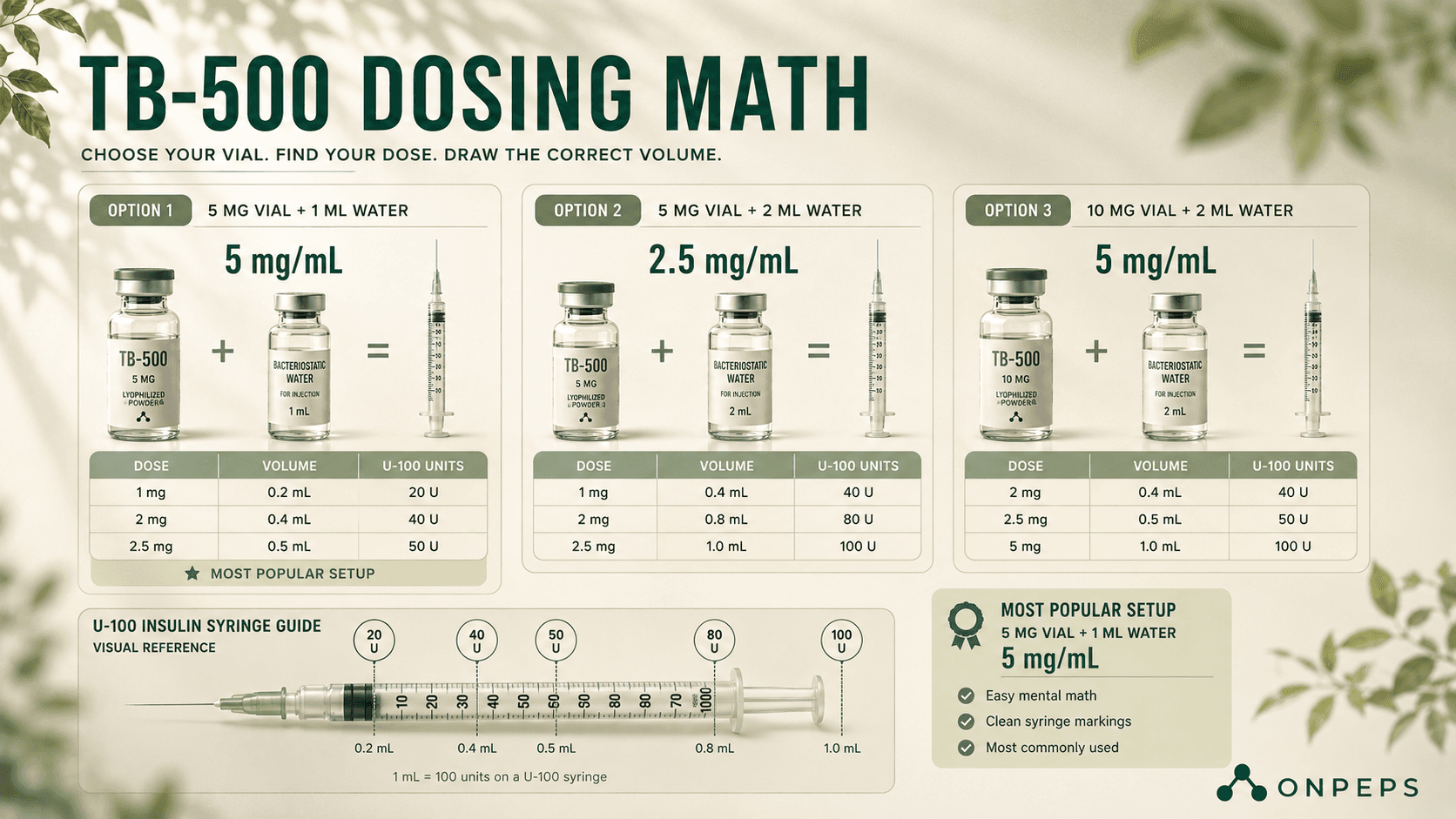
TB-500 Dosing Math by Vial Size
5 mg vial + 1 mL bacteriostatic water = 5 mg/mL (5,000 mcg/mL)
Dose | Volume | Syringe units (U-100) |
1 mg | 0.2 mL | 20 units |
2 mg | 0.4 mL | 40 units |
2.5 mg | 0.5 mL | 50 units |
5 mg vial + 2 mL bacteriostatic water = 2.5 mg/mL (2,500 mcg/mL)
Dose | Volume | Syringe units (U-100) |
1 mg | 0.4 mL | 40 units |
2 mg | 0.8 mL | 80 units |
2.5 mg | 1.0 mL | 100 units |
10 mg vial + 2 mL bacteriostatic water = 5 mg/mL (5,000 mcg/mL)
Dose | Volume | Syringe units (U-100) |
2 mg | 0.4 mL | 40 units |
2.5 mg | 0.5 mL | 50 units |
5 mg | 1.0 mL | 100 units |
The 5 mg/mL ratio (1 mL of water per 5 mg vial) is the most popular setup because the doses land on clean, easy numbers.
Storing Reconstituted TB-500
Reconstituted solution:
Get it in the fridge right away, 2 to 8°C. Use it within 28 days. Write the reconstitution date on the vial so you don't lose track. Don't freeze it, freeze-thaw cycles cause the peptide to clump together. Keep it upright and out of direct light.
Unreconstituted powder:
Sealed lyophilized vials can handle room temperature for up to 24 months in most formulations; just keep them away from light and humidity. Refrigerating unopened vials extends shelf life even further. Never freeze lyophilized peptides either, same clumping risk applies.
Drawing a TB-500 Dose
Use a new insulin syringe each time you inject. Wipe the vial stopper with an alcohol swab before every draw. Insert the needle, flip the vial upside down, and slowly pull the plunger to your target volume. Tap out any air bubbles and push out a small amount before injecting to clear them.
Troubleshooting
TB-500 Powder isn't dissolving:
Give it more time at room temperature. Some batches just take longer. Gentle swirling over 10 to 15 minutes solves most slow-dissolving cases.
TB-500 Solution turned yellow:
A slight yellow tint is normal. Anything darker yellow or brownish suggests degradation, throw it out.
TB-500 Solution is cloudy after being refrigerated:
Warm it up to room temperature and swirl gently. If the cloudiness clears up, it might just be reversible cold aggregation. If it doesn't clear, discard the vial.
FAQ
What is TB-500 reconstitution?
It is the process of mixing lyophilized TB-500 powder with bacteriostatic water before use.
Should I use bacteriostatic water or sterile water for TB-500?
Bacteriostatic water is generally preferred for multi-dose vials because it contains a preservative.
Can sterile water be used to reconstitute TB-500?
Yes, but it should generally be used promptly because it contains no preservative.
How long does reconstituting TB-500 take?
The process typically takes less than five minutes.
Can I shake the vial after adding water?
No. Swirl the vial gently until the powder dissolves.
Why should the water be added down the side of the vial?
Adding it slowly against the glass helps avoid damaging the peptide during reconstitution.
How should reconstituted TB-500 look?
The solution should be clear and colorless, although a slight yellow tint may be normal.
Can I use TB-500 if the solution is cloudy?
No. Persistent cloudiness or visible particles may indicate contamination or degradation.
How should reconstituted TB-500 be stored?
Store it refrigerated at 2 to 8°C and protect it from light.
How long does reconstituted TB-500 last?
When prepared with bacteriostatic water and stored correctly, it is commonly used within 28 days.
Can TB-500 be frozen after reconstitution?
No. Freeze-thaw cycles may damage the peptide.
How long does unopened TB-500 powder last?
Properly stored lyophilized TB-500 is commonly stable for up to 24 months, depending on the manufacturer.
Should I use a new syringe for every injection?
Yes. Always use a new sterile syringe and needle for each injection.
Why isn't my TB-500 dissolving?
Some batches dissolve more slowly and may require additional gentle swirling at room temperature.
Is a slight yellow color normal after reconstitution?
Yes. A faint yellow tint can occur, but dark yellow or brown discoloration may indicate degradation.
What if my TB-500 becomes cloudy after refrigeration?
Allow it to return to room temperature and swirl gently. If the cloudiness does not clear, discard the vial.
Resources:
Rahaman et al. (2024) — https://pubmed.ncbi.nlm.nih.gov/38382158/
Maar et al. (2025) — https://pubmed.ncbi.nlm.nih.gov/40362372/
Di et al. (2026) — https://pubmed.ncbi.nlm.nih.gov/41570941/
Zhu et al. (2016) — https://pubmed.ncbi.nlm.nih.gov/27288307/
Gao et al. (2015) — https://pubmed.ncbi.nlm.nih.gov/26083021/
Morris et al. (2018) — https://pmc.ncbi.nlm.nih.gov/articles/PMC6481613/
Kleinman and Sosne (2016) — https://www.sciencedirect.com/science/chapter/bookseries/abs/pii/S008367291630005X?via%3Dihub
Philp et al. (2003) — https://onlinelibrary.wiley.com/doi/10.1046/j.1524-475X.2003.11105.x
Xing et al. (2021) — https://pmc.ncbi.nlm.nih.gov/articles/PMC8724243/
SEER-1 Phase 3 Trial (2023) — https://pmc.ncbi.nlm.nih.gov/articles/PMC9820614/
ClinicalTrials.gov (NCT00832091) — https://clinicaltrials.gov/study/NCT00832091
Applied Sciences (2026) — https://www.mdpi.com/2076-3417/16/12/6202
He et al. (2022) — https://pmc.ncbi.nlm.nih.gov/articles/PMC9794587/
Lee and Burgess (2025) — https://pubmed.ncbi.nlm.nih.gov/40131143/
Mayfield et al. (2026) — https://pubmed.ncbi.nlm.nih.gov/41476424/
Jozwiak et al. (2025) — https://www.mdpi.com/1424-8247/18/2/185
Yuan et al. (2026) — https://www.mdpi.com/1422-0067/27/6/2876
FDA Federal Register (2026) — https://www.federalregister.gov/documents/2026/04/16/2026-07361/pharmacy-compounding-advisory-committee-notice-of-meeting-establishment-of-a-public-docket-request
WADA 2026 Prohibited List — https://www.wada-ama.org/en/resources/2026-prohibited-list