

TB-500's side effects are generally mild, but the cancer concern that comes up around its mechanism is real and deserves a straight answer, not a wave-off. This article covers both sides of it.
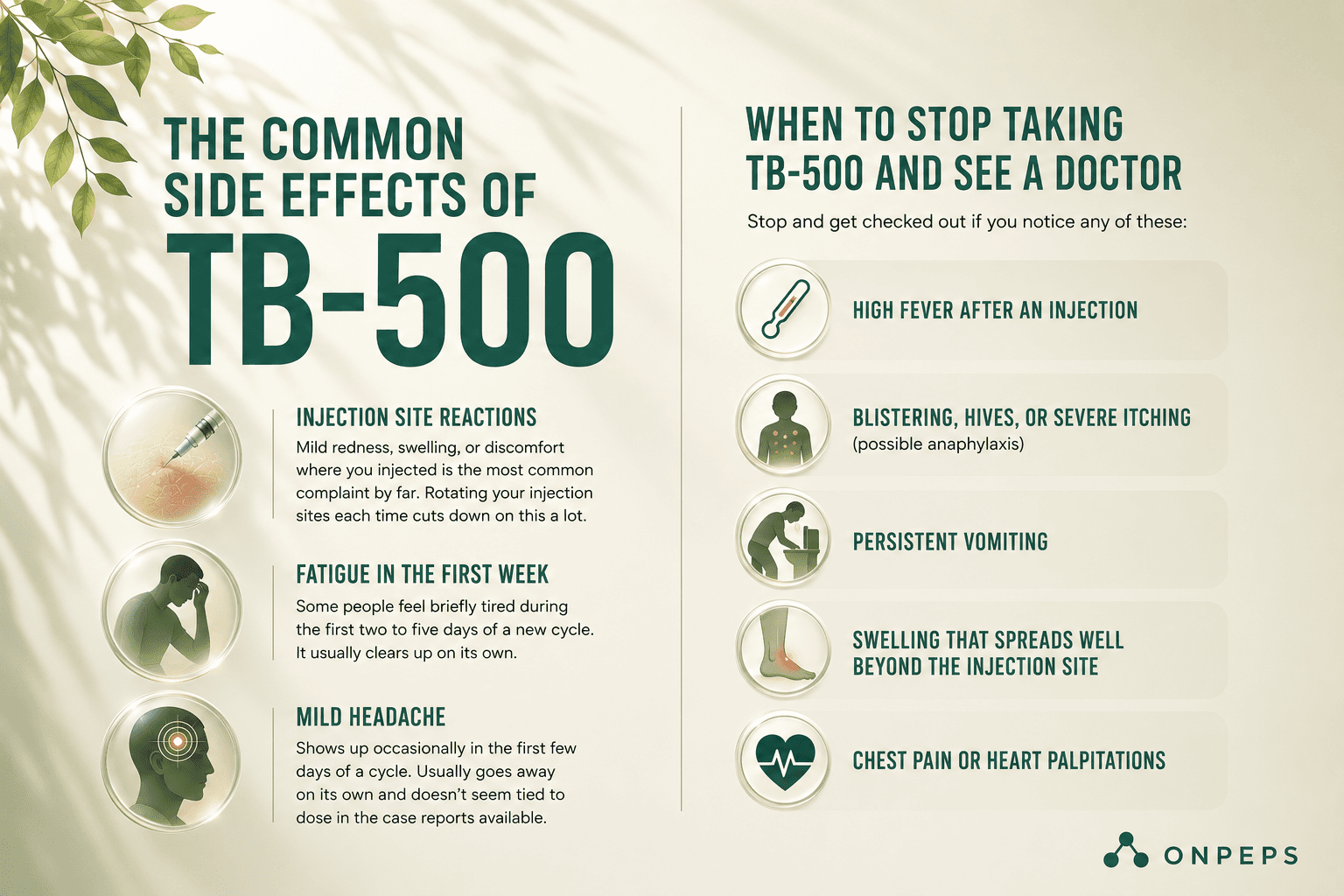
The Common Side Effects of TB-500
Injection site reactions. Mild redness, swelling, or discomfort where you injected is the most common complaint by far. Rotating your injection sites each time cuts down on this a lot.
Fatigue in the first week. Some people feel briefly tired during the first two to five days of a new cycle. It usually clears up on its own.
Mild headache. Shows up occasionally in the first few days of a cycle. Usually goes away on its own and doesn't seem tied to dose in the case reports available.
These three account for the vast majority of reported side effects. They're typically mild, go away by themselves, and don't mean you need to stop your protocol.
When to Stop Taking TB-500 and See a Doctor
Stop and get checked out if you notice any of these:
High fever after an injection
Blistering, hives, or severe itching (possible anaphylaxis)
Persistent vomiting
Swelling that spreads well beyond the injection site
Chest pain or heart palpitations
None of these show up often in the available practitioner literature, but they're worth knowing.
Does TB-500 Cause Cancer?
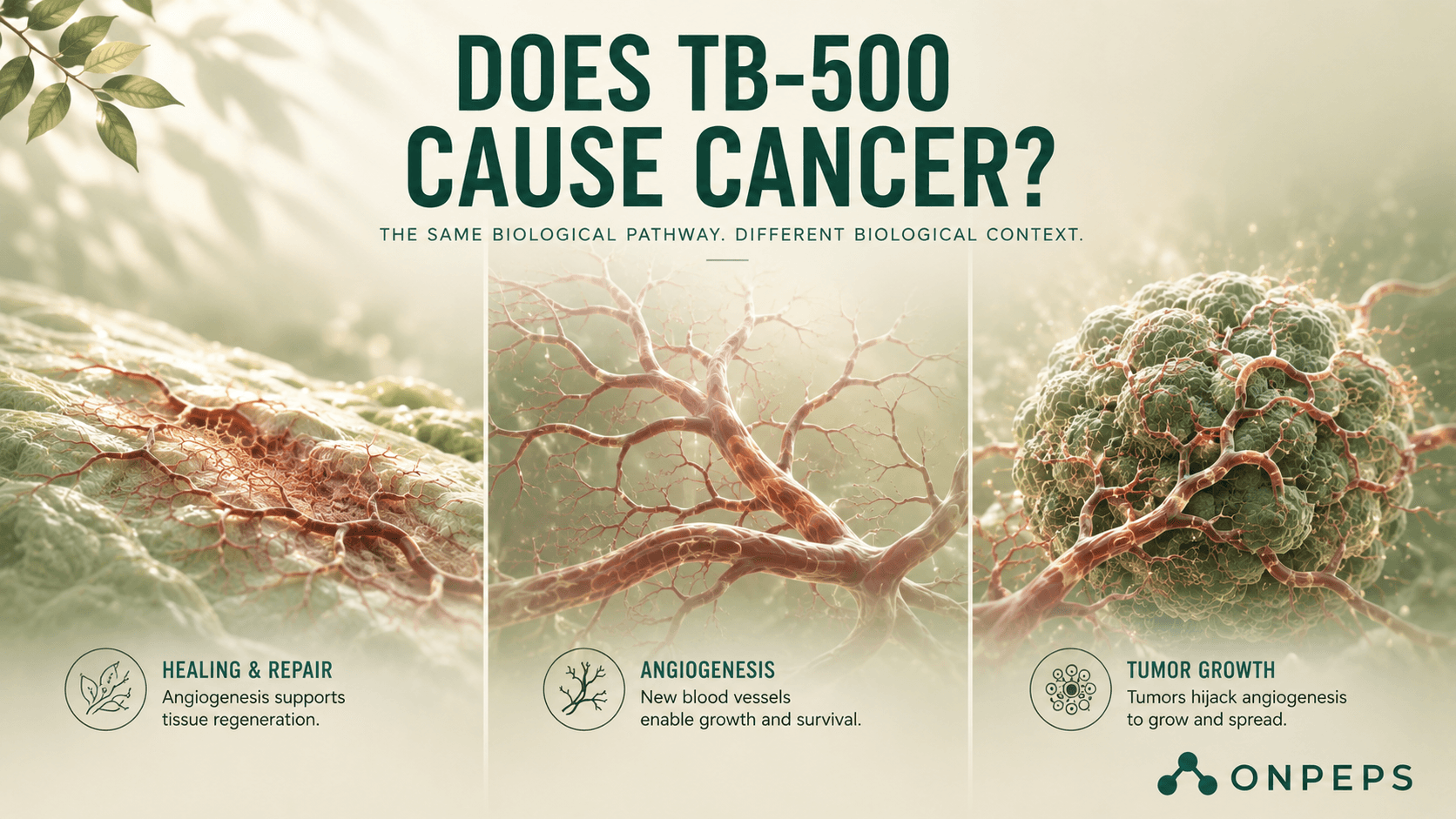
TB-500 promotes angiogenesis, meaning it helps grow new blood vessels. That's actually the same mechanism behind its therapeutic benefits. It's also exactly why the cancer concern exists. Solid tumors need angiogenesis to grow past about 1 to 2 mm in size. So if TB-500 promotes blood vessel growth in general, the theoretical worry is that it could help feed an existing tumor you don't even know you have.
Here's what the actual evidence shows:
Tβ4 expression goes up in several cancer types in preclinical models, including liver cancer, colorectal cancer, and head and neck cancers (Xing et al., 2021, Frontiers in Endocrinology, PMC8724243). But it's not clear which way the causation runs. Higher Tβ4 levels might just be a response to the tumor already being there, rather than something driving its growth.
No animal study has shown TB-500 or Tβ4 causing cancer at standard doses. No human study has documented TB-500 causing cancer or speeding up tumor growth either.
The honest, evidence-based take: the mechanistic concern is real, and the clinical evidence for actual harm is absent. Those are two separate facts, and it's worth keeping them separate. TB-500 is not appropriate for anyone with active or suspected cancer.
Don't confuse a theoretical worry with a documented clinical risk, but don't ignore the theoretical worry either.
The Long-Term Safety Gap
The longest published human safety window for Tβ4 is 180 days, from the 2016 cardiac pilot study by Zhu et al. (Cytotherapy, PMID 27288307). No published study has tracked TB-500 or Tβ4 use in humans for a full year or longer.
Why that matters:
Angiogenic effects that look fine over 12 weeks could behave differently after two or three years of repeated cycles
Immune effects from long-term peptide exposure haven't really been studied
The Ac-LKKTE metabolite identified by Rahaman et al. (2024, PMID 38382158) hasn't been checked for long-term buildup in the body
If you're running TB-500 continuously, or stacking multiple cycles back to back with no real break, you're doing so without any safety data to reference.
TB-500 Product Quality Is Its Own Safety Risk
FDA inspections of compounded and research-grade peptide products have repeatedly found significant rates of inaccurate dosing, contamination, or both.
That's the main reason the FDA moved several peptides to Category 2 back in 2023. Contaminants that have actually been found include bacterial endotoxins, leftover solvents, incomplete peptide chains, heavy metals, and microbial contamination.
Endotoxins in particular are a serious injection risk. They can cause fever, a body-wide inflammatory response, and in high enough doses, septic shock. The peptide itself might have a clean safety profile, but what's actually in an unverified vial is a completely separate question.

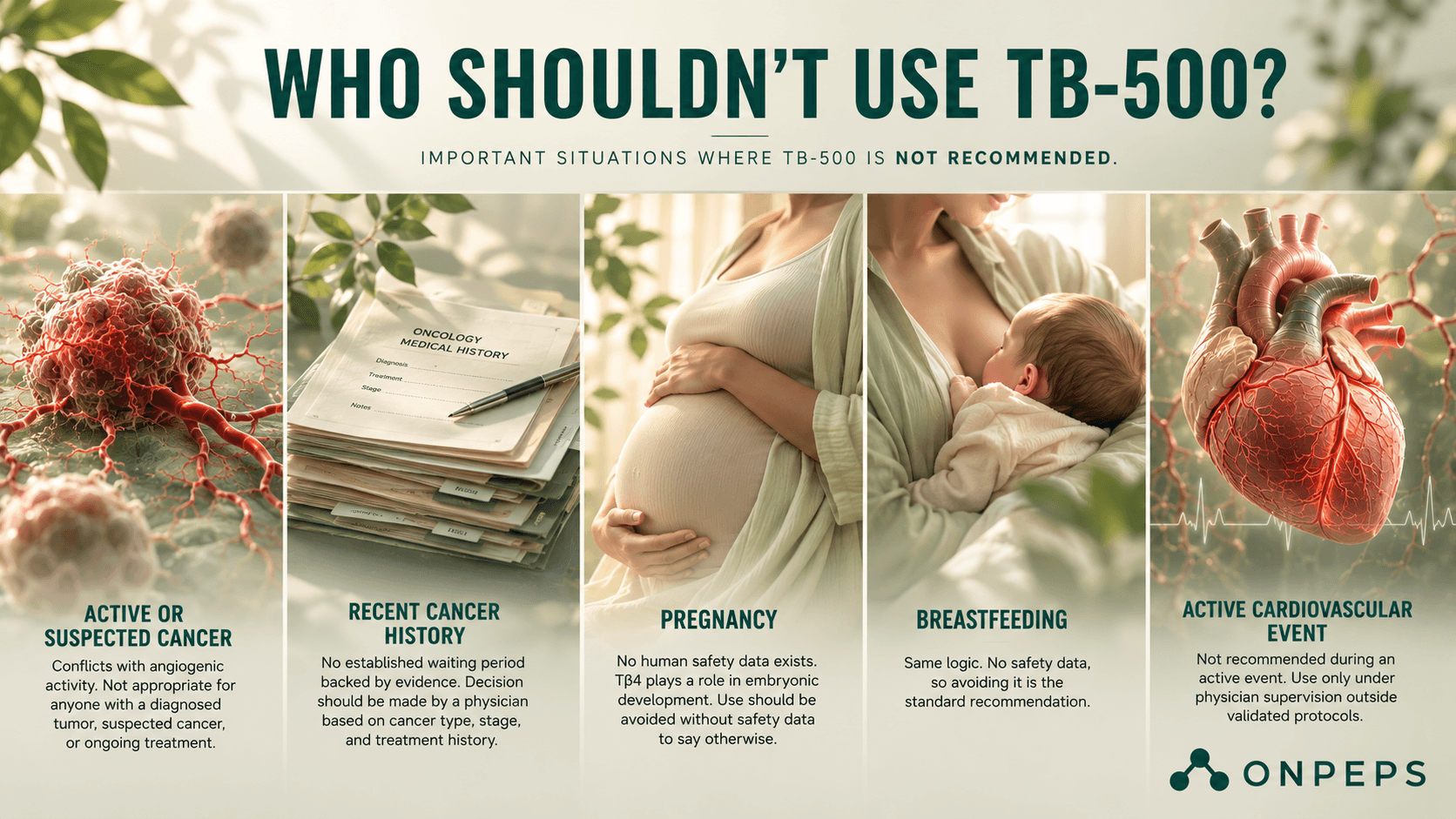
Who Shouldn't Use TB-500?
Active or suspected cancer:
This directly conflicts with the angiogenic mechanism. Not appropriate for anyone with a diagnosed tumor, a suspected one, or ongoing cancer treatment.
Recent cancer history:
There's no established waiting period backed by evidence. This is a decision for a physician based on cancer type, stage, and treatment history.
Pregnancy:
No human safety data exists. Tβ4 plays a role in embryonic development, so any peptide with growth factor and angiogenic activity should be treated as off-limits without safety data to say otherwise.
Breastfeeding:
Same logic. No safety data, so avoiding it is the standard recommendation.
Active cardiovascular event:
TB-500 does have a studied cardiac application in stable post-heart attack patients (Zhu et al., 2016), but using it during an active cardiac event without a physician's supervision falls outside any validated protocol.
FAQ
What are the most common side effects of TB-500?
Injection site irritation, mild fatigue, and headaches are the most commonly reported side effects.
Does TB-500 cause cancer?
There is no evidence that TB-500 causes cancer in humans, but its angiogenic activity raises a theoretical concern for people with existing tumors.
Why is cancer a concern with TB-500?
Because TB-500 promotes blood vessel growth, which tumors can also use to support their growth.
Has TB-500 been shown to accelerate tumor growth?
No published human or animal studies have demonstrated this at standard research doses.
Is TB-500 safe for someone with active cancer?
No. It should be avoided in anyone with active or suspected cancer.
Are there long-term safety studies on TB-500?
No. Long-term human safety data beyond several months are not available.
Can you use TB-500 continuously for years?
There is no published evidence supporting the long-term safety of continuous use.
When should you stop using TB-500 and seek medical attention?
Stop immediately if you develop severe allergic symptoms, high fever, chest pain, persistent vomiting, or significant swelling after an injection.
Can TB-500 cause allergic reactions?
Serious allergic reactions appear to be rare but require immediate medical attention if they occur.
Is TB-500 safe during pregnancy?
No human safety data exist, so it should be avoided during pregnancy.
Can TB-500 be used while breastfeeding?
There are no safety data, so its use is not recommended while breastfeeding.
Is TB-500 safe after cancer treatment?
There is no evidence-based waiting period, so this decision should be made with an oncologist.
Can poor-quality TB-500 products increase health risks?
Yes. Contaminated or inaccurately dosed products may pose risks independent of the peptide itself.
What contaminants have been found in research-grade peptides?
Reports have identified endotoxins, residual solvents, heavy metals, incomplete peptide chains, and microbial contamination.
Does TB-500 have a well-established safety profile?
Short-term human data are limited, while long-term safety remains unknown.
Resources:
Rahaman et al. (2024) — https://pubmed.ncbi.nlm.nih.gov/38382158/
Maar et al. (2025) — https://pubmed.ncbi.nlm.nih.gov/40362372/
Di et al. (2026) — https://pubmed.ncbi.nlm.nih.gov/41570941/
Zhu et al. (2016) — https://pubmed.ncbi.nlm.nih.gov/27288307/
Gao et al. (2015) — https://pubmed.ncbi.nlm.nih.gov/26083021/
Morris et al. (2018) — https://pmc.ncbi.nlm.nih.gov/articles/PMC6481613/
Kleinman and Sosne (2016) — https://www.sciencedirect.com/science/chapter/bookseries/abs/pii/S008367291630005X?via%3Dihub
Philp et al. (2003) — https://onlinelibrary.wiley.com/doi/10.1046/j.1524-475X.2003.11105.x
Xing et al. (2021) — https://pmc.ncbi.nlm.nih.gov/articles/PMC8724243/
SEER-1 Phase 3 Trial (2023) — https://pmc.ncbi.nlm.nih.gov/articles/PMC9820614/
ClinicalTrials.gov (NCT00832091) — https://clinicaltrials.gov/study/NCT00832091
Applied Sciences (2026) — https://www.mdpi.com/2076-3417/16/12/6202
He et al. (2022) — https://pmc.ncbi.nlm.nih.gov/articles/PMC9794587/
Lee and Burgess (2025) — https://pubmed.ncbi.nlm.nih.gov/40131143/
Mayfield et al. (2026) — https://pubmed.ncbi.nlm.nih.gov/41476424/
Jozwiak et al. (2025) — https://www.mdpi.com/1424-8247/18/2/185
Yuan et al. (2026) — https://www.mdpi.com/1422-0067/27/6/2876
FDA Federal Register (2026) — https://www.federalregister.gov/documents/2026/04/16/2026-07361/pharmacy-compounding-advisory-committee-notice-of-meeting-establishment-of-a-public-docket-request
WADA 2026 Prohibited List — https://www.wada-ama.org/en/resources/2026-prohibited-list
USADA — https://www.usada.org


