TL;DR
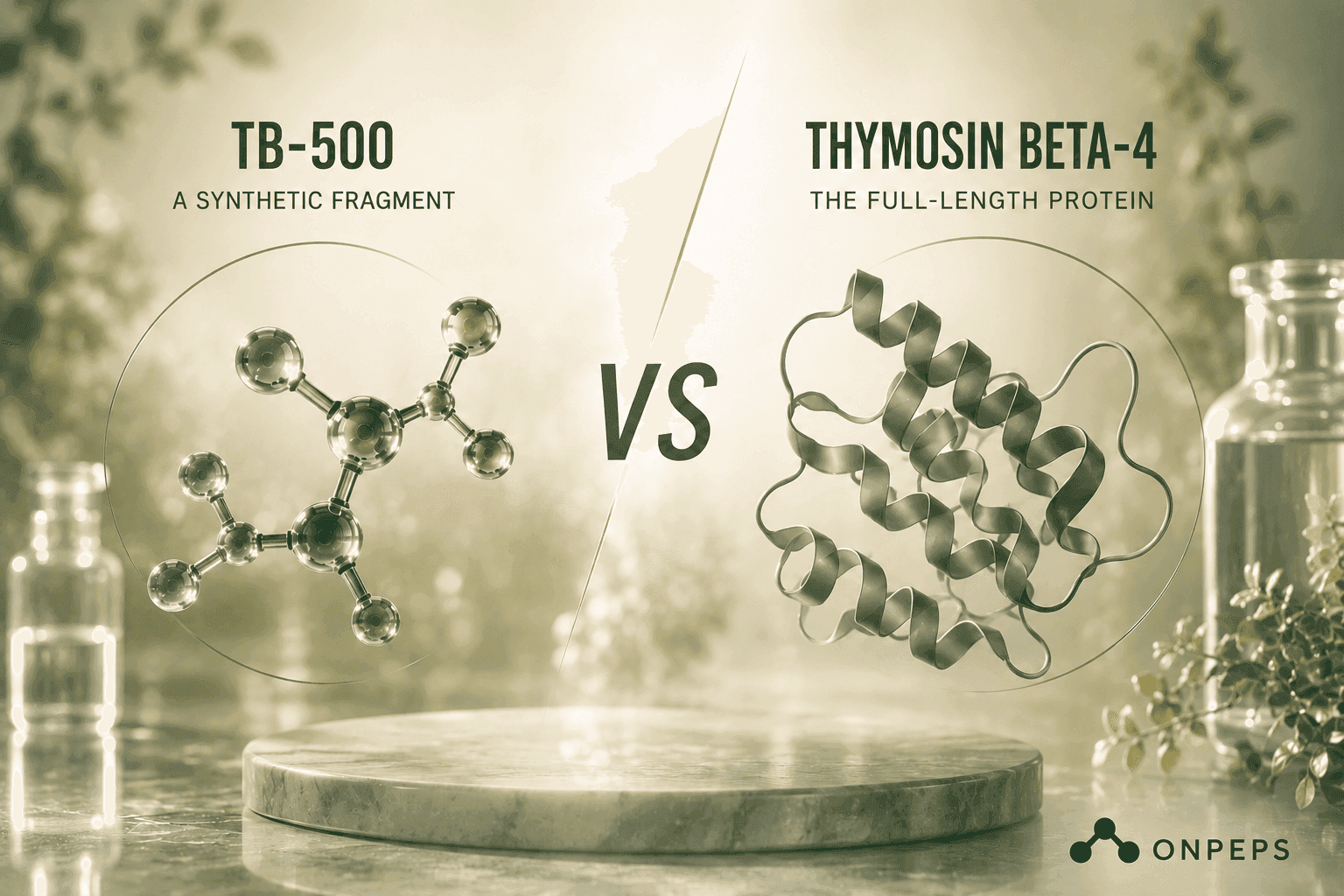
TB-500 is not the same as thymosin beta-4 (Tβ4). It is a synthetic seven-amino acid fragment (Ac-LKKTETQ) derived from the full 43-amino acid protein.
Almost all published human clinical evidence comes from studies of full-length Tβ4, while the TB-500 fragment itself has not been evaluated in human clinical trials.
Although TB-500 contains Tβ4's actin-binding domain, the full protein has additional functional regions involved in cell signaling, cardiac repair, and tissue regeneration that the fragment may not replicate.
A 2024 study found TB-500 is rapidly metabolized into Ac-LKKTE, raising the possibility that some biological activity may come from this metabolite rather than TB-500 itself.
Clinical evidence for thymosin beta-4 should not be treated as direct evidence for injectable TB-500, making it important to distinguish between the two when interpreting the research.
What is Thymosin Beta-4?
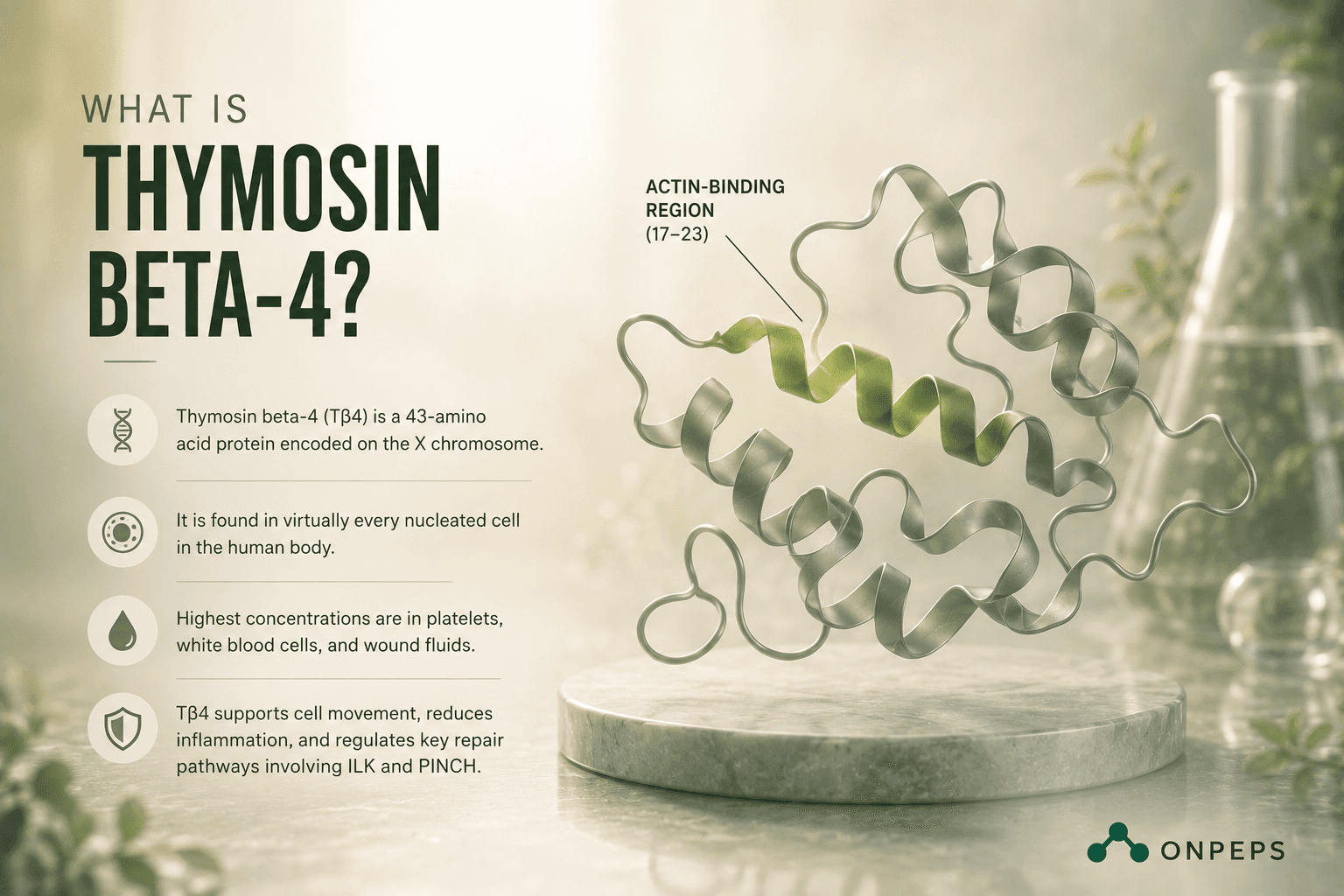
Thymosin beta-4 (Tβ4) is a 43-amino acid protein. It is encoded on the X chromosome, meaning that the gene responsible for telling cells to make thymosin beta-4 is located on the X chromosome. Cells read that gene and produce the Tβ4 protein.
It can be found in virtually every nucleated cell in the human body. A nucleated cell is simply a cell that contains a nucleus. It stores the DNA, which contains the instructions for making proteins.
The highest concentration of thymosin beta 4 can be found in platelets, white blood cells, and wound fluids. Tβ4 was first isolated from thymic tissue in 1966, though its actin-binding role wasn’t fully characterized until decades later. The protein has several functional regions across its 43-amino acid structure.
The central actin-binding region, located between positions 17 and 23, helps cells move. Other parts of the protein help reduce inflammation, interact with proteins that support surrounding tissues, and regulate important repair pathways involving ILK (integrin-linked kinase) and PINCH.
What is ILK (integrin-linked kinase)?
ILK is a protein that helps cells sense and respond to their surroundings. It sits where cells attach to the extracellular matrix and acts as a signaling hub.
Studies on Tβ4 suggest that it can activate ILK, which then:
Helps cells move toward damaged tissue.
Promotes cell survival after injury.
Supports the formation of new blood vessels.
Helps switch on repair cells that help heal the heart.
The best-known evidence comes from the 2004 study by Bock-Marquette et al., which showed that Tβ4 activates an ILK-dependent pathway required for cardiac regeneration.
What is PINCH?
PINCH is an adaptor (scaffold) protein that binds to ILK and parvin to form the ILK-PINCH-parvin (IPP) complex.
This complex helps:
Connect cells to the extracellular matrix.
Stabilize the cell's internal skeleton.
Coordinate cell movement.
Promote cell survival during tissue repair.
Tβ4 has been reported to influence this pathway, although the exact molecular relationship is less well established than its interaction with ILK
So as you can see, all of these combined together give Tβ4 a bigger range of biological functions than any single peptide fragment can replicate. (Xing et al., 2021, Frontiers in Endocrinology, PMC8724243).
Why does this matter? Because TB-500 contains only one small part of the full Tβ4 protein, so it may not reproduce all of the biological effects seen with full-length Tβ4.
What is TB-500, a Fragment of Thymosin Beta 4?
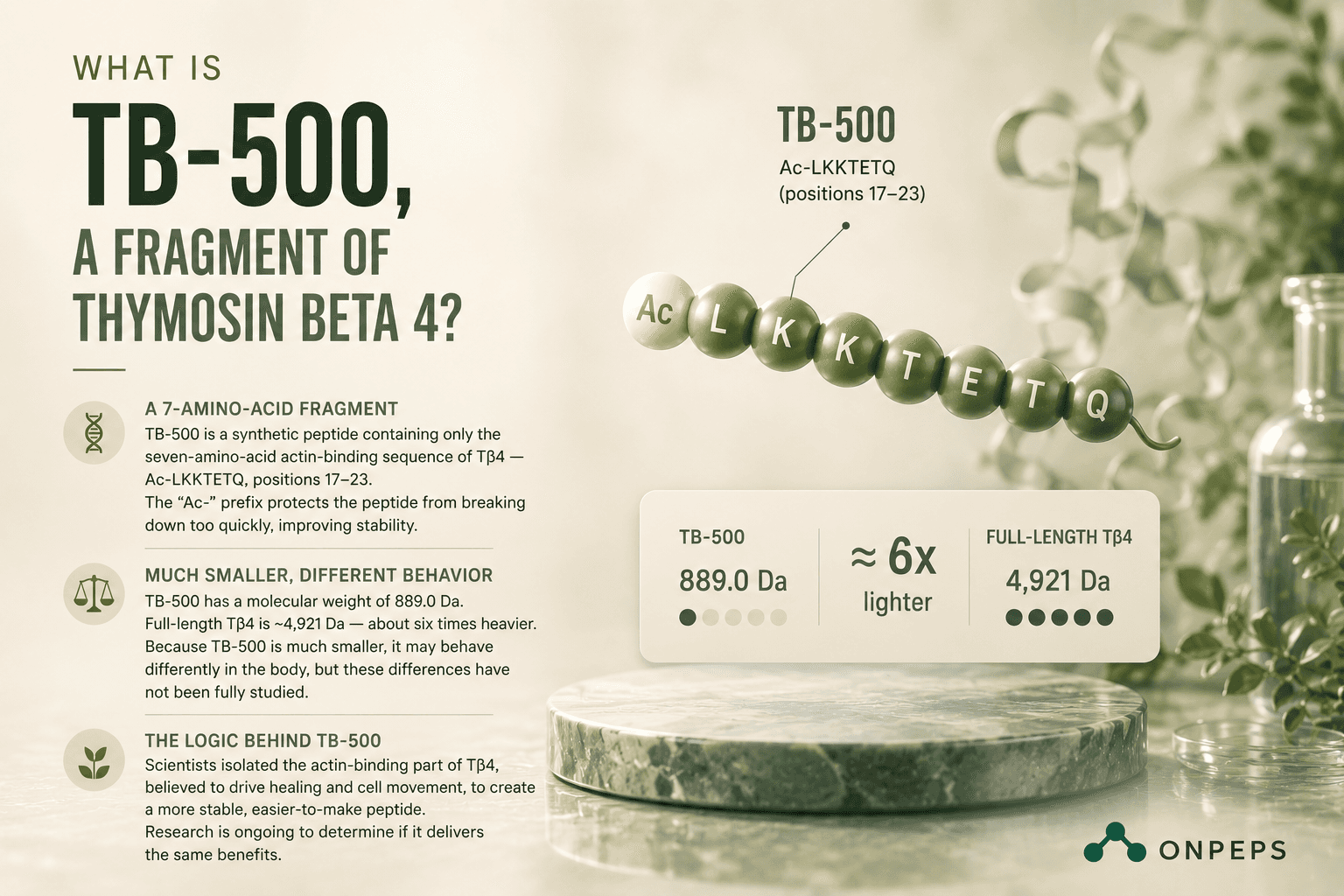
TB-500 is a synthetic peptide containing only the seven-amino-acid actin-binding sequence of Tβ4 — Ac-LKKTETQ, positions 17–23. The "Ac-" prefix is a small chemical modification added to the beginning of the peptide. It helps protect TB-500 from breaking down too quickly, making it more stable than the same peptide without it.
TB-500 has a molecular weight of 889.0 Da (PubChem). Full-length Tβ4 is approximately 4,921 Da, which is roughly six times heavier. Because TB-500 is much smaller than full-length Tβ4, it may behave differently in the body. It could be absorbed, distributed, broken down, and interact with cells differently, but these differences have not been fully studied.
The logic behind creating TB-500 was not that complicated. Scientists believed that they could isolate the actin-binding part, which was responsible for healing and cell movement. This would help them create more stable and easy-to-make peptides. The research is still going on as to whether it offers the same benefits.
What Do the Human Studies Say?
As we mentioned in our previous TB-500 article, the evidence that is usually mentioned in support of TB-500 is mainly taken from full-length Tβ4, not the synthetic fragment.
The SEER-1 Phase 3 trial for neurotrophic keratopathy (a rare eye disease where the cornea loses its nerve supply and cannot heal properly after injury) used RGN-259, a formulation of full-length Tβ4.
ARISE-3 addressed dry eye disease separately and did not meet its primary endpoint.
The cardiac pilot by Zhu et al. (2016, Cytotherapy, PMID 27288307) used intravenous Tβ4.
The Phase 2 venous stasis ulcer trial (NCT00832091) used topical Tβ4.
The foundational wound healing work by Philp et al. (2003, Wound Repair and Regeneration) used the 7-amino acid actin-binding fragment in diabetic and aged mice. While we can see that this study is closest to the TB-500’s actual profile, it is not a human trial.
And here is where we at ONPEPS have to warn you.
Peptide practitioners and vendors who are citing human clinical evidence for TB-500 are mostly taking their data from Tβ4 studies. TB-500 has not been tested in human clinical trials.
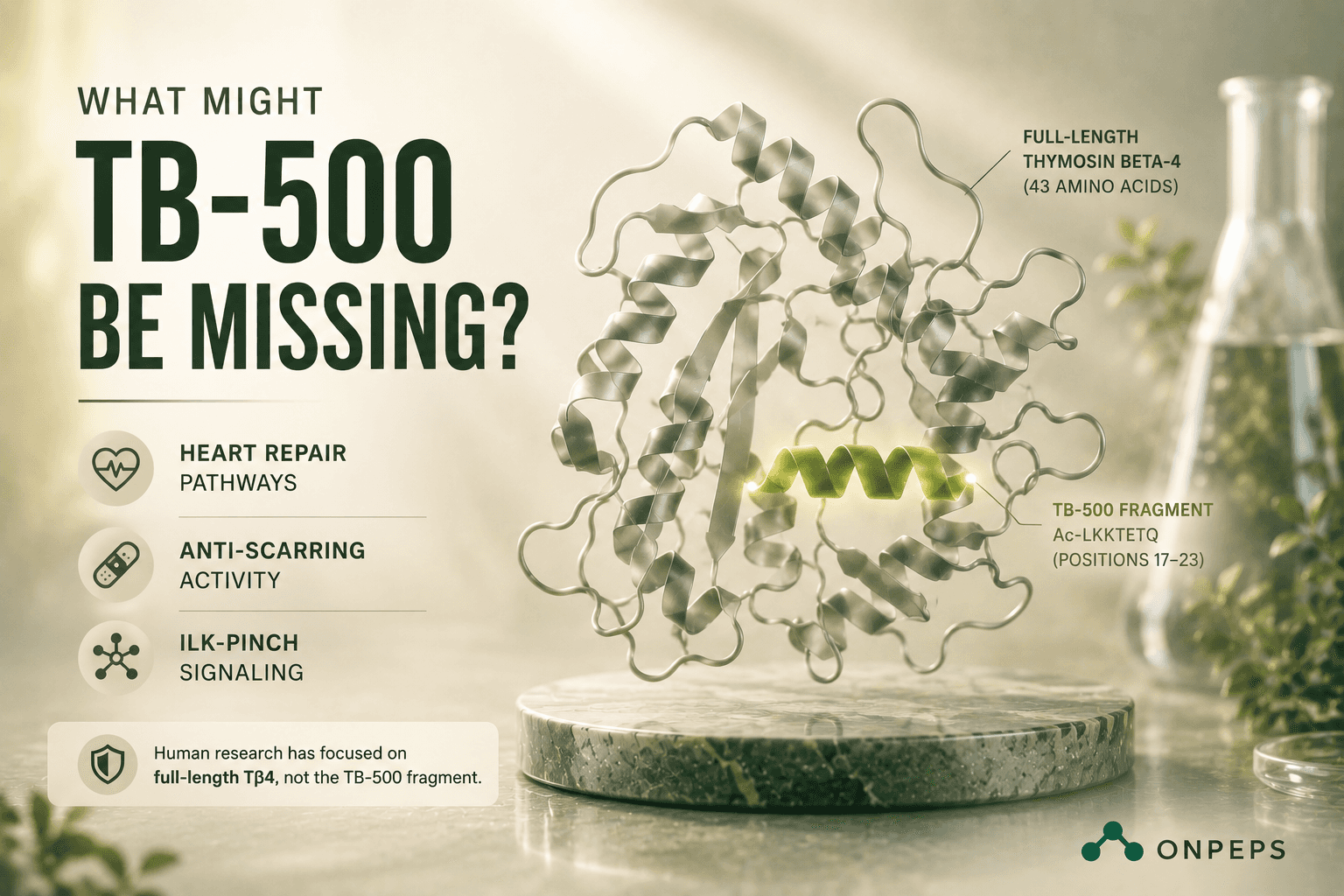
What TB-500 Peptide May Be Missing
Heart Repair:
The C-terminal region of Tβ4 activates ILK (integrin-linked kinase). This helps to:
move cells toward damaged tissue
support the growth of new blood vessels
promote cell survival
activates dormant heart repair cells after an injury (Bock-Marquette et al., 2004, Nature, PMID 15565145).
And since TB-500 lacks the C-terminal region, it may not activate ILK to the same extent.
Anti-scarring effects:
A 2025 study by Maar et al. (PMID 40362372) found that Tβ4 helps prevent scar tissue from forming by stopping a key process: it blocks fibroblasts (regular repair cells) from turning into myofibroblasts, the cells that actually create scar tissue. It does this by shutting down a protein called ROCK1.
Researchers have not identified which part of Tβ4 is responsible for this effect, so it is unknown whether the seven-amino acid TB-500 fragment retains the same activity.
Cell Survival:
Tβ4 also influences the ILK-PINCH signaling pathway, which helps regulate genes involved in cell survival and the body's response to injury. Whether TB-500 can influence this pathway remains unknown.
None of this means TB-500 is inactive. Philp et al. (2003) demonstrated wound-healing activity for the seven-amino acid fragment itself. It simply means that the full-length Tβ4 protein has a broader range of biological functions than a seven-residue fragment is unlikely to fully reproduce.
The Rahaman 2024 Finding
A 2024 study by Rahaman et al. (Journal of Chromatography B, PMID 38382158) looked at how TB-500 breaks down in the body. What they found is not what forums and social media will have you believe.
TB-500 converts into a smaller metabolite called Ac-LKKTE, and the wound-healing benefits people credit to TB-500 might actually be coming from this metabolite, not TB-500 itself.
If that turns out to be true, TB-500 might just be acting as a delivery vehicle, something that converts into the molecule actually doing the work. That doesn't mean TB-500 is useless. It would still explain the effects people see. It just adds another wrinkle to an already complicated picture of how well Tβ4 research actually applies to TB-500 use.
This finding has shown up in later papers, but you won't find it mentioned in most consumer content about TB-500. It also hasn't been independently confirmed by other researchers as of mid-2026.
Why Pharmaceutical Companies Chose Full-Length Tβ4
No pharmaceutical company has pursued the TB-500 fragment as a drug candidate for any indication. RegeneRx’s clinical development used full-length Tβ4 throughout, a deliberate choice reflecting the broader functional profile of the intact protein.
What This Means for TB-500 Research
When a study reports that Tβ4 accelerated wound healing, reduced cardiac fibrosis, or promoted corneal repair, that finding cannot be directly transferred to injectable TB-500. The mechanism overlaps in the actin-binding domain, but the full protein has functional domains the fragment lacks.
“Clinical evidence for thymosin beta-4” and “clinical evidence for TB-500” are not interchangeable, even though they’re treated that way across most of the market. The Rahaman 2024 metabolite finding adds the possibility that the active molecule is neither one of them.
FAQ
What is the difference between TB-500 and Thymosin Beta-4?
Thymosin Beta-4 is the full 43-amino acid protein made by the body. TB-500 is just a short, synthetic 7-amino acid fragment of it.
Has TB-500 been tested in human clinical trials?
No, TB-500 has zero human clinical trials. All the human data you see cited online actually comes from studies on the full-length protein.
Why do vendors conflate TB-500 with Thymosin Beta-4?
They use the full protein's human data to market the fragment because both share the same localized wound-healing domain.
What healing mechanisms is TB-500 missing?
It lacks the sections needed for deep signaling, meaning it likely misses out on the heart repair and anti-scarring benefits of the full protein.
What is the Rahaman 2024 metabolite finding?
A 2024 study showed TB-500 quickly breaks down into a smaller piece (Ac-LKKTE), meaning that metabolite might be doing all the actual healing work.
Why do pharma companies only develop full-length Thymosin Beta-4?
Because the full protein triggers a much wider range of systemic healing and cell survival pathways that the tiny fragment cannot replicate.
Resources:
Rahaman et al. (2024) — https://pubmed.ncbi.nlm.nih.gov/38382158/
Maar et al. (2025) — https://pubmed.ncbi.nlm.nih.gov/40362372/
Di et al. (2026) — https://pubmed.ncbi.nlm.nih.gov/41570941/
Zhu et al. (2016) — https://pubmed.ncbi.nlm.nih.gov/27288307/
Gao et al. (2015) — https://pubmed.ncbi.nlm.nih.gov/26083021/
Morris et al. (2018) — https://pmc.ncbi.nlm.nih.gov/articles/PMC6481613/
Kleinman and Sosne (2016) — https://www.sciencedirect.com/science/chapter/bookseries/abs/pii/S008367291630005X?via%3Dihub
Philp et al. (2003) — https://onlinelibrary.wiley.com/doi/10.1046/j.1524-475X.2003.11105.x
Xing et al. (2021) — https://pmc.ncbi.nlm.nih.gov/articles/PMC8724243/
SEER-1 Phase 3 Trial (2023) — https://pmc.ncbi.nlm.nih.gov/articles/PMC9820614/
ClinicalTrials.gov (NCT00832091) — https://clinicaltrials.gov/study/NCT00832091
Applied Sciences (2026) — https://www.mdpi.com/2076-3417/16/12/6202
He et al. (2022) — https://pmc.ncbi.nlm.nih.gov/articles/PMC9794587/
Lee and Burgess (2025) — https://pubmed.ncbi.nlm.nih.gov/40131143/
Mayfield et al. (2026) — https://pubmed.ncbi.nlm.nih.gov/41476424/
Jozwiak et al. (2025) — https://www.mdpi.com/1424-8247/18/2/185
Yuan et al. (2026) — https://www.mdpi.com/1422-0067/27/6/2876
FDA Federal Register (2026) — https://www.federalregister.gov/documents/2026/04/16/2026-07361/pharmacy-compounding-advisory-committee-notice-of-meeting-establishment-of-a-public-docket-request
WADA 2026 Prohibited List — https://www.wada-ama.org/en/resources/2026-prohibited-list
USADA — https://www.usada.org/