Cagrilintide is the peptide almost nobody was searching for a year ago and quite a few people are searching for now. US search interest has nearly doubled over twelve months, and it spiked in the middle of September when a paper in Nature Metabolism reported that combining it with retatrutide out-performed either drug on its own. In rats. That last part keeps getting dropped.
It is also one half of CagriSema, the Novo Nordisk combination that is sitting in front of the FDA right now. That gives cagrilintide something almost no gray-market peptide has: a Phase 3 programme with thousands of participants and results in the New England Journal of Medicine. So what is it, what has actually been shown, and what does the vial being sold as a "cagri-reta blend" have to do with any of it? Let's dive in.
TLDR
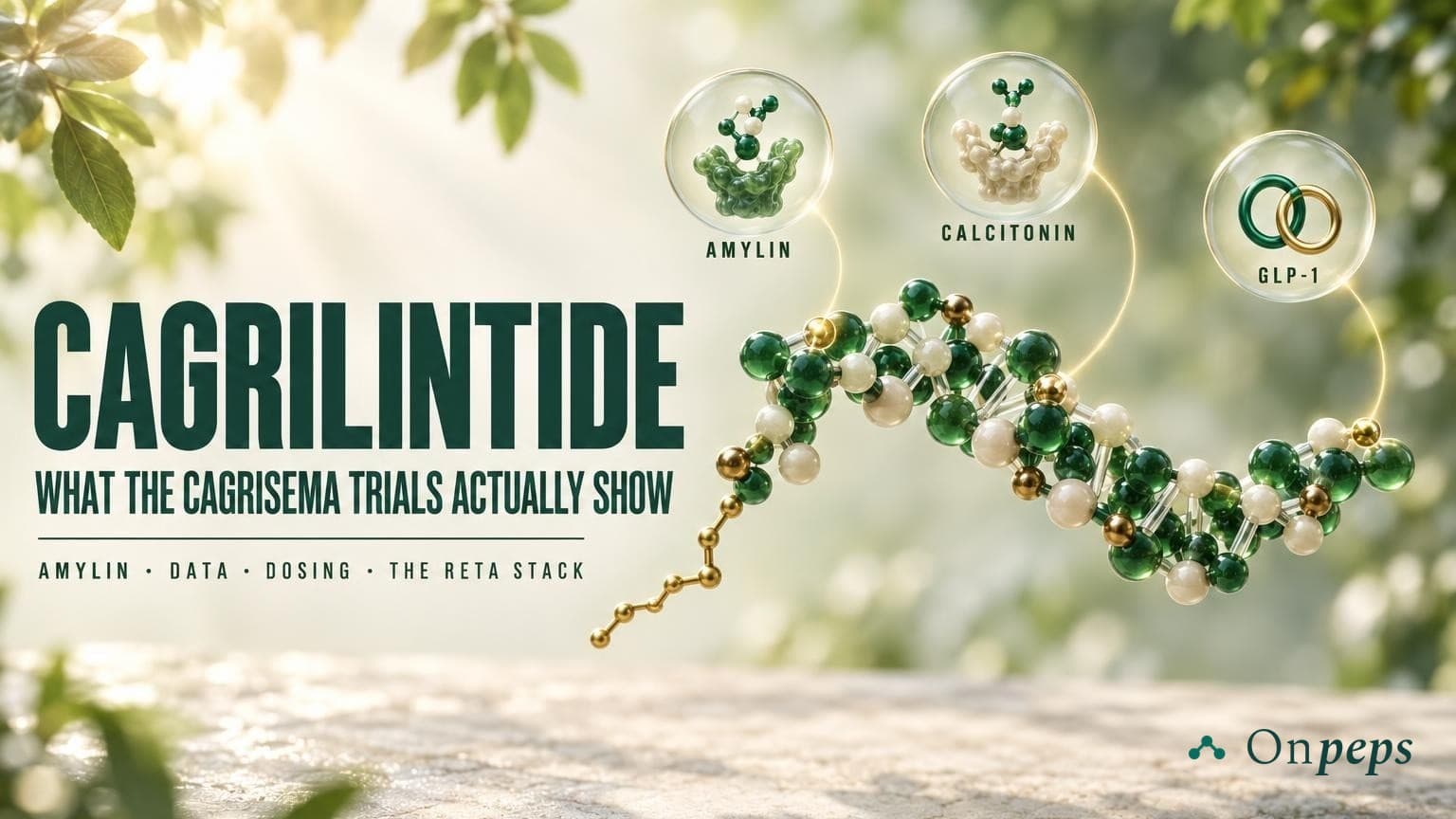
What is cagrilintide? A long-acting, once-weekly analog of amylin, the hormone your pancreas releases alongside insulin after a meal. Developed by Novo Nordisk under the code AM833. It works through amylin and calcitonin receptors, a different pathway from the GLP-1 drugs, which is the entire reason for combining them.
Results: On its own, 10.8% weight loss at 26 weeks on the top Phase 2 dose and 11.5% at 68 weeks in the Phase 3 monotherapy arm of REDEFINE 1. Paired with semaglutide as CagriSema, 20.4% at 68 weeks. No human trial has ever combined it with retatrutide.
Dosage: Trials stepped up to 2.4 mg once weekly, with 4.5 mg tested in Phase 2. Community protocols copy the 2.4 mg target, often from pre-mixed blend vials whose fixed ratio decides the dose for you. No validated protocol exists outside a trial.
Safety: Nausea, constipation, diarrhea and injection-site reactions. Gastrointestinal adverse events hit 41% to 63% on cagrilintide alone against 32% on placebo, and about 80% on CagriSema. Nothing is known about use beyond 84 weeks, and nothing at all about the retatrutide combination in humans.
Legal Status (September 2026): Approved nowhere. CagriSema is under FDA review with a decision expected in 2026. Cagrilintide cannot be compounded under US federal law, in FDA's own words, and vendors selling it were sent warning letters in March.
What Is Cagrilintide, and Why Is It Trending Now?
Start with the hormone. Amylin is a 37-amino-acid peptide that your pancreatic beta cells release together with insulin every time you eat. It slows stomach emptying, suppresses the glucagon surge after a meal, and signals fullness through the brainstem, in the area postrema, one of the few parts of the brain a circulating hormone can reach directly (Hay et al., 2015, Pharmacological Reviews, PMID 26071095).
The problem with amylin as a drug has always been the molecule itself: it clumps into amyloid fibrils. The first fix was pramlintide, approved in 2005 as an add-on to insulin, which needs three injections a day and produced 3.7% placebo-corrected weight loss in a 16-week obesity trial (Aronne et al., 2007, JCEM, PMID 17504894). Useful, not transformative.
Cagrilintide is the second attempt. Novo Nordisk's chemists stabilised the sequence against fibril formation and attached a fatty-acid chain so the peptide binds albumin in the blood (Kruse et al., 2021, Journal of Medicinal Chemistry, PMID 34288673). The result has a half-life of 159 to 195 hours, roughly a week, which is what makes a single weekly injection possible (Enebo et al., 2021, The Lancet, PMID 33894838).
Why the search graph looks the way it does comes down to three things stacked on top of each other.
On September 15, a University of Copenhagen group published a study in Nature Metabolism showing that cagrilintide plus retatrutide produced more weight loss in obese rats than either drug alone, and more than matched-dose combinations built on semaglutide or tirzepatide (Petersen et al., 2026, Nature Metabolism, PMID 42744908). Within days, "cagrilintide retatrutide metabolic outcomes study" was the fastest-rising cagrilintide query in the United States.
Underneath that, CagriSema is moving through the FDA. Novo filed its New Drug Application on December 18, 2025, and a decision is expected this year. Two more Phase 3 toplines landed on September 21: CagriSema beat tirzepatide 5 mg on weight in people with type 2 diabetes, and a lower 1 mg / 1 mg dose delivered 21% weight loss in people without diabetes.
And then there's retatrutide. The community that adopted retatrutide over the past year has been looking for the next thing to add to it, and vendors built the product for them: a single vial holding both peptides in a fixed ratio. The rat paper looked like a permission slip. It isn't, and we'll get to why.
How Does Cagrilintide Work?
Amylin receptors are unusual. There is no single amylin receptor gene. Instead, the calcitonin receptor pairs up with one of three receptor activity-modifying proteins, and each pairing produces a different amylin receptor subtype (Hay et al., 2015). Cagrilintide activates all of those subtypes and the bare calcitonin receptor too, which pharmacologists call a dual amylin and calcitonin receptor agonist (Fletcher et al., 2021, Journal of Pharmacology and Experimental Therapeutics, PMID 33727283). Pramlintide, by contrast, is selective for the amylin receptors. That non-selectivity appears to matter for weight loss, though nobody has fully explained why.
Where it acts was mapped this June. A cross-species atlas of the brainstem found that long-term cagrilintide treatment switches on a specific population of neurons in the nucleus of the solitary tract, and that knocking those neurons down abolished cagrilintide's effect on body weight while leaving semaglutide's effect intact (Ludwig et al., 2026, Nature Metabolism, PMID 42260119).
That is the whole mechanistic case for the combination, in one experiment. GLP-1 drugs and amylin analogs reduce appetite through different neurons. Stack them and you are not turning the same dial harder, you are turning a second dial.
The reason to combine cagrilintide with a GLP-1 drug isn't that it's stronger. It's that it works somewhere else.
What it does downstream looks familiar: less food intake, slower gastric emptying, and a modest effect on blood sugar. Alone in people with type 2 diabetes, it lowered HbA1c by 0.9 percentage points over 32 weeks, about half what semaglutide managed (Frias et al., 2023, The Lancet, PMID 37364590). It is a weight drug first and a glucose drug second.
Cagrilintide vs Semaglutide vs Tirzepatide vs Retatrutide
Here is where cagrilintide sits against the drugs it gets compared with. Weight-loss figures are from the largest published trial of each, and they are not from the same trial, so read across the rows with care.
| Compound | Target | Status | Best published weight loss | Dosing |
|---|---|---|---|---|
| Pramlintide | Amylin receptors (selective) | Approved 2005, insulin add-on | 3.7% placebo-corrected at 16 weeks | Three times daily |
| Cagrilintide | Amylin + calcitonin receptors | Investigational | 10.8% at 26 weeks (4.5 mg, Phase 2); 11.5% at 68 weeks (2.4 mg, REDEFINE 1 arm) | Once weekly |
| Semaglutide | GLP-1 | Approved | 14.9% at 68 weeks (STEP 1) | Once weekly |
| CagriSema | Amylin + calcitonin + GLP-1 | NDA under FDA review | 20.4% at 68 weeks (REDEFINE 1) | Once weekly, 2.4 mg / 2.4 mg |
| Tirzepatide | GIP + GLP-1 | Approved | 20.9% at 72 weeks (SURMOUNT-1) | Once weekly |
| Retatrutide | GIP + GLP-1 + glucagon | Investigational | 24.2% at 48 weeks (Phase 2) | Once weekly |
Sources: Aronne et al., 2007; Lau et al., 2021; Garvey et al., 2025; Wilding et al., 2021, NEJM, PMID 33567185; Jastreboff et al., 2022, NEJM, PMID 35658024; Jastreboff et al., 2023, NEJM, PMID 37366315.
Two things jump out. First, cagrilintide alone is a liraglutide-tier drug, not a tirzepatide-tier one. In its Phase 2 trial the 4.5 mg dose beat daily liraglutide 3.0 mg by 1.8 percentage points, and that is the only active comparator it has beaten on a primary endpoint (Lau et al., 2021, The Lancet, PMID 34798060). Second, the value is in the addition. Semaglutide alone in REDEFINE 1 gave 14.9%. Adding cagrilintide took it to 20.4%.
Here's the caveat that gets dropped: the one time CagriSema was put head-to-head against tirzepatide in obesity, it lost. In the open-label REDEFINE 4 trial, CagriSema produced 23.0% weight loss at 84 weeks against 25.5% for tirzepatide 15 mg, and the trial missed its non-inferiority endpoint. Novo announced that on February 23, 2026. It has not been published.
What the Evidence Actually Shows
Cagrilintide has an unusually deep human record for a peptide sold on research-use-only sites. Here is what has passed peer review, separated from what exists only in a press release.
| Study | Design | Result | Status |
|---|---|---|---|
| Enebo et al., 2021, Phase 1b | 96 adults, cagrilintide 0.16 to 4.5 mg plus semaglutide 2.4 mg, 20 weeks | 17.1% weight loss with cagrilintide 2.4 mg vs 9.8% with semaglutide plus placebo | Published (The Lancet) |
| Lau et al., 2021, Phase 2 | 706 adults without diabetes, five doses vs liraglutide vs placebo, 26 weeks | 6.0% to 10.8% vs 3.0% placebo; 4.5 mg beat liraglutide 3.0 mg (10.8% vs 9.0%) | Published (The Lancet) |
| Frias et al., 2023, Phase 2 | 92 adults with type 2 diabetes, CagriSema vs each component, 32 weeks | Weight: CagriSema 15.6%, cagrilintide 8.1%, semaglutide 5.1%. HbA1c: 2.2, 0.9 and 1.8 points | Published (The Lancet) |
| Garvey et al., 2025, REDEFINE 1 | 3,417 adults without diabetes, CagriSema vs each component vs placebo, 68 weeks | CagriSema 20.4%, semaglutide 14.9%, cagrilintide 11.5%, placebo 3.0%. 22.7% on CagriSema among those who stayed on treatment | Published (NEJM) |
| Davies et al., 2025, REDEFINE 2 | 1,206 adults with type 2 diabetes, CagriSema vs placebo, 68 weeks | 13.7% vs 3.4%; 73.5% reached HbA1c of 6.5% or lower | Published (NEJM) |
| Verma et al., 2026, REDEFINE 1 secondary analysis | Blood pressure | Systolic pressure down 10.9 mmHg vs 2.8 on placebo | Published (Hypertension) |
| Buse et al., 2026, REIMAGINE 2 | 2,713 adults with type 2 diabetes, CagriSema vs semaglutide vs cagrilintide, 68 weeks | HbA1c down 1.91 points vs 1.75 on semaglutide alone | Published (Lancet Diabetes & Endocrinology) |
| Petersen et al., 2026 | Diet-induced obese male rats, daily cagrilintide plus retatrutide | More weight loss than either drug alone or matched-dose semaglutide or tirzepatide combinations | Published (Nature Metabolism), preclinical |
| REDEFINE 4 | 809 adults with obesity, CagriSema vs tirzepatide 15 mg, open-label, 84 weeks | 23.0% vs 25.5%; non-inferiority not met | Company topline, February 2026 |
| REIMAGINE 5 | Adults with type 2 diabetes, CagriSema 1 mg / 1 mg vs tirzepatide 5 mg, 60 weeks | 12.4% vs 9.1% weight loss; HbA1c non-inferior | Company topline, September 2026 |
| REDEFINE 9 | Adults without diabetes, CagriSema 1 mg / 1 mg vs placebo, 68 weeks | 21% vs 2% | Company topline, September 2026 |
A 2026 meta-analysis pooling the placebo-controlled trials put cagrilintide monotherapy at 6.08 percentage points more weight loss than placebo, with a blood-pressure benefit but no meaningful HbA1c effect on its own (Yaseen et al., 2026, Annals of Medicine and Surgery, PMID 42583410). That is the honest size of the standalone drug.
Now the rat paper, because it is the reason you are reading this. The Copenhagen group dosed obese rats daily with cagrilintide and retatrutide together and found the pair beat both monotherapies and beat matched-dose combinations of cagrilintide with semaglutide or tirzepatide. Pair-feeding experiments showed the extra weight loss could not be explained by eating less alone, which points to an energy-expenditure component (Petersen et al., 2026). The authors' own conclusion is that the data "support five-receptor polypharmacology as a strategy" and offer "guidance for the design of next-generation" molecules. It is a drug-design paper.
There is no human trial of cagrilintide plus retatrutide. Not a Phase 1, not a registered study, nothing. The combination exists in rats and in vials.
One more thing about the record. Every human trial above was funded by Novo Nordisk, and the rat study came out of a centre funded by the Novo Nordisk Foundation. Normal for a drug in development, and a reason the independent replication that follows approval hasn't happened yet.
Cagrilintide Dosage: What the Trials Used vs What the Community Does
Let's be clear about what exists. There is a trial titration schedule, which is documented. There is community practice, which people have converged on without validation. Neither is a guideline, and nobody has published one.
What the trials used
The Phase 2 monotherapy trial tested 0.3, 0.6, 1.2, 2.4 and 4.5 mg once weekly, escalating to the target dose over up to six weeks (Lau et al., 2021). The Phase 1b combination study co-escalated cagrilintide and semaglutide in four-week steps over 16 weeks before holding at target (Enebo et al., 2021). The Phase 3 programme settled on 2.4 mg of each, and the newest trials are testing 1 mg / 1 mg as a lower-dose option.
The 4.5 mg dose was dropped after Phase 2. It gave a little more weight loss than 2.4 mg and more nausea, and Novo never took it forward.
What the community reports
Gray-market cagrilintide is sold two ways: on its own, usually in 5 mg or 10 mg vials, and pre-mixed with retatrutide, most often 12.5 mg of retatrutide with 2.5 mg of cagrilintide in one vial. The protocols circulating online start cagrilintide at 0.25 mg once weekly and step up through 0.5, 1.0 and 1.7 mg to 2.4 mg, a schedule copied from semaglutide's label rather than from any cagrilintide trial. Many add it only after retatrutide has been running for two months. None of this has been tested, and there is no dataset of community outcomes of any size.
The blend vial has a problem the single vial doesn't. A fixed 5:1 ratio means the retatrutide dose sets the cagrilintide dose. Inject 4 mg of retatrutide and you have taken 0.8 mg of cagrilintide. Inject 8 mg and you have taken 1.6 mg. You cannot hold one steady while you titrate the other, which is exactly what the trials did, and you cannot tell which peptide is causing the nausea. We made the same point about fixed-ratio vials in the KLOW blend.
The reconstitution arithmetic
For a standalone vial, the numbers are simple. Units below are on a standard U-100 insulin syringe. Check them against the reconstitution calculator and the dosage calculator before drawing anything up.
| Target dose | 5 mg vial + 2 mL water (2.5 mg/mL) | 10 mg vial + 2 mL water (5 mg/mL) |
|---|---|---|
| 0.25 mg | 0.10 mL (10 units) | 0.05 mL (5 units) |
| 0.5 mg | 0.20 mL (20 units) | 0.10 mL (10 units) |
| 1.0 mg | 0.40 mL (40 units) | 0.20 mL (20 units) |
| 1.7 mg | 0.68 mL (68 units) | 0.34 mL (34 units) |
| 2.4 mg | 0.96 mL (96 units) | 0.48 mL (48 units) |
A 5 mg vial at 2.4 mg a week lasts two doses. That is worth knowing before you compare prices, because the per-vial cost of cagrilintide is misleading at the target dose.
No validated cagrilintide protocol exists outside a clinical trial. The trial schedule is a fact about the trial, not an instruction.
Cagrilintide Side Effects
The side-effect profile is the GLP-1 profile with the volume turned down, plus injection-site reactions that show up more often than with semaglutide.
Gastrointestinal. In the Phase 2 monotherapy trial, 41% to 63% of participants on cagrilintide had a GI adverse event against 32% on placebo, mostly nausea, constipation and diarrhea. Nausea alone ran from 20% to 47% depending on dose, against 18% on placebo (Lau et al., 2021). Permanent discontinuation was 10% and did not differ much between groups.
Combined with semaglutide. GI adverse events reached 79.6% on CagriSema in REDEFINE 1 against 39.9% on placebo, and 72.5% in REDEFINE 2. Most were transient and mild to moderate (Garvey et al., 2025, NEJM, PMID 40544433; Davies et al., 2025, NEJM, PMID 40544432). In REIMAGINE 2, any adverse event was reported by 86.9% on CagriSema and 81.2% on semaglutide alone, so the addition costs something (Buse et al., 2026, PMID 42251859).
Fatigue. This is the one to watch in the amylin class. It wasn't prominent in the cagrilintide abstracts, but Lilly's selective amylin agonist eloralintide produced fatigue in 43% of participants at the 9 mg dose against 12% on placebo (Billings et al., 2025, The Lancet, PMID 41207310). Whether that is a class effect or a molecule effect is an open question.
Hypoglycemia. None of clinical significance was reported in the type 2 diabetes Phase 2 trial, including in the cagrilintide-alone arm (Frias et al., 2023). Amylin analogs lower glucose in a meal-dependent way, which is why this has not been a problem.
What's unknown. The longest exposure on record is 84 weeks, in a trial that hasn't been published. There is no withdrawal or maintenance study. There is no human tolerability data for cagrilintide with retatrutide, and the rat paper was not designed to produce any. Two appetite drugs that each cause nausea will, at minimum, add.
The gray-market harm record
We could not find a published case series of harm specific to gray-market cagrilintide, which is not the same as there being none. The nearest signal is the class one. As of May 31, 2026, the FDA had logged 990 adverse event reports for compounded semaglutide and more than 730 for compounded tirzepatide. Those are drugs that were at least made by licensed pharmacies. Cagrilintide has no such route: it is arriving from the same unregulated supply chain that put six people in an Australian hospital with liver injury from products labelled as retatrutide, which we covered in our retatrutide guide.
The vial risk is the usual list: purity, endotoxin, whether the stated milligrams are in there, and for a blend, whether the ratio on the label is the ratio in the powder. Nobody has independently tested a cagri-reta blend and published the result.
Is Cagrilintide Legal?
Cagrilintide is not approved as a drug anywhere in the world, and on its own it is not heading for approval. What Novo filed with the FDA on December 18, 2025 is CagriSema, the fixed-dose combination with semaglutide, supported by REDEFINE 1 and REDEFINE 2. If it is approved this year, cagrilintide will reach patients only inside that pen. There is no plan for a standalone product.
Compounding is closed too. FDA's statement on unapproved GLP-1 drugs, updated on September 1, 2026, says it in one sentence: "Retatrutide and cagrilintide cannot be used in compounding under federal law." Neither is a component of an approved drug, and neither has been found safe and effective for anything. That is a different situation from semaglutide, where compounding was lawful during the shortage. No telehealth clinic can lawfully prescribe cagrilintide today, whatever its website says.
The research-use-only label doesn't help the sellers either. On March 31, 2026, the FDA issued warning letters to a group of online peptide vendors whose product lists included cagrilintide, and its reasoning was that testimonials, dosing content and marketing on the sites established the products were intended for human use regardless of the disclaimer. The agency infers intent from the whole website, not the label.
The enforcement target is the seller, not the buyer, and that has been true across the whole peptide crackdown. But what arrives in the post is an unapproved drug from an unlicensed source, and every consumer protection that applies to a pharmacy product is absent.
The Honest Take
Cagrilintide is a real drug with real data, which makes it rare in this aisle. It has a mechanism that is genuinely different from the GLP-1 drugs, a Phase 3 programme with more than 8,000 participants across the published trials, and an FDA decision on the way.
It is also, on its own, a modest drug. Eleven percent at 68 weeks is liraglutide territory. Its value is as an addition, and the addition is real: about five and a half points on top of semaglutide in REDEFINE 1. That still wasn't enough to beat tirzepatide when the two were put side by side.
The retatrutide stack is a different object. It is two unapproved drugs, in a ratio no trial has used, tested in rats on a daily schedule that no human follows, supplied by vendors the FDA has just written to. The rat paper is interesting science about how to build the next molecule. It says nothing about what happens when a person injects both this week.
The moment that matters is the FDA's CagriSema decision. If it approves, amylin becomes a real drug class with a label, a dose, and a pharmacovigilance record. Until then, the trial data and the gray-market vial share a name and not much else.
FAQ
What is cagrilintide?
A synthetic, long-acting version of amylin, a hormone the pancreas releases with insulin after meals. Novo Nordisk developed it for weight management. It is injected once a week and is not approved anywhere.
What is cagrilintide used for?
Weight loss, in trials. On its own it produced 10.8% weight loss at 26 weeks and 11.5% at 68 weeks. Its main role is as the amylin half of CagriSema, the combination with semaglutide that is under FDA review.
Cagrilintide vs retatrutide: which is stronger?
Retatrutide, and it isn't close. Retatrutide's Phase 2 trial reported 24.2% weight loss at 48 weeks; cagrilintide's Phase 2 reported 10.8% at 26 weeks. They have never been compared directly, and they work through different receptors.
Can you take cagrilintide with retatrutide?
No human study has tested it. The only evidence is a September 2026 rat study in which the pair out-performed either drug alone. Both are unapproved, neither can be compounded, and the fixed-ratio blend vials sold online have not been tested for anything.
What is the cagrilintide dosage?
Trials escalated to 2.4 mg once weekly, with 4.5 mg tested and abandoned in Phase 2. Community protocols copy semaglutide's titration: 0.25, 0.5, 1.0, 1.7 and 2.4 mg in four-week steps. There is no validated protocol outside a trial.
What are the side effects of cagrilintide?
Nausea, constipation, diarrhea and injection-site reactions. GI adverse events affected 41% to 63% of Phase 2 participants against 32% on placebo. Combined with semaglutide, about 80% reported a GI event. Fatigue is a possible class effect seen with eloralintide.
What is CagriSema, and is it FDA approved?
CagriSema is cagrilintide 2.4 mg plus semaglutide 2.4 mg in one weekly pen. It produced 20.4% weight loss at 68 weeks in REDEFINE 1. Novo filed for FDA approval on December 18, 2025 and a decision is expected in 2026. It is not yet approved.
Is cagrilintide legal to buy?
Selling it for human use is a violation of US federal law, and the FDA sent warning letters to vendors in March 2026. It cannot be compounded or prescribed. Enforcement targets sellers, but what you receive is an unapproved drug from an unregulated source.
What is eloralintide, and how is it different?
Eloralintide is Eli Lilly's amylin agonist, and it is selective for the amylin receptors where cagrilintide also hits the calcitonin receptor. In Phase 2 it produced up to 20% weight loss at 48 weeks as a monotherapy, almost double cagrilintide's standalone result, and it entered Phase 3 in 2026.
Did CagriSema beat tirzepatide?
Not in obesity. In REDEFINE 4, CagriSema produced 23.0% weight loss at 84 weeks against 25.5% for tirzepatide 15 mg and missed non-inferiority. In a diabetes trial reported in September 2026, a low 1 mg / 1 mg dose beat tirzepatide 5 mg on weight. Neither is published yet.
Resources
Hay et al. (2015), Pharmacological Reviews, amylin physiology and receptors — https://pubmed.ncbi.nlm.nih.gov/26071095/
Aronne et al. (2007), JCEM, pramlintide in obesity — https://pubmed.ncbi.nlm.nih.gov/17504894/
Kruse et al. (2021), Journal of Medicinal Chemistry, development of cagrilintide — https://pubmed.ncbi.nlm.nih.gov/34288673/
Fletcher et al. (2021), JPET, receptor pharmacology of AM833 — https://pubmed.ncbi.nlm.nih.gov/33727283/
Enebo et al. (2021), The Lancet, Phase 1b with semaglutide, half-life — https://pubmed.ncbi.nlm.nih.gov/33894838/
Lau et al. (2021), The Lancet, Phase 2 monotherapy dose-finding — https://pubmed.ncbi.nlm.nih.gov/34798060/
Frias et al. (2023), The Lancet, Phase 2 in type 2 diabetes — https://pubmed.ncbi.nlm.nih.gov/37364590/
Garvey et al. (2025), NEJM, REDEFINE 1 — https://pubmed.ncbi.nlm.nih.gov/40544433/
Davies et al. (2025), NEJM, REDEFINE 2 — https://pubmed.ncbi.nlm.nih.gov/40544432/
American Diabetes Association (June 22, 2025), REDEFINE 1 and 2 arm-by-arm figures — https://diabetes.org/newsroom/press-releases/cagrisema-demonstrates-significant-weight-loss-adults-obesity
Verma et al. (2026), Hypertension, blood pressure in REDEFINE 1 — https://pubmed.ncbi.nlm.nih.gov/41328546/
Buse et al. (2026), Lancet Diabetes & Endocrinology, REIMAGINE 2 — https://pubmed.ncbi.nlm.nih.gov/42251859/
Yaseen et al. (2026), Annals of Medicine and Surgery, meta-analysis — https://pubmed.ncbi.nlm.nih.gov/42583410/
Ludwig et al. (2026), Nature Metabolism, brainstem neurons mediating cagrilintide — https://pubmed.ncbi.nlm.nih.gov/42260119/
Petersen et al. (2026), Nature Metabolism, cagrilintide plus retatrutide in rats — https://pubmed.ncbi.nlm.nih.gov/42744908/
Billings et al. (2025), The Lancet, eloralintide Phase 2 — https://pubmed.ncbi.nlm.nih.gov/41207310/
ClinicalTrials.gov, ENLIGHTEN-1, eloralintide Phase 3 — https://clinicaltrials.gov/study/NCT07321886
Wilding et al. (2021), NEJM, STEP 1 semaglutide — https://pubmed.ncbi.nlm.nih.gov/33567185/
Jastreboff et al. (2022), NEJM, SURMOUNT-1 tirzepatide — https://pubmed.ncbi.nlm.nih.gov/35658024/
Jastreboff et al. (2023), NEJM, retatrutide Phase 2 — https://pubmed.ncbi.nlm.nih.gov/37366315/
Novo Nordisk (February 23, 2026), REDEFINE 4 headline results — https://www.novonordisk.com/news-and-media/news-and-ir-materials/news-details.html?id=916501
Novo Nordisk (February 2, 2026), REIMAGINE 2 headline results — https://www.novonordisk.com/content/nncorp/global/en/news-and-media/news-and-ir-materials/news-details.html?id=916481
Healio (September 21, 2026), REIMAGINE 5 and REDEFINE 9 toplines — https://www.healio.com/news/endocrinology/20260921/cagrisema-bests-tirzepatide-for-weight-loss-in-adults-with-type-2-diabetes
Pharmaceutical Executive (December 18, 2025), CagriSema NDA submission — https://www.pharmexec.com/view/novo-nordisk-submits-nda-fda-cagrisema
FDA, concerns with unapproved GLP-1 drugs, updated September 1, 2026 — https://www.fda.gov/drugs/drug-alerts-and-statements/fdas-concerns-unapproved-glp-1-drugs-used-weight-loss
ArentFox Schiff (April 2026), analysis of the March 31 research-use-only warning letters — https://www.afslaw.com/perspectives/alerts/ruo-ined-five-peptide-vendors-learn-research-use-only-not-legal-strategy