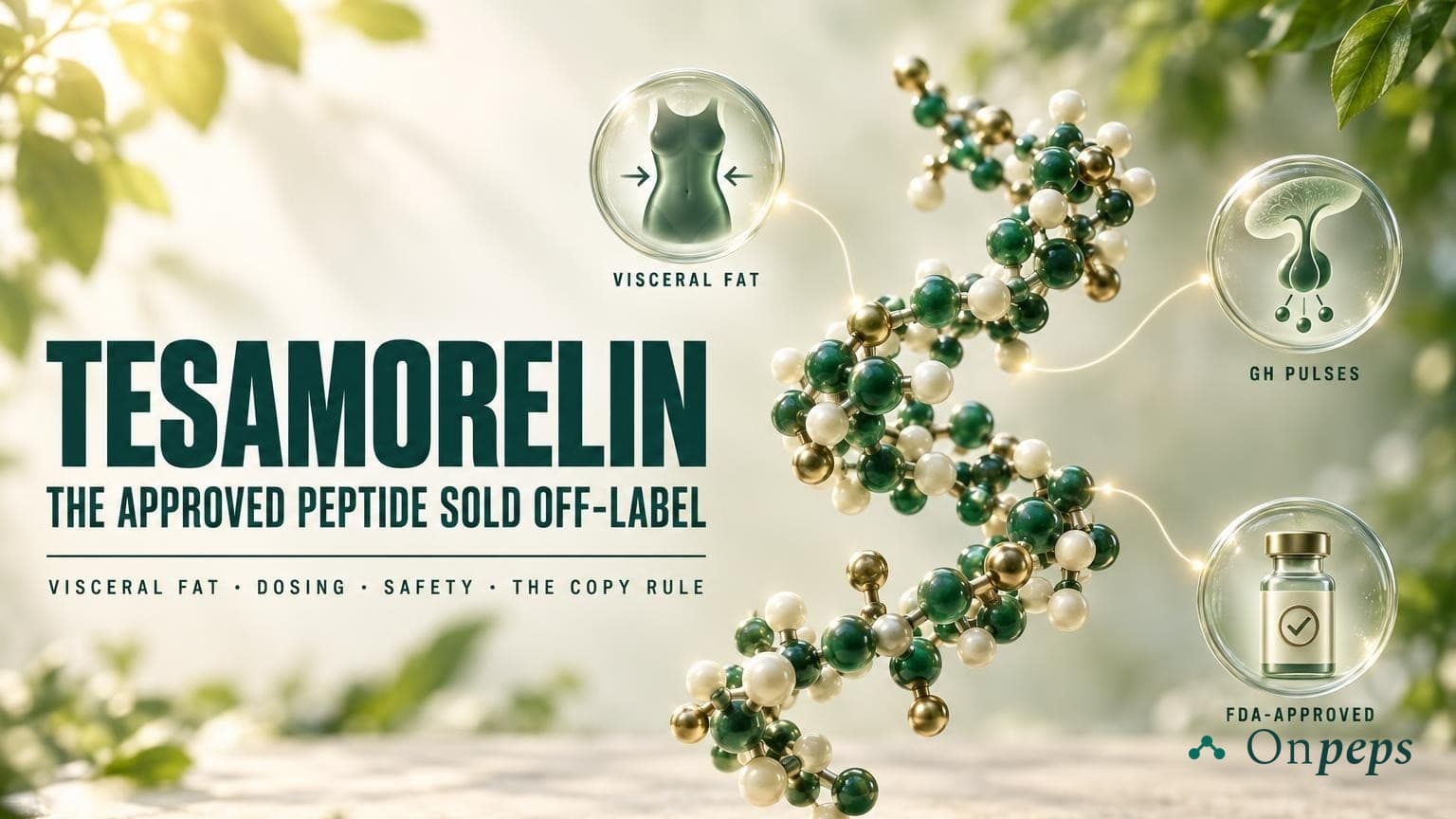
Tesamorelin is the one peptide in the gray-market top ten that is actually an approved drug. US search interest in it has more than doubled over the past twelve months, and "tesamorelin ipamorelin" is now the second most common thing people search alongside it. Clinics sell it for stubborn belly fat, telehealth services sell it for "metabolic optimisation", and research-chemical vendors sell it in vial sizes the approved product has never come in.
The approval is real. The question is what it approves, who the evidence is in, and whether any of that transfers to the person buying it. Let's dive in.
TLDR
What is tesamorelin? A stabilised, full-length synthetic version of growth-hormone-releasing hormone (GHRH). It makes your pituitary release your own growth hormone in pulses. Sold as Egrifta, it has been FDA-approved since November 2010 for one thing: excess abdominal fat in adults with HIV who have lipodystrophy.
Results: In the two approval trials, 26 weeks of 2 mg a day cut visceral fat by about 15% relative to placebo, with no change in subcutaneous fat and no weight loss. The fat comes back when you stop. Two 2026 meta-analyses confirm the picture. Every controlled trial for fat was in people with HIV.
Dosage: The approved dose is 2 mg daily of the original formulation, now given as 1.4 mg of Egrifta SV or 1.28 mg of Egrifta WR, which are bioequivalent. Clinics and the community mostly run 1 to 2 mg at bedtime, often five days on and two off, often stacked with ipamorelin. No study has tested that stack.
Safety: Joint pain, injection-site redness and itching, limb pain, swelling, and muscle pain are the label's most common effects. The real watch-items are IGF-1, blood glucose, and the contraindication for active cancer. Long-term cardiovascular and cancer safety has not been established.
Legal Status (September 2026): FDA-approved for HIV-associated lipodystrophy, not approved in Europe. Off-label prescribing is lawful. Compounded tesamorelin is lawful only when it is not "essentially a copy" of Egrifta, which most of it is. Prohibited in sport under WADA section S2.
What Is Tesamorelin, and Why Is It Trending Now?
Your hypothalamus makes a 44-amino-acid peptide called growth-hormone-releasing hormone. It tells the pituitary to release growth hormone. Injected on its own, natural GHRH is destroyed by enzymes within minutes, which is why nobody uses it as a drug.
Tesamorelin is that same 44-residue sequence with a small chemical group (a trans-3-hexenoyl tail) attached to the first amino acid. That tail blocks the enzyme that would chop the peptide up, and it stretches the action long enough for one injection a day (Falutz et al., 2007, NEJM, PMID 18057338).
It was developed by Theratechnologies of Montreal under the code TH9507 and approved by the FDA on November 10, 2010 as Egrifta, for "the reduction of excess abdominal fat in HIV-infected adult patients with lipodystrophy." That is still the only indication anywhere in the world.
Three things explain the search graph.
First, the peptide clinics. Tesamorelin has become the standard "visceral fat" offer at telehealth and longevity practices, usually stacked with ipamorelin and usually pitched at people without HIV. Its FDA approval is the sales point, and it is doing a lot of work it was never designed for.
Second, the science moved. Two separate meta-analyses of the randomised trials were published in 2026, one in January (Badran et al., 2026, Obesity Research and Clinical Practice, PMID 41545261) and one in July (Ditta et al., 2026, Journal of the International Association of Providers of AIDS Care, PMID 42538058). Both confirmed the visceral-fat effect, and both were in HIV populations.
Third, the new box. Egrifta WR, a weekly-reconstitution formulation, was approved on March 25, 2025 and replaced daily mixing with one vial a week. That is a convenience change, not a new indication, but it put tesamorelin back in the news.
An approved drug being sold for an unapproved use, with fresh data that only applies to the approved patient. That is the whole tesamorelin story, and the rest of this article is the detail.
How Does Tesamorelin Work?
It works one step upstream of growth hormone.
Injected growth hormone (somatropin) floods the system with a steady level of GH, and the body's feedback loops are bypassed. Tesamorelin instead stimulates the pituitary, which still releases GH in its natural pulses and still shuts off when somatostatin tells it to. IGF-1, the hormone that carries most of GH's effects, rises, but tends to stay inside the normal range rather than shooting past it.
That is the pharmacological argument for a GHRH analogue over GH itself, and it showed up in the trials. Growth hormone at comparable fat-reducing doses had caused glucose problems in earlier HIV lipodystrophy studies. Tesamorelin, in the pooled Phase 3 analysis, produced no clinically meaningful change in glucose parameters over 52 weeks (Falutz et al., 2010, Journal of Clinical Endocrinology and Metabolism, PMID 20554713).
Why visceral fat specifically? Growth hormone is lipolytic, and visceral fat is more sensitive to it than subcutaneous fat. The approval trials measured this with CT scans, not scales, and the result was exactly that split: visceral fat down, subcutaneous fat unchanged, body weight essentially flat. The label says it in plain terms: Egrifta "is not indicated for weight loss management as it has a weight neutral effect."
Tesamorelin is a body-composition drug, not a weight-loss drug. If the number you care about is on the scale, you are looking at the wrong compound.
Tesamorelin vs Sermorelin vs CJC-1295 vs Ipamorelin vs Growth Hormone
These get sold as interchangeable "GH peptides." They are not.
| Compound | What it is | Approved? | Human fat-loss evidence | US compounding status |
|---|---|---|---|---|
| Tesamorelin | Full-length GHRH (1-44) analogue, stabilised | Yes, Egrifta, HIV lipodystrophy (2010) | Two Phase 3 RCTs, 806 patients, CT-measured visceral fat | Eligible as an approved-drug ingredient, but the copy rule applies |
| Sermorelin | Shortened GHRH (1-29) analogue | Was approved (Geref) for paediatric GH deficiency; withdrawn from the market in 2008 for commercial reasons | None for fat loss | Compounded widely; status rests on its history as an approved ingredient |
| CJC-1295 | GHRH (1-29) analogue with a long-acting DAC tail | No, development stopped | None | FDA Category 2 since 2023, cannot be lawfully compounded |
| Ipamorelin | Ghrelin-receptor agonist (a GH secretagogue, not a GHRH) | No | None | FDA Category 2 since 2023, cannot be lawfully compounded |
| Growth hormone (somatropin) | The hormone itself | Yes, for GH deficiency and other named conditions | Reduces fat in GH deficiency; not approved for fat loss | Approved product only; federal law makes distributing it for any non-approved use a criminal offence |
The row that matters for most readers is the one they never see: ipamorelin, the thing tesamorelin is most often stacked with, is on the FDA's Category 2 list. A telehealth "tesa/ipa" blend combines an approved ingredient with one that cannot lawfully be compounded, and the pharmacy label on the vial does not change that. The library entries on ipamorelin and CJC-1295 cover their records in full.
What the Evidence Actually Shows
Tesamorelin has a real evidence base, which is unusual in this space. It also has a very specific one.
Published, peer-reviewed
| Study | Population | Design | Result | Status |
|---|---|---|---|---|
| Falutz et al., 2007, NEJM (PMID 18057338) | 412 adults with HIV and excess abdominal fat | 26-week RCT, 2 mg daily vs placebo | Visceral fat -15.2% vs +5.0% on placebo; triglycerides down 50 mg/dL; IGF-1 up 81% | Published |
| Falutz et al., 2010, JCEM (PMID 20554713) | 806 adults with HIV, both Phase 3 trials pooled | 26 weeks plus 26-week extension | -15.4% visceral fat treatment effect at 26 weeks; -17.5% from baseline at 52 weeks in those who stayed on drug; no change in subcutaneous fat; no meaningful glucose change | Published, the basis of the label |
| Falutz et al., 2008, AIDS (PMID 18690162) | Extension phase of the first trial | Re-randomised to continue or switch to placebo | Visceral fat reaccumulated in those switched to placebo; effects "do not last beyond the duration of treatment" | Published |
| Stanley et al., 2014, JAMA (PMID 25038357) | 50 adults with HIV and abdominal fat | 6-month RCT | Visceral fat reduced; liver fat modestly reduced | Published |
| Stanley et al., 2019, Lancet HIV (PMID 31611038) | 61 adults with HIV and fatty liver disease | 12-month RCT | Liver fat fraction down 4.1 percentage points (a 37% relative reduction); 35% reached under 5% liver fat vs 4% on placebo; no change in glucose or HbA1c | Published |
| Baker et al., 2012, Archives of Neurology (PMID 22869065) | 152 adults aged 55 to 87, with and without mild cognitive impairment, no HIV | 20-week RCT, 1 mg nightly | Favourable effect on cognition, mainly executive function; IGF-1 up 117%; body fat down 7.4%; adverse events in 68% vs 36% | Published, never replicated at scale |
| Clemmons et al., 2017, PLoS One (PMID 28617838) | 53 adults with type 2 diabetes, no HIV | 12-week RCT | No change in insulin response or glycaemic control | Published, safety-focused |
| Ellis et al., 2025, Journal of Infectious Diseases (PMID 39813152) | 73 adults with HIV and abdominal obesity | Open-label Phase 2, cognition | No significant difference vs standard care; authors note the trial was underpowered and unblinded | Published |
| Badran et al., 2026 (PMID 41545261) | 5 RCTs in HIV lipodystrophy | Meta-analysis | Visceral fat -27.7 cm²; liver fat -4.3 percentage points; lean mass +1.4 kg; no change in subcutaneous fat or BMI | Published |
| Ditta et al., 2026 (PMID 42538058) | 4 RCTs, 909 patients with HIV | Meta-analysis | Visceral fat -21.5 cm²; waist -1.6 cm; lean mass +1.4 kg; growth-hormone-type adverse effects and a higher discontinuation rate | Published |
Unpublished, marketing, or absent
| Claim | Where it comes from | Status |
|---|---|---|
| Visceral fat reduction in people without HIV | Clinic and telehealth marketing, extrapolated from the HIV trials | No controlled trial exists |
| "Anti-ageing" and cognitive benefit | One 20-week trial from 2012 | Not replicated; a 2025 trial in HIV found no effect |
| Tesamorelin plus ipamorelin synergy | Clinic protocols and vendor blend pages | No study of the combination has ever been run |
| Sleep, recovery, skin, muscle gain | Community reports | Lean mass rose about 1.4 kg in the meta-analyses; nothing else has been measured |
Notice what the published column has in common. Every controlled trial of tesamorelin for fat was in people with HIV on antiretroviral therapy, a population with a specific drug-induced fat disorder. The two trials outside HIV were designed to answer safety questions (diabetes) and a cognition question (older adults), not whether it trims a healthy person's waist.
Nobody has run a controlled trial of tesamorelin for visceral fat in people without HIV. That is the use it is most often sold for. The evidence is strong; it just belongs to a different patient.
Dosage: What the Trials Used vs What the Community Runs
The approved dose
The Phase 3 trials used 2 mg once daily, given as two 1 mg vials of the original Egrifta. Two reformulations have followed, each more concentrated, each bioequivalent to that 2 mg dose:
| Product | Vial | Reconstitution | Daily dose | Injection volume |
|---|---|---|---|---|
| Egrifta (2010, discontinued) | 1 mg, two per dose | Daily | 2 mg | Per original label |
| Egrifta SV (2019) | 2 mg | 0.5 mL sterile water, use immediately, discard the rest | 1.4 mg | 0.35 mL (35 units on an insulin syringe) |
| Egrifta WR (2025) | 11.6 mg | 1.3 mL diluent, covers 7 days at room temperature, discard after 7 days | 1.28 mg | 0.16 mL (16 units) |
The label states that Egrifta WR and Egrifta SV "are not substitutable." Someone switching between them without reading that line could dose themselves at nearly double or roughly half of what they intend. The approved dosing has no on-off schedule and no cycle: it is daily, for as long as the effect is wanted, with a check at about six months on whether visceral fat has actually fallen.
What clinics and the community report
Off-label protocols are lower and more elaborate than the label. The pattern that appears most often across clinic pages and community threads:
- 1 mg at bedtime, at least two hours after the last meal, on the theory that GH pulses are largest during early sleep and that food blunts them.
- Five days on, two days off, which has no basis in any trial. The trials dosed every day.
- Three months on, two months off, likewise untested. The one thing the extension data does say is that visceral fat returns when dosing stops.
- Stacked with ipamorelin, typically 1 to 1.5 mg tesamorelin with 0.5 to 0.75 mg ipamorelin in the same syringe.
- Titrated up to 2 mg after a few weeks if joint aches and water retention are tolerable.
The 1 mg starting point at least has a footprint in the literature: it was the dose in the 2012 cognition trial. Everything else in that list is convention, not evidence.
The reconstitution arithmetic
Research-labelled tesamorelin comes as lyophilised powder, usually in 5 mg or 10 mg vials, and you add bacteriostatic water yourself. The maths is the same as for any peptide. Concentration is milligrams of peptide divided by millilitres of water; the dose in millilitres is the dose you want divided by that concentration; and on a standard U-100 insulin syringe, 1 mL is 100 units.
| Vial | Bacteriostatic water | Concentration | 1 mg dose | 2 mg dose |
|---|---|---|---|---|
| 5 mg | 2 mL | 2.5 mg/mL | 0.4 mL (40 units) | 0.8 mL (80 units) |
| 5 mg | 2.5 mL | 2 mg/mL | 0.5 mL (50 units) | 1 mL (100 units) |
| 10 mg | 2 mL | 5 mg/mL | 0.2 mL (20 units) | 0.4 mL (40 units) |
| 10 mg | 2.5 mL | 4 mg/mL | 0.25 mL (25 units) | 0.5 mL (50 units) |
| 10 mg | 3 mL | 3.33 mg/mL | 0.3 mL (30 units) | 0.6 mL (60 units) |
Run your own numbers through the reconstitution calculator and the dosage calculator rather than copying a row. Two cautions specific to tesamorelin: it is a 44-residue peptide, long for synthetic manufacture, and the whole difference between it and native GHRH is that one small group on the first amino acid. A vial missing it has the right sequence and almost none of the activity, and a purity figure on a certificate of analysis would not show it. The sourcing page goes through what a certificate can and cannot tell you.
There is no validated off-label protocol for tesamorelin. There is an approved one, and it is daily, without breaks, with IGF-1 and glucose monitored.
Side Effects
Tesamorelin's side effects are the side effects of more growth hormone.
What the label lists
From the 26-week placebo-controlled data on the Egrifta SV label, the reactions at least one percentage point more common on tesamorelin than placebo were:
| Reaction | Tesamorelin | Placebo |
|---|---|---|
| Injection site reactions (redness, itching, pain, irritation) | 17% | 6% |
| Joint pain | 13% | 11% |
| Pain in the arms or legs | 6% | 5% |
| Muscle pain | 6% | 2% |
| Peripheral swelling | 6% | 2% |
Fluid retention is the classic GH signature: puffy hands, joint aches, carpal tunnel symptoms. It usually eases with time or a lower dose, and it is the most common reason people quit. The 2026 meta-analysis found roughly twice the discontinuation rate on tesamorelin as on placebo, though the confidence interval crossed one (Ditta et al., 2026, PMID 42538058).
What the label warns about
- IGF-1. Tesamorelin raises it, by 81% in the first Phase 3 trial and 117% in the cognition trial. The label says the effects of prolonged elevation "are unknown," tells prescribers to monitor it, and suggests stopping if it persistently exceeds three standard deviations above normal. A clinic that prescribes tesamorelin without ever measuring IGF-1 is skipping the one safety check the label actually requires.
- Blood glucose. GH is counter-regulatory to insulin. The trials showed no clinically meaningful glucose change, and a dedicated 12-week trial in type 2 diabetes found none either (Clemmons et al., 2017, PMID 28617838), but the label still warns of glucose intolerance and asks for monitoring.
- Cancer. IGF-1 is a growth factor. The label contraindicates tesamorelin in active malignancy and tells prescribers to weigh the "increased background risk of malignancies" before starting, and to stop if a cancer recurs. The trials excluded people with active cancer and ran for a year. Nobody has data on what years of elevated IGF-1 in a person without HIV does, and the honest answer is that the mechanistic concern is real and the clinical evidence for harm is absent. Those are two separate facts.
- Hypersensitivity. Rashes and hives have been reported; stop and seek care if they appear.
- Acute critical illness. GH-axis drugs have increased mortality in ICU-type settings. Not a concern for a healthy person at home, but it is on the label.
The gray-market harm record
ONPEPS has not identified any published case series, FDA warning, or health-department alert tying a specific harm to research-labelled tesamorelin, and we say so rather than implying one. The general risks of unverified vials apply in full: wrong content, wrong concentration, endotoxin contamination, and the identity problem above, where a vial can be pure and still not be tesamorelin.
The drug's own safety record is decent for a year of daily use in the approved population. Beyond a year, outside that population, or without IGF-1 and glucose checks, you are past the edge of the data.
The Legal and Regulatory Situation
This is where tesamorelin is different from every other peptide on this site, and the difference cuts both ways.
Approval
FDA-approved since November 10, 2010 (NDA 022505), for reduction of excess abdominal fat in adults with HIV who have lipodystrophy. Not approved by the European Medicines Agency. Theratechnologies markets it as the only approved therapy for that condition.
Off-label prescribing
Lawful, and common. A US physician can prescribe Egrifta to a person without HIV for visceral fat, and nobody is breaking a rule. What changes is the money and the evidence. There is no covered indication, so it is cash-pay, and one 2026 access guide puts branded Egrifta SV at roughly $3,500 to $4,200 a month retail. The label's contraindications and monitoring requirements do not switch off because the reason for the prescription changed.
Compounding: the rule nobody mentions
Because tesamorelin is the active ingredient of an approved drug, 503A pharmacies can compound it without it needing to be on any bulks list. That is why tesamorelin was not among the peptides the FDA's Pharmacy Compounding Advisory Committee voted on in July 2026; it never needed the vote.
But the same section of the law forbids compounding a product that is "essentially a copy of a commercially available drug product." The FDA's guidance treats a compounded product with the same active ingredient, a similar or easily substitutable strength, and the same route of administration as a copy unless the prescriber documents a change, for a specific patient, that makes a significant clinical difference. The guidance is explicit that a lower price is not such a change.
Apply that to the market. A pharmacy supplying subcutaneous tesamorelin at 1 or 2 mg a day to a person who could take Egrifta is making a copy. A telehealth service dispensing it by the thousand because Egrifta is unaffordable is making copies for a reason the rule does not accept. The lawful cases are narrow: a documented excipient allergy, a strength the approved product cannot deliver, a shortage. The same 2026 access guide quotes compounded tesamorelin via telehealth at $300 to $600 a month all-in, and the discount is exactly the manufacturing standard, stability data, and label that the compounded product does not carry.
ONPEPS has not found an FDA warning letter naming compounded tesamorelin specifically. The rule exists whether or not it has been enforced against any particular seller.
Research-use-only vials
The same position every other research peptide takes, with an extra layer of absurdity: the seller is disclaiming human use of a molecule whose human use is approved, on a product page that usually cites the approval. The FDA has held in warning letters that the disclaimer does not survive marketing copy that establishes human use.
Sport
WADA's Prohibited List names tesamorelin under S2 as a growth-hormone-releasing hormone analogue, prohibited at all times. Anti-doping laboratories have published urine methods for it and its metabolites (Memdouh et al., 2021, Drug Testing and Analysis, PMID 34665524). A therapeutic use exemption is possible for the approved indication.
The Honest Take
Tesamorelin is the best-evidenced compound in the "GH peptide" category by a wide margin, and that is worth saying plainly. Two randomised Phase 3 trials, two 2026 meta-analyses, a real label, a real manufacturer, and a CT-measured effect on the fat depot that matters most for metabolic health. If you compare it with sermorelin, CJC-1295, or ipamorelin, it is not a close contest.
It is also the compound where the gap between what was proven and what is sold is easiest to see, because the proof is so specific. Every fat-loss trial was in HIV lipodystrophy. The effect is around 15% of visceral fat, not of body weight, and it reverses when you stop. The most popular stack pairs it with a peptide that cannot lawfully be compounded, and the most popular way of buying it, compounded through telehealth, sits on the wrong side of a rule the FDA wrote in 2018.
If you are going to use it anyway, the label tells you how: daily, with IGF-1 and glucose checked, and not at all if you have or recently had a cancer. A clinic that skips the bloodwork is not prescribing the approved drug. It is prescribing the molecule.
FAQ
What is tesamorelin peptide used for?
Officially, one thing: reducing excess abdominal fat in adults with HIV who have lipodystrophy, a drug-induced fat disorder. Off-label, clinics prescribe it for visceral fat, fatty liver, body composition, and "anti-ageing" in people without HIV. Only the first use has controlled-trial evidence.
What does tesamorelin do?
It makes your pituitary release more of your own growth hormone, in natural pulses. GH breaks down fat, visceral fat most of all, and raises IGF-1. In the trials that meant about a 15% drop in visceral fat over six months, a small rise in lean mass, lower triglycerides, and no change in body weight.
Is tesamorelin FDA approved?
Yes, since 2010, as Egrifta, for HIV-associated lipodystrophy only. That approval does not extend to visceral fat in people without HIV, to weight loss, or to any compounded or research-labelled version.
Does tesamorelin work for weight loss?
No. The label says it "is not indicated for weight loss management as it has a weight neutral effect." It changes where fat is stored, not how much you weigh. For weight itself, the compounds with evidence are the GLP-1 class, covered in the semaglutide and retatrutide entries.
What is the right tesamorelin dosage?
The approved dose is 2 mg of the original formulation daily, equivalent to 1.4 mg of Egrifta SV or 1.28 mg of Egrifta WR. Off-label protocols usually run 1 to 2 mg at bedtime. No trial has tested a five-on-two-off schedule or a cycling pattern.
Should tesamorelin be taken with ipamorelin?
No study has ever tested the combination. The theory is that a GHRH analogue and a ghrelin-receptor agonist hit the pituitary through two different doors and release more GH together. That is plausible pharmacology and zero clinical evidence. Ipamorelin is also on the FDA's Category 2 list, so a compounded "tesa/ipa" product is not lawful regardless of the tesamorelin half.
How is tesamorelin different from sermorelin?
Sermorelin is a shortened GHRH (the first 29 amino acids); tesamorelin is the full 44 with a stabilising tail. Sermorelin was approved for children with GH deficiency and withdrawn from the market in 2008; it has no fat-loss trials. Tesamorelin has two Phase 3 trials and a current approval.
How long does tesamorelin take to work?
The trials measured visceral fat at 26 weeks, and the label suggests reassessing at around six months to see whether it has fallen. Triglyceride changes and water retention show up within weeks; visible changes in the abdomen are a months-long process.
Does the fat come back after stopping tesamorelin?
Yes. In the extension phase of the approval trial, patients switched from tesamorelin to placebo regained visceral fat, and the authors wrote that the effects "do not last beyond the duration of treatment." It is a maintenance drug.
What are the side effects of tesamorelin?
Injection-site reactions, joint pain, limb pain, muscle pain, and swelling are the most common. IGF-1 and blood glucose need monitoring. It is contraindicated in active cancer, pregnancy, and disrupted pituitary function.
Does tesamorelin cause cancer?
There is no evidence that it does. It raises IGF-1, a growth factor, so the label contraindicates it in active malignancy and tells prescribers to weigh cancer history. The trials ran for a year and excluded people with cancer; nobody has long-term data.
Is tesamorelin legal to buy?
With a prescription, yes, as Egrifta. Compounded tesamorelin is lawful only when it is not essentially a copy of Egrifta, which rules out most of what telehealth sells. Research-labelled vials are unapproved drugs sold under a disclaimer. It is banned in sport under WADA S2.
Resources
Falutz et al. (2007), NEJM, first Phase 3 trial — https://pubmed.ncbi.nlm.nih.gov/18057338/
Falutz et al. (2010), Journal of Clinical Endocrinology and Metabolism, pooled Phase 3 analysis — https://pubmed.ncbi.nlm.nih.gov/20554713/
Falutz et al. (2008), AIDS, long-term extension and fat reaccumulation — https://pubmed.ncbi.nlm.nih.gov/18690162/
Stanley et al. (2014), JAMA, visceral and liver fat — https://pubmed.ncbi.nlm.nih.gov/25038357/
Stanley et al. (2019), Lancet HIV, fatty liver disease trial — https://pubmed.ncbi.nlm.nih.gov/31611038/
Russo et al. (2024), AIDS, efficacy on integrase inhibitors — https://pubmed.ncbi.nlm.nih.gov/38905488/
Baker et al. (2012), Archives of Neurology, cognition trial in older adults — https://pubmed.ncbi.nlm.nih.gov/22869065/
Friedman et al. (2013), JAMA Neurology, brain GABA substudy — https://pubmed.ncbi.nlm.nih.gov/23689947/
Ellis et al. (2025), Journal of Infectious Diseases, cognition in HIV — https://pubmed.ncbi.nlm.nih.gov/39813152/
Clemmons et al. (2017), PLoS One, type 2 diabetes safety trial — https://pubmed.ncbi.nlm.nih.gov/28617838/
Badran et al. (2026), Obesity Research and Clinical Practice, meta-analysis of five RCTs — https://pubmed.ncbi.nlm.nih.gov/41545261/
Ditta et al. (2026), Journal of the International Association of Providers of AIDS Care, meta-analysis of four RCTs — https://pubmed.ncbi.nlm.nih.gov/42538058/
Memdouh et al. (2021), Drug Testing and Analysis, anti-doping detection — https://pubmed.ncbi.nlm.nih.gov/34665524/
Theratechnologies (2026), Egrifta WR prescribing information, DailyMed — https://dailymed.nlm.nih.gov/dailymed/drugInfo.cfm?setid=839334d3-8c1d-4c26-9036-2ab524a6ea75
Theratechnologies (2026), Egrifta SV prescribing information, DailyMed — https://dailymed.nlm.nih.gov/dailymed/drugInfo.cfm?setid=3d783378-b02d-4f19-99dd-0fc91a042224
FDA, Drugs@FDA entry for Egrifta, NDA 022505 — https://www.accessdata.fda.gov/scripts/cder/daf/index.cfm?event=overview.process&ApplNo=022505
EATG (2025), Theratechnologies press release on Egrifta WR approval, March 25, 2025 — https://www.eatg.org/hiv-news/theratechnologies-receives-fda-approval-for-egrifta-wr-tesamorelin-f8-to-treat-excess-visceral-abdominal-fat-in-adults-with-hiv-and-lipodystrophy/
FDA (2018), Compounded Drug Products That Are Essentially Copies of a Commercially Available Drug Product Under Section 503A, guidance for industry — https://www.fda.gov/media/98964/download
FDA (2026), Pharmacy Compounding Advisory Committee meeting, July 23–24, 2026 — https://www.fda.gov/advisory-committees/advisory-committee-calendar/july-23-24-2026-meeting-pharmacy-compounding-advisory-committee-07232026
RAPS (2026), FDA considers adding a dozen peptides to its bulk drug compounding list — https://www.raps.org/resource/fda-considers-adding-a-dozen-peptides-to-its-bulk-drug-compounding-list.html
WADA (2026), The Prohibited List, section S2 — https://www.wada-ama.org/en/resources/2026-prohibited-list
PeptideDeck (2026), routes and price ranges for tesamorelin, the source of the monthly cost figures above — https://www.peptidedeck.com/peptides/how-to-get-tesamorelin
ClinicalTrials.gov, studies listing tesamorelin as an intervention — https://clinicaltrials.gov/search?intr=tesamorelin
ONPEPS peptide library, tesamorelin entry with sourcing and cost pages — https://www.onpeps.com/peptides/tesamorelin