Searches for MOTS-c have roughly tripled in a year, and the question climbing fastest alongside it is "mots c dosing protocol." It is sold as an exercise mimetic, a longevity peptide, a fat-loss helper you can stack with retatrutide, and, since 23 July 2026, as the peptide an FDA committee voted for. The people searching for it are increasingly also searching for SS-31, the other "mitochondrial peptide" in the same vendor carousel.
Here is the caveat that gets dropped from almost every one of those listings. MOTS-c itself has never been tested in a published human trial. The only molecule like it that reached people was a modified analogue whose sponsor then abandoned the formulation, and human blood breaks the native peptide down within minutes in a test tube. So what is it, what did the mice actually show, what is the one piece of human evidence that is genuinely good, and what does the dosing math look like when no human dose exists? Let's dive in.
TLDR
What is MOTS-c? A 16-amino-acid peptide encoded in your mitochondrial DNA, discovered in 2015. In muscle it activates AMPK, the cell's energy sensor, which is the same switch exercise and metformin flip.
Results: Strong in mice: it prevented diet-induced obesity and insulin resistance, and old mice treated with it ran about twice as long. In humans, exercise raises the body's own MOTS-c, and a gene variant that weakens it is linked to type 2 diabetes in inactive men. No trial of injected MOTS-c has reported.
Dosage: No validated protocol exists. The community reports 5 to 10 mg subcutaneously one to three times a week; the mouse studies used 5 to 15 mg/kg a day by intraperitoneal injection, which converts to far more than anyone injects.
Safety: Unmeasured. The FDA found no toxicology, no pharmacokinetics and no adverse-event reports. Low intrinsic toxicity is plausible for a peptide every cell makes; the product in the vial is a separate question.
Legal Status (October 2026): Not approved anywhere. On 23 July 2026 the FDA's compounding advisory committee voted 7 to 5, with two abstentions, to recommend it for compounding; the FDA has not acted. Prohibited at all times by WADA since 1 January 2025.
What Is MOTS-c, and Why Is Everyone Searching for It Now?
Let's get this straight first. MOTS-c is not a fragment of a bigger protein and not a designer analogue. Its name stands for mitochondrial open reading frame of the 12S rRNA type-c, and it is exactly that: a short stretch of mitochondrial DNA, long assumed to code only for ribosomal RNA, that turns out to also code for a 16-residue peptide (MRWQEMGYIFYPRKLR).
A group at the University of Southern California reported it in 2015. It circulates in plasma, its level falls with age, and under metabolic stress it moves into the nucleus and changes which genes are switched on (Lee et al., 2015, Cell Metab, PMID 25738459; Zheng et al., 2023, Front Endocrinol, PMID 36761202). That makes it one of a small family of "mitochondrial-derived peptides," alongside humanin.
The reason it is trending is not a new study. It is a vote and a curve. In our Google Trends pull for the US, MOTS-c's interest over the past 12 months, measured against a set of comparable peptides, climbed from an average of about 8 in the first four months to 23 in the last four, peaking in late May. Over the past 90 days it peaked in the week of 31 July, a week after the FDA's Pharmacy Compounding Advisory Committee recommended it (ONPEPS, FDA peptide update July 2026).
The related queries tell you what people want to know: "what is mots c," "mots c dosage," "mots c benefits," "mots c protocol," and, rising, "ss31 peptide" and "reta and mots c." That last one is the stacking question, and we answer it below.
MOTS-c is trending because a committee voted for it and the longevity crowd found it, not because a human trial reported. Keep those apart.
How Does MOTS-c Work?
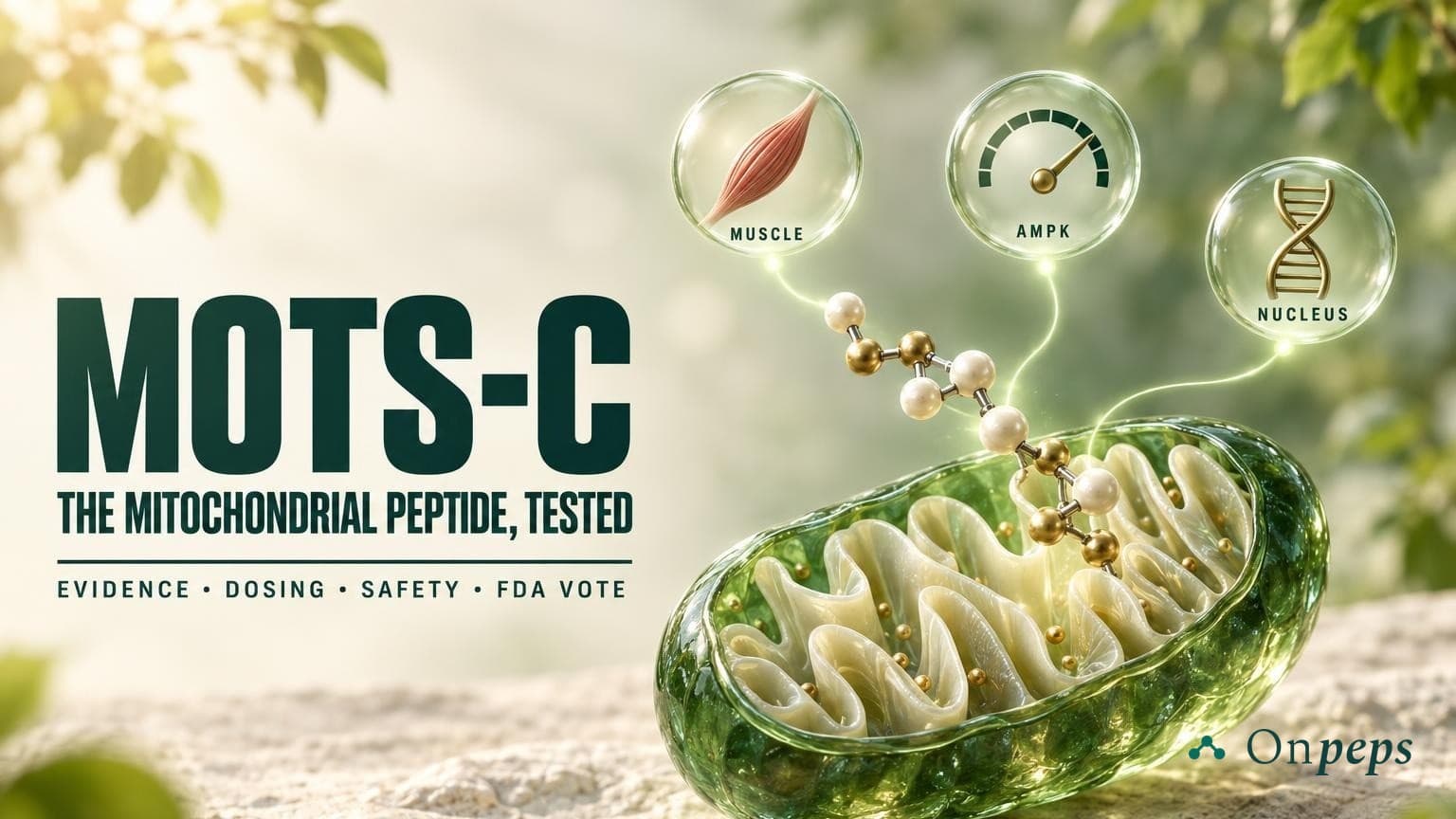
In mouse skeletal muscle, MOTS-c inhibits the folate cycle and the de novo synthesis of purines. That causes a build-up of an intermediate called AICAR, and AICAR activates AMPK (Lee et al., 2015, Cell Metab, PMID 25738459).
AMPK is the cell's fuel gauge. When energy runs low it switches on glucose uptake and fat burning and switches off energy-expensive building work. Exercise activates it. So does caloric restriction. So does metformin, the most prescribed diabetes drug on earth (Zhou et al., 2001, J Clin Invest, PMID 11602624). That shared switch is the entire basis of the phrase "exercise mimetic."
The second half of the mechanism is nuclear. Under stress MOTS-c relocates to the nucleus and regulates genes tied to metabolism and protein homeostasis (Reynolds et al., 2021, Nat Commun, PMID 33473109). That is unusual: a peptide made by the mitochondrion telling the nucleus what to do.
Here is the caveat that matters more than the mechanism. All of this was mapped in mice and cells. And in the FDA's July 2026 review, incubating MOTS-c with human whole blood at body temperature for 15 to 60 minutes "results in rapid proteolytic hydrolysis," and the agency said it is unclear whether injecting it under the skin "can generate pharmacologically active concentrations" (FDA PCAC presentation, July 2026).
The mechanism is elegant and real in mice. Whether an injected dose survives long enough in a person to use it has never been measured.
MOTS-c vs SS-31 vs Metformin vs Semaglutide
MOTS-c is usually sold next to SS-31 as a "mitochondrial stack," and it is marketed against GLP-1 drugs as the cheaper metabolic option. Here is how they actually line up.
| Compound | What it is | Target | Human evidence | Status (October 2026) |
|---|---|---|---|---|
| MOTS-c | 16-residue peptide encoded in mitochondrial DNA | Folate cycle, then AMPK; nuclear gene regulation | None for the injected peptide; genetic and exercise data only | Unapproved; PCAC recommended, FDA has not acted; WADA-prohibited |
| SS-31 (elamipretide) | Synthetic 4-residue peptide | Cardiolipin in the inner mitochondrial membrane | Randomized trial in Barth syndrome (TAZPOWER) | FDA accelerated approval as Forzinity, September 2025, for Barth syndrome only |
| Metformin | Small-molecule biguanide | Activates AMPK, among other actions | Decades of randomized trials | Approved, generic |
| Semaglutide | GLP-1 receptor agonist peptide | GLP-1 receptor | STEP 1: 14.9% mean weight loss at 68 weeks vs 2.4% placebo | Approved (Wegovy, Ozempic) |
| Exercise | You | AMPK, among many others | Raises your own muscle MOTS-c about 12-fold | Free |
The SS-31 row is the one people mix up. SS-31 is a different molecule with a different target, and it is the mitochondrial peptide that actually got through the FDA: 40 mg once daily under the skin, approved on a surrogate endpoint of knee muscle strength in a rare genetic disease (FDA, September 2025). None of its data transfers to MOTS-c. Sharing the word "mitochondrial" is not sharing evidence.
The semaglutide figure is there for scale (Wilding et al., 2021, NEJM, PMID 33567185). When a listing says MOTS-c is "cheaper than a GLP-1," the comparison has a measured human effect on one side and nothing on the other.
What the Evidence Actually Shows
MOTS-c has an unusual evidence shape. The mouse work is strong and comes from the discoverers. The best human evidence involves no injection at all. And the one company that tried to make it a drug published nothing.
Published
| Finding | Model | Source | Status |
|---|---|---|---|
| MOTS-c activated AMPK in muscle and prevented age- and high-fat-diet-induced insulin resistance and diet-induced obesity | Mice, cells | Lee et al., 2015, Cell Metab, PMID 25738459 | Peer-reviewed, animal |
| Daily MOTS-c (5 or 15 mg/kg, intraperitoneal) improved treadmill performance in young, middle-aged and old mice; old mice ran about 2-fold longer and 2.16-fold farther. Started at 23.5 months, three times a week, it improved physical capacity and healthspan | Mice | Reynolds et al., 2021, Nat Commun, PMID 33473109 | Peer-reviewed, animal |
| A single exercise bout raised endogenous MOTS-c 11.9-fold in muscle and about 1.6-fold in blood | Human volunteers, no injection | Reynolds et al., 2021, Nat Commun, PMID 33473109 | Peer-reviewed, human observation |
| An East Asian mtDNA variant (m.1382A>C, K14Q) that weakens MOTS-c was linked to higher type 2 diabetes prevalence in men, mainly physically inactive men, across 27,527 people; the variant peptide failed in mice where the normal one worked | Human cohorts plus mice | Zempo et al., 2021, Aging, PMID 33468709 | Peer-reviewed, human genetic |
| Review: "no effective method of applying MOTS-c in the clinic has been developed" | Literature review | Zheng et al., 2023, Front Endocrinol, PMID 36761202 | Peer-reviewed review |
Company topline and unpublished
| Study | What was given | Result | Status |
|---|---|---|---|
| CohBar CB4211 Phase 1a/1b (NCT03998514), 88 healthy and fatty-liver adults | CB4211, a modified MOTS-c analogue, subcutaneous | Well tolerated; company reported lower ALT, AST and glucose and a trend to weight loss at four weeks | Press release only, never published; in May 2023 the company told the SEC the formulation was "not suitable for further development" |
| Hudson Biotech Phase 2 (NCT07505745), 120 adults with prediabetes and overweight or obesity | MOTS-c, subcutaneous, 12 weeks | None yet; primary endpoint insulin sensitivity | Recruiting since February 2026; completion estimated 2028 |
| FDA review for the July 2026 committee | Search of all available data | "Did not identify" any human studies of MOTS-c-related substances; no evidence to evaluate effectiveness for any nominated use | Regulatory finding |
The genetic study is the most persuasive human data on this page, and it is worth sitting with what it does and does not say. It says the body's own MOTS-c plausibly matters for blood sugar in people, that the effect interacts with how active you are, and that it may differ between men and women. It says nothing about whether a synthetic peptide from a vial does anything.
The CB4211 story deserves its own paragraph. CohBar was founded by the peptide's discoverer, took a stabilised analogue through a randomised, placebo-controlled study, and announced positive topline results in August 2021 (CohBar press release). Less than two years later it told the SEC that efforts to improve the formulation "have not been successful to date" (CohBar 10-Q, May 2023).
The people best placed to deliver this peptide, with a modified version built for stability, could not make a formulation they were willing to take forward. That bears directly on unmodified powder in a vial.
MOTS-c Dosage: What the Studies Used vs What People Report
Say it plainly: there is no validated MOTS-c protocol for humans, because no human study of MOTS-c has reported. Everything below is either an animal figure, a regulatory figure or a community figure, and you should know which is which.
What the studies used
The Reynolds mice got 5 or 15 mg/kg a day by intraperitoneal injection, daily for two weeks, or three times a week for the late-life healthspan arm. If you run 15 mg/kg through the standard FDA body-surface conversion for a mouse, you get about 1.2 mg/kg for a human, which is roughly 85 mg for a 70 kg adult per injection (FDA guidance on human equivalent dose). Even the 5 mg/kg dose converts to about 28 mg.
That conversion is a starting-dose rule for drug developers, not a dosing recommendation, and intraperitoneal is not subcutaneous. But it shows something the vendor sheets do not: the doses that produced the famous mouse results are several times larger than anything sold as a protocol.
What the regulator saw
The nomination the FDA reviewed in July 2026, since withdrawn, proposed subcutaneous injection at 5 mg and 10 mg (FDA PCAC presentation). That is a description of what was being compounded, not evidence that the dose works.
What the community reports
The figures on forums and clinic pages cluster around 5 mg subcutaneously two or three times a week, or 10 mg once a week, in cycles of four to eight weeks, often with a break before repeating. None of these numbers has a source you can read; they are convention.
The reconstitution math
Vials are commonly 10 mg of lyophilised powder, with 40 mg and larger "clinic" vials also sold. MOTS-c doses are large by peptide standards, which changes the arithmetic: on a standard 100-unit (1 mL) insulin syringe, a 5 mg dose fills half the syringe even at a strong concentration.
| Vial | Bacteriostatic water added | Concentration | Units for 2.5 mg | Units for 5 mg | Units for 10 mg |
|---|---|---|---|---|---|
| 10 mg | 1 mL | 10 mg/mL | 25 | 50 | 100 |
| 10 mg | 2 mL | 5 mg/mL | 50 | 100 | Two full syringes |
| 40 mg | 2 mL | 20 mg/mL | 12.5 | 25 | 50 |
| 40 mg | 4 mL | 10 mg/mL | 25 | 50 | 100 |
Check your own numbers with the reconstitution calculator and the dosage calculator.
Two practical points follow from the table. A 10 mg vial is one to two doses at community figures, so it is used up fast. And a 40 mg vial at 5 mg twice a week lasts four weeks after reconstitution, for a peptide whose only stability claim on record is storage in a freezer (ONPEPS, MOTS-c sourcing and quality). How long it stays intact in a fridge after you add water is not something anyone has published.
No human dose exists. The community number is a convention, the mouse number converts to something far larger, and the trial that would settle it reports in 2028.
MOTS-c Side Effects
Here is the honest starting point: there is no human safety dataset for MOTS-c itself. The FDA found no pharmacokinetic study, no nonclinical toxicity study, no human exposure data and no adverse-event reports, and warned that the absence of reports "does not imply that the substance is safe" (FDA PCAC presentation).
What exists:
- The analogue. CB4211 was well tolerated with no serious adverse events across 88 people over four weeks, per the company. Different molecule, short exposure, unpublished.
- Community reports. Forum posts mostly describe injection-site stinging and redness, which is expected when you inject half a millilitre or more of anything under the skin, and occasional tiredness. None of it has been collected, verified or compared with placebo.
- The plausible worry. Anything that pushes glucose uptake could, in principle, add to the effect of insulin or sulfonylureas. No case has been documented. If you take glucose-lowering medication, that is a conversation for your prescriber before, not after.
The bigger risk is the product. A 16-residue injectable of unverified purity is exactly what the FDA's specific concern addressed: immunogenicity from aggregation and impurities. Endotoxin contamination is the standing risk of every gray-market injectable, and the large volumes MOTS-c protocols use mean more of whatever is in the vial goes in.
We found no published case report of serious harm attributed to MOTS-c. That is a fact about reporting, not a clean bill of health; nobody is systematically looking.
The peptide is probably low-toxicity, because your own cells make it. The vial is unmeasured. Those are two separate facts.
The Legal and Regulatory Situation
MOTS-c has no marketing authorisation anywhere, no pharmacopeial monograph and is not a component of any approved drug.
Category 2, then the vote
In September 2023 the FDA placed MOTS-c in Category 2 of its interim compounding policy, the list of substances that "may present significant safety risks," noting it had found no human exposure data by any route. By April 2026 its nomination had been withdrawn and it was listed among substances nominated but withdrawn (FDA, Category 2 list).
On 23 July 2026 the Pharmacy Compounding Advisory Committee considered MOTS-c free base and MOTS-c acetate for the 503A bulks list. FDA staff recommended against: neither form was well characterised, the extent of compounding use was unknown, and there was no human data on safety or effectiveness. The committee voted 7 to 5, with two abstentions, to recommend inclusion for obesity and osteoporosis anyway (FDA meeting page; ABC News).
What that vote does not do
The vote is advisory. The bulks list changes only by rulemaking, and as of mid-October 2026 we could find no FDA action on any of the six recommended peptides. Until there is one, no US pharmacy has a lawful basis to compound MOTS-c. A reported stopgap that would let pharmacies sell some of these peptides under enforcement discretion is, as far as the public record shows, still a draft (ONPEPS, the temporary sale plan).
Research-grade MOTS-c sold "not for human consumption" sits where it always did: a laboratory reagent being bought by people who are going to inject it.
Sport
If you are a tested athlete, stop here. WADA added MOTS-c to the Prohibited List effective 1 January 2025, named as an example of an AMPK activator under S4.4.1, metabolic modulators, prohibited at all times (ISSF summary of the 2025 list; WADA 2026 Prohibited List).
The Honest Take
MOTS-c has a better scientific story than most peptides in the gray market. It is a real molecule your body makes, discovered by a serious lab, with a clean mechanism, striking mouse data and one genuinely good piece of human genetics. That is more than BPC-157 or KPV can say.
But the story has a hole exactly where you would stand. No one has shown that injecting it into a person does anything. The FDA's own lab work suggests human blood chews it up in minutes. The company that knew it best built a more stable version, saw encouraging four-week numbers, and could not make a formulation it would take forward.
So if you are buying MOTS-c in 2026, be clear about what you are buying: a bet on a Phase 2 that reports in 2028, placed with a product that may not deliver the molecule the trial is testing. If what you want is the thing MOTS-c is supposed to mimic, the one intervention with human data showing it raises your MOTS-c is a hard training session.
Interesting molecule, untested drug. The exercise-mimetic label is earned in mice and borrowed in people.
FAQ
What is MOTS-c?
A 16-amino-acid peptide encoded in mitochondrial DNA, discovered in 2015. In mice it activates AMPK in muscle and improves insulin sensitivity and exercise capacity. It is not approved as a drug anywhere.
What does MOTS-c do?
In mice, it prevented diet-induced weight gain and insulin resistance and improved running performance at every age. In humans, it is known to rise with exercise. What an injected dose does in a person has not been measured.
What are the benefits of MOTS-c?
The claimed benefits are fat loss, better insulin sensitivity, endurance and longevity. All of them come from animal studies. The only human evidence is observational and genetic, not from giving the peptide.
What is the MOTS-c dosage?
No validated human dose exists. The community reports 5 mg two or three times a week or 10 mg weekly, subcutaneously, in four- to eight-week cycles. The 2026 FDA nomination proposed 5 mg and 10 mg doses. None of these come from a trial.
What is the best MOTS-c dosing protocol?
There is no evidence-based one. Any protocol you see is convention. The first controlled human data will come from the Hudson Biotech Phase 2, estimated to complete in 2028.
How much bacteriostatic water for a 10 mg MOTS-c vial?
1 mL gives 10 mg/mL, so 5 mg is 50 units on a 100-unit syringe. 2 mL gives 5 mg/mL, so 5 mg is a full syringe. Use the reconstitution calculator to check your own vial.
Is MOTS-c the same as SS-31?
No. SS-31 (elamipretide) is a synthetic four-residue peptide that binds cardiolipin in the mitochondrial membrane. It is FDA-approved as Forzinity for Barth syndrome. MOTS-c is a natural 16-residue peptide that acts through AMPK and is approved nowhere.
Can you take MOTS-c with retatrutide?
People do, and "reta and mots c" is a rising search. No study has tested the combination, retatrutide itself is still investigational, and neither is legal to compound. Stacking two unverified injectables doubles the product-quality risk without any data on the interaction.
What are the side effects of MOTS-c?
There is no human safety data for the peptide itself. Community reports mostly describe injection-site reactions, unverified. The FDA's main concern was immune reactions from impurities in unverified product.
Is MOTS-c FDA approved?
No. An FDA advisory committee voted 7 to 5 in July 2026 to recommend it for compounding, against FDA staff advice. The FDA has not acted, so it is not legal for US pharmacies to compound it.
Is MOTS-c banned in sport?
Yes. WADA has listed it as a prohibited AMPK activator under S4.4.1 since 1 January 2025, banned in and out of competition.
Does MOTS-c work in humans?
Unknown. Exercise raises your own MOTS-c, and a gene variant that weakens it is linked to diabetes. But no published trial has given MOTS-c to people and measured an outcome.
Resources
Lee et al. (2015), Cell Metab, discovery of MOTS-c; AMPK activation and protection from obesity and insulin resistance in mice — https://pubmed.ncbi.nlm.nih.gov/25738459/
Reynolds et al. (2021), Nat Commun, MOTS-c improves physical capacity in aging mice; exercise raises endogenous MOTS-c in humans — https://pubmed.ncbi.nlm.nih.gov/33473109/
Zempo et al. (2021), Aging, the m.1382A>C MOTS-c variant and type 2 diabetes in men — https://pubmed.ncbi.nlm.nih.gov/33468709/
Zheng et al. (2023), Front Endocrinol, review of MOTS-c as a therapeutic candidate — https://pubmed.ncbi.nlm.nih.gov/36761202/
Zhou et al. (2001), J Clin Invest, metformin acts through AMPK — https://pubmed.ncbi.nlm.nih.gov/11602624/
Wilding et al. (2021), NEJM, STEP 1 semaglutide trial — https://pubmed.ncbi.nlm.nih.gov/33567185/
CohBar (2021), press release, CB4211 Phase 1a/1b topline; not peer reviewed — https://www.globenewswire.com/news-release/2021/08/10/2278324/0/en/CohBar-Announces-Positive-Topline-Results-from-the-Phase-1a-1b-Study-of-CB4211-Under-Development-for-NASH-and-Obesity.html
CohBar (2023), Form 10-Q, CB4211 formulation not suitable for further development — https://www.sec.gov/Archives/edgar/data/1522602/000121390023039321/f10q0323_cohbar.htm
ClinicalTrials.gov (2019–2021), NCT03998514, CB4211 Phase 1a/1b — https://clinicaltrials.gov/study/NCT03998514
ClinicalTrials.gov (2026), NCT07505745, MOTS-c Phase 2 in prediabetes — https://clinicaltrials.gov/study/NCT07505745
FDA (2026), MOTS-c presentation to the Pharmacy Compounding Advisory Committee, docket FDA-2025-N-6895 — https://www.fda.gov/media/193773/download
FDA (2026), July 23–24 Pharmacy Compounding Advisory Committee meeting page — https://www.fda.gov/advisory-committees/advisory-committee-calendar/july-23-24-2026-meeting-pharmacy-compounding-advisory-committee-07232026
FDA (2026), Category 2 bulk drug substances list — https://www.fda.gov/drugs/human-drug-compounding/certain-bulk-drug-substances-use-compounding-may-present-significant-safety-risks
FDA (2005), guidance on estimating the maximum safe starting dose (human equivalent dose) — https://www.fda.gov/media/72309/download
FDA (2025), accelerated approval of Forzinity (elamipretide) for Barth syndrome — https://www.fda.gov/news-events/press-announcements/fda-grants-accelerated-approval-first-treatment-barth-syndrome
ABC News (2026), FDA advisers narrowly vote to add six peptides to compounding list — https://abcnews.com/Health/fda-advisers-narrowly-vote-add-6-peptides-drug/story?id=135064915
ISSF (2024), summary of the 2025 WADA Prohibited List, MOTS-c added under S4.4.1 — https://www.issf-sports.org/news/4471
WADA (2026), Prohibited List — https://www.wada-ama.org/en/resources/2026-prohibited-list
ONPEPS, MOTS-c library entry, sourcing and cost pages — https://www.onpeps.com/peptides/mots-c
ONPEPS, FDA peptide update July 2026 — https://www.onpeps.com/blog/fda-peptide-update-july-2026