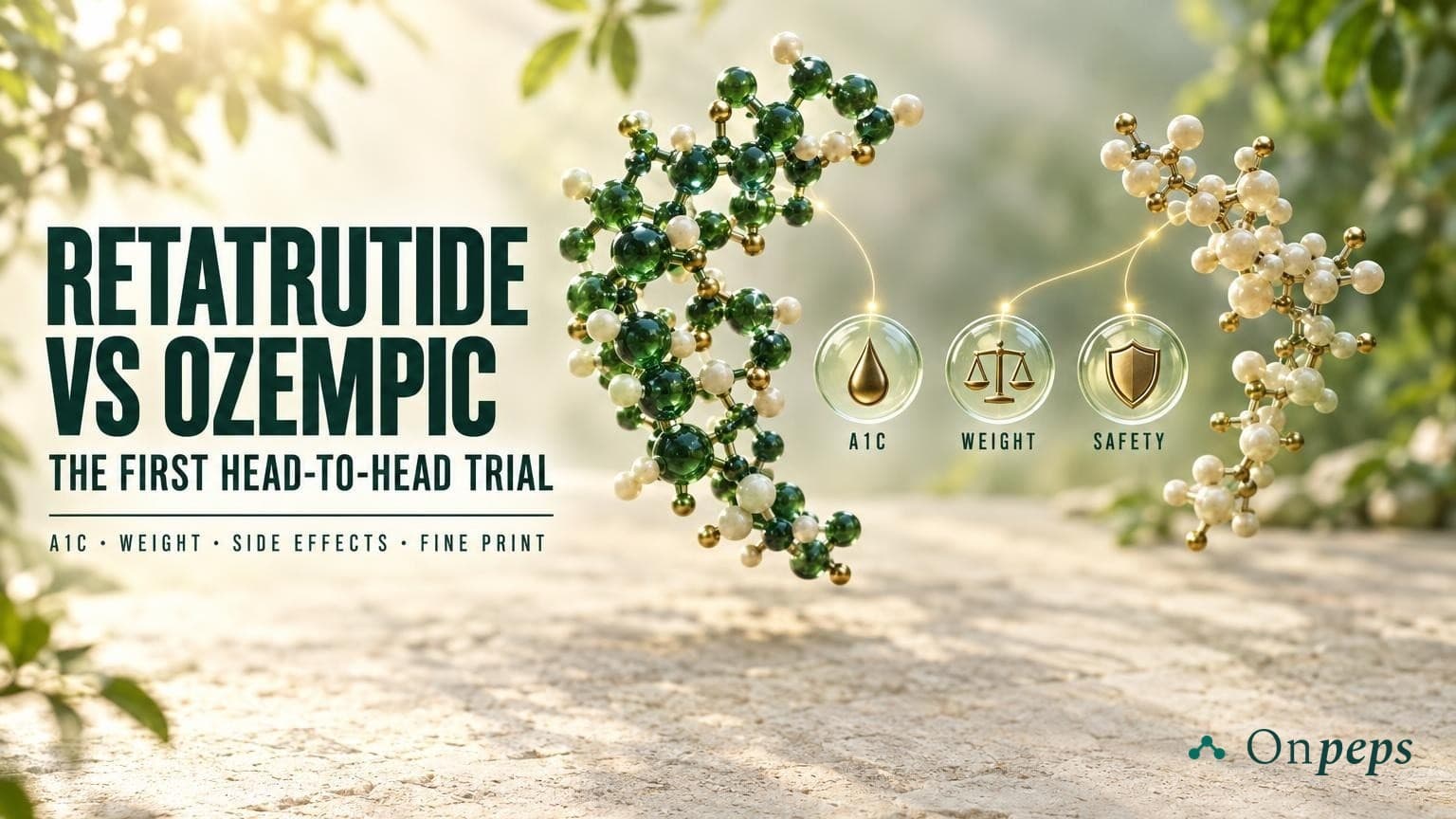
On October 28, Lilly put retatrutide up against Ozempic in a Phase 3 trial for the first time, and the headline wrote itself: more than double the weight loss of Ozempic's highest approved dose. The next day, US searches for retatrutide hit their highest point of the past three months.
Then the claim started travelling, and the details fell off. This trial was in people with type 2 diabetes. It was open-label. Every number Lilly released assumes people stayed on the drug. And 2 mg of Ozempic is not the strongest semaglutide a doctor can prescribe. So what did this trial actually show, and what didn't it? Let's dive in.
TLDR
What is it? TRANSCEND-T2D-2 is an 80-week, open-label Phase 3 trial of 1,298 adults with type 2 diabetes, comparing once-weekly retatrutide (9 mg or 12 mg) with once-weekly Ozempic 2 mg. It's the first head-to-head result retatrutide has against an approved GLP-1 drug in Phase 3.
Results: A1C fell 2.2 points on both retatrutide doses against 1.8 on Ozempic. Weight fell 19.5% on 9 mg and 20.9% on 12 mg against 9.4% on Ozempic. These are company topline figures for people who stayed on treatment. The trial hasn't been published.
Dosage: Retatrutide started at 2 mg and went up every four weeks to the target dose. Ozempic's label starts at 0.25 mg and tops out at 2 mg. Community retatrutide protocols run lower and slower, and no validated protocol exists outside a trial.
Safety: Stomach side effects were closer than you'd expect. Stopping because of side effects wasn't: 7.9% on retatrutide 12 mg against 2.7% on Ozempic. Heart rate, serious adverse events, and low blood sugar weren't reported in the topline.
Legal Status (November 2026): Ozempic is FDA-approved for type 2 diabetes. Retatrutide isn't approved anywhere, cannot be compounded under federal law, and Lilly plans to file in Q1 2027. A small expanded access program exists for people who meet strict criteria and can't join a trial.
What Is TRANSCEND-T2D-2, and Why Is Everyone Searching for It?
It's the sixth Phase 3 trial Lilly has reported as positive for retatrutide, and the first where the opponent is a household name.
The 1,298 participants had type 2 diabetes that wasn't controlled on metformin, with or without an SGLT2 inhibitor. They started with an average A1C of 8.3%, an average weight of 225.8 lbs, and an average BMI of 36.8. They were randomized 2:2:1 to retatrutide 9 mg, retatrutide 12 mg, or Ozempic 2 mg, and followed for 80 weeks (NCT06260722).
The primary goal was modest: show that retatrutide 12 mg was no worse than Ozempic on A1C. It cleared that and went on to show superiority.
The searches followed the news almost to the day. Over the past 90 days, the fastest-rising retatrutide queries have been about this comparison, the Phase 3 results, Lilly's lawsuits, and whether there's any way in through expanded access. People aren't asking what retatrutide is anymore. They're asking whether it's worth leaving Ozempic for.
How Do Retatrutide and Ozempic Work?
Ozempic is semaglutide, and it does one thing: it activates the GLP-1 receptor, which slows stomach emptying, blunts appetite, and helps the body release insulin when blood sugar is high.
Retatrutide does three things. It activates GLP-1, GIP, and glucagon receptors from a single molecule. The GLP-1 and GIP arms handle appetite and glucose. The glucagon arm is the new part: in obese animals, it raised energy expenditure on top of the drop in food intake (Coskun et al., 2022, Cell Metabolism, PMID 35985340).
Whether that's what explains the human results hasn't been settled. It's the design case, and the size of the gap fits it. But a bigger weight-loss number doesn't prove a mechanism.
Glucagon normally raises blood sugar, which sounds like a bad idea in a diabetes drug. In practice, the other two arms more than cover it, and A1C fell further on retatrutide than on Ozempic. Our retatrutide guide goes through the full mechanism.
Retatrutide vs Ozempic vs the Stronger Options
Ozempic 2 mg was a fair opponent in a diabetes trial. It isn't the strongest option if your goal is weight.
| Drug | Receptors | Top dose | Status | Direct comparison data |
|---|---|---|---|---|
| Ozempic (semaglutide) | GLP-1 | 2 mg weekly | Approved, type 2 diabetes | Lost to retatrutide on A1C and weight (topline) |
| Wegovy (semaglutide) | GLP-1 | 7.2 mg weekly (Wegovy HD) | Approved, weight management | Lost to tirzepatide at up to 2.4 mg: 13.7% vs 20.2% (SURMOUNT-5) |
| Zepbound / Mounjaro (tirzepatide) | GIP + GLP-1 | 15 mg weekly | Approved | Beat semaglutide in SURPASS-2 and SURMOUNT-5 |
| Retatrutide | GIP + GLP-1 + glucagon | 12 mg weekly in trials | Investigational | No result against tirzepatide yet |
Tirzepatide is the comparison that matters most, and it doesn't exist yet. A direct trial of retatrutide against tirzepatide in obesity is listed as active, with primary completion expected in November 2026 (NCT06662383). No results have been reported.
Beating Ozempic was the expected result. Beating Zepbound is the question that's still open.
What the Evidence Actually Shows
A lot has changed in the past six weeks. Retatrutide coverage still calls the TRIUMPH obesity trials unpublished, but two of them reached journals on September 29, and the sleep apnea data followed in October. The Ozempic trial is still just a press release.
Published
| Trial | Population | Key result | Status |
|---|---|---|---|
| TRIUMPH-1 (Jastreboff et al., 2026, NEJM, PMID 42814954) | Obesity, no diabetes, 80 weeks | −25.0% on 12 mg vs −3.9% placebo, counting everyone randomized | Peer reviewed |
| TRIUMPH-2 (Bellido et al., 2026, The Lancet, PMID 42810372) | Obesity + type 2 diabetes, 80 weeks | −18.8% on 12 mg vs −5.1% placebo, counting everyone randomized | Peer reviewed |
| TRIUMPH OSA trials (Grunstein et al., 2026, NEJM, PMID 42904878) | Moderate-to-severe sleep apnea | Apnea events fell 25 to 34 per hour on 9 and 12 mg vs about 10 on placebo | Peer reviewed |
| TRANSCEND-T2D-1 (Bajaj et al., 2026, The Lancet, PMID 42250575) | Type 2 diabetes, 40 weeks | A1C −1.94 on 12 mg vs −0.81 placebo | Peer reviewed |
Company topline, unpublished
| Measure at 80 weeks | Retatrutide 9 mg | Retatrutide 12 mg | Ozempic 2 mg | Status |
|---|---|---|---|---|
| A1C change | −2.2 | −2.2 | −1.8 | Topline, Oct 2026 |
| Weight change | −19.5% | −20.9% | −9.4% | Topline, Oct 2026 |
| Weight change, lbs | −44.3 | −47.4 | −20.9 | Topline, Oct 2026 |
Lilly says detailed results will go to a future medical meeting and a peer-reviewed journal. It hasn't said which one or when.
The results are strong, and they're consistent: TRIUMPH-2 reported 20.8% on 12 mg in a similar diabetic population, using the same analysis. That's a good sign the number is real. But there are five things to know before you repeat it.
Does "double" apply to you if you don't have diabetes?
Not automatically. People with type 2 diabetes lose less weight on these drugs. Retatrutide 12 mg gave 28.3% in people without diabetes and 20.8% in people with it. Semaglutide 2.4 mg shows the same drop: 14.9% in STEP 1 (Wilding et al., 2021, NEJM, PMID 33567185) and 9.6% in STEP 2 (Davies et al., 2021, The Lancet, PMID 33667417).
Those are separate trials with different analyses, so don't do arithmetic on them. The ratio in this trial belongs to this population.
What does "efficacy estimand" mean?
It's the analysis that asks what happens if people stay on the drug. It's the better-looking number, and the only one Lilly released: every figure in the press release uses it.
The published papers show how much that matters. In TRIUMPH-1, 12 mg went from 28.3% on that analysis to 25.0% when everyone randomized was counted. In TRIUMPH-2, it went from 20.8% to 18.8%, and 9 mg went from 19.1% to 16.8%.
Here's the caveat that gets dropped: the 20.9% in this trial will probably shrink too, and so will Ozempic's 9.4%. By how much, nobody outside Lilly knows yet.
How strong is the A1C win?
The 12 mg result is solid. Superiority on A1C at 12 mg was tested with proper statistical controls. The 9 mg result was only nominally significant, meaning it fell outside that protected testing plan, so it's weaker evidence even though the number is identical.
Starting A1C matters as well. Ozempic 2 mg reached −2.2 on its own in SUSTAIN FORTE, at 40 weeks, from a starting A1C of 8.9% (Frías et al., 2021, Lancet Diabetes Endocrinol, PMID 34293304). Higher starting points produce bigger drops, so that doesn't mean the drugs tie. It does mean a 0.4-point gap is the honest size of the difference, and weight is where the real distance opened up.
Why does open-label matter?
Everyone knew which drug they were on. A1C and scale weight are hard to fool, so the headline numbers are less exposed than a pain score would be. But knowing your drug can affect whether you report a side effect and whether you stay in the trial, and the side-effect comparison is exactly what's being read closely here. Lilly also ran the trial, against a competitor's product.
Is 9 mg the better dose?
On these numbers, it's a fair question. Both doses landed on the same A1C. Going from 9 to 12 mg added 1.4 points of weight loss, and took discontinuation for side effects from 4.8% to 7.9%. One topline isn't enough to choose a dose, and TRIUMPH-2 ran the other way (11.6% on 9 mg, 7.7% on 12 mg). But "more is better" isn't what this trial shows.
Retatrutide vs Ozempic Dosage: Trials vs the Community
Ozempic has a label. Retatrutide has a trial schedule and a set of community habits, and those aren't the same thing.
| Ozempic (label) | Retatrutide (TRANSCEND-T2D-2) | Retatrutide (community reports) | |
|---|---|---|---|
| Start | 0.25 mg weekly for 4 weeks | 2 mg weekly | 0.5 to 1 mg weekly |
| Steps | 0.5 mg, then 1 mg, then 2 mg, at least 4 weeks apart | Up every 4 weeks | Held 3 to 4 weeks per step |
| Top dose | 2 mg weekly | 9 or 12 mg weekly | Usually 4 to 8 mg |
No validated retatrutide protocol exists outside a clinical trial. The community column describes what people report doing. It isn't a recommendation, and nobody has tested it. Our retatrutide dosage chart goes through it week by week.
Switching deserves a plain answer. This trial doesn't tell you how to move from Ozempic to retatrutide. Participants were stable on metformin with or without an SGLT2 inhibitor, and anyone who'd taken a weight-reduction medication in the 90 days before screening was excluded. It compared two starting points, not a switch.
The reconstitution math
Gray-market retatrutide comes as lyophilized powder, so the dose depends on how much bacteriostatic water goes in. Here's the arithmetic for the 2 mg dose the trial started on.
| Vial | BAC water added | Concentration | 2 mg dose on a U-100 syringe |
|---|---|---|---|
| 10 mg | 2 mL | 5 mg/mL | 0.4 mL = 40 units |
| 20 mg | 2 mL | 10 mg/mL | 0.2 mL = 20 units |
| 30 mg | 3 mL | 10 mg/mL | 0.2 mL = 20 units |
At 10 mg/mL, the trial's 12 mg dose would be 120 units, which won't fit in a standard 1 mL syringe. Check your own numbers with our reconstitution calculator and dosage calculator rather than trusting a table.
Retatrutide vs Ozempic Side Effects
This is the most interesting table in the release, and the one that gets the least attention.
| Adverse event | Retatrutide 9 mg | Retatrutide 12 mg | Ozempic 2 mg |
|---|---|---|---|
| Diarrhea | 28.3% | 32.7% | 26.4% |
| Nausea | 21.2% | 23.8% | 21.3% |
| Constipation | 14.2% | 13.1% | 19.8% |
| Vomiting | 10.2% | 15.0% | 13.2% |
| Dyspepsia | 10.4% | 8.5% | 11.6% |
| Dysesthesia (abnormal skin sensation) | 4.8% | 6.5% | 2.7% |
| Urinary tract infection | 5.8% | 4.2% | 5.8% |
| Stopped due to side effects | 4.8% | 7.9% | 2.7% |
The stomach numbers are close. At 9 mg, nausea matched Ozempic, and constipation was actually lower on both retatrutide doses.
And yet nearly three times as many people on 12 mg stopped because of side effects. The release doesn't say why. That gap and the similar stomach rates don't fit together neatly, and the full paper will need to explain it. Open-label design may be part of it. So may something the topline leaves out.
What the topline leaves out
The release gives no figures for heart rate, serious adverse events, low blood sugar, or deaths. Those aren't small omissions.
Heart rate rose with dose in the Phase 2 obesity trial (Jastreboff et al., 2023, NEJM, PMID 37366315). The published TRIUMPH-2 paper adds a signal to watch: hypotension in 5% on 9 mg and 6% on 12 mg, against under 1% on placebo. That paper also recorded seven deaths across its four arms, six on retatrutide and one on placebo, and investigators judged all of them unrelated to the study drug.
Skin sensitivity isn't unique to retatrutide
Dysesthesia ran higher on retatrutide here, but it also appeared on Ozempic at 2.7%. At much higher semaglutide exposure, altered skin sensation reached 22.9% on the 7.2 mg dose in STEP UP (Wharton et al., 2025, Lancet Diabetes Endocrinol, PMID 40961952). It looks more like a dose-related effect in this class than a quirk of one molecule.
What Ozempic's label already tells you
Ozempic has a boxed warning for thyroid C-cell tumors, based on rodent findings, and it's contraindicated in people with a personal or family history of medullary thyroid carcinoma or MEN 2. Its label also covers pancreatitis, diabetic retinopathy complications, and gallbladder disease. It's a long list, and it exists because years of real-world use produced it. Retatrutide has no equivalent yet.
The gray-market record
None of the trial safety data applies to a vial bought online. The FDA says products falsely labeled "for research purposes" are "of unknown quality and may be harmful to their health." The Victorian health department in Australia recorded six acute liver injury cases linked to products labelled as retatrutide, with a contaminant suspected rather than the molecule itself. Our retatrutide sourcing page has the enforcement record.
Is Retatrutide Legal? And What Does Each One Cost?
Ozempic is FDA-approved for adults with type 2 diabetes, including for lowering cardiovascular risk in those with known heart disease and for protecting kidney function in those with chronic kidney disease. It isn't approved for weight loss. Wegovy is the semaglutide brand with that indication.
Retatrutide isn't approved anywhere. The FDA's position is direct: it "cannot be used in compounding under federal law," isn't a component of any approved drug, and hasn't been found safe and effective for any condition.
When could retatrutide be approved?
Lilly plans to file in Q1 2027. A dispute could complicate that. Lilly wants to file as a biologic, which brings 12 years of exclusivity rather than five. The FDA's protein definition requires 40 or more alpha amino acids, and the agency says retatrutide falls short, while Lilly counts 41 amino acids. A court vacated the FDA's decision and sent part of the question back to the agency, and Lilly has appealed (BioSpace, 2026).
Is there any legal way to get it now?
Two: a clinical trial, or Lilly's expanded access program, confirmed on August 3. It's narrow. Reported criteria differ by outlet, but they include refractory obesity and being unable to enroll in a trial. One report adds two or more serious complications, and another says obesity that persists despite tolerating the highest approved dose of an obesity therapy. Requests come through a doctor, and they're reviewed individually (AJMC, 2026). Having type 2 diabetes doesn't qualify you.
What about the cost?
Ozempic's self-pay price through NovoCare is $349 a month for 0.25, 0.5, or 1 mg and $499 a month for 2 mg. New patients can get the first two fills of the lower doses at $199 through December 31, 2026. Eligible commercial insurance can bring it down to as little as $25.
Retatrutide has no list price and no legal retail route. Whatever is being sold online at a retail price isn't Lilly's drug.
The Honest Take
This is a real result. A randomized Phase 3 trial, a clean A1C win at 12 mg, and a weight gap of more than 10 points that matches what Lilly reported elsewhere in diabetic patients. You shouldn't wave that away because it came from a press release.
It also proves less than the headline suggests. It tells you retatrutide beat Ozempic's top dose, in people with diabetes, among those who stayed on treatment, in a trial where everyone knew what they were taking. It doesn't tell you retatrutide beats Wegovy HD, because nobody's tested that. It doesn't tell you it beats Zepbound. And it says nothing about what's in a vial from a website.
The discontinuation number is the one to watch. If the full paper explains why nearly three times as many people on 12 mg walked away, that'll tell you more about how this drug behaves in real life than the weight curve will.
The trial shows what Lilly's retatrutide can do against Ozempic. It doesn't make a gray-market vial a safer or smarter choice than a drug with a label.
FAQ
Is retatrutide stronger than Ozempic?
In this trial, yes. It lowered A1C more and produced more than twice the weight loss of Ozempic 2 mg at 80 weeks in adults with type 2 diabetes. These are unpublished, company-reported figures for people who stayed on treatment.
How much weight did people lose on retatrutide compared with Ozempic?
An average of 44.3 lbs on 9 mg and 47.4 lbs on 12 mg, against 20.9 lbs on Ozempic 2 mg, from an average starting weight of 225.8 lbs.
Does retatrutide lower A1C more than Ozempic?
Yes, by 0.4 points: 2.2 against 1.8, from a starting A1C of 8.3%. Superiority was statistically protected at 12 mg and only nominal at 9 mg.
Does retatrutide have more side effects than Ozempic?
Stomach side effects were broadly similar, with slightly more diarrhea on retatrutide and more constipation on Ozempic. Skin sensitivity was higher on retatrutide, and more people stopped because of side effects: 4.8% and 7.9% against 2.7%.
Can I switch from Ozempic to retatrutide?
There's no legal retail way to do it, and this trial didn't test switching. The only lawful routes to retatrutide are a clinical trial or Lilly's expanded access program, and both go through a doctor or study site.
Can you take retatrutide and Ozempic together?
There's no evidence supporting it. Both act on the GLP-1 receptor, so you'd be stacking overlapping side effects with no trial data behind it.
Is retatrutide better than tirzepatide?
Nobody knows yet. A direct trial is active (NCT06662383), but no results have been reported. Everything circulating now comes from comparing separate trials.
When will retatrutide be available?
Lilly plans to file in Q1 2027. The FDA decision would come after that, and no approval date exists.
What is Lilly's expanded access program?
A limited route to authentic retatrutide before approval, for patients who meet defined clinical criteria and can't enroll in a trial. A doctor has to submit the request, and each one is reviewed individually. It's listed as NCT07629401.
Did retatrutide help sleep apnea?
Yes, in two published Phase 3 trials. At 80 weeks, apnea events fell by 31.7 to 34.3 per hour in people without diabetes and 24.7 to 25.4 in people with it on 9 and 12 mg, against about 10 on placebo (Grunstein et al., 2026, NEJM, PMID 42904878).
Why is Lilly suing over retatrutide?
On August 12, Lilly filed six lawsuits against US businesses selling products as retatrutide. Its position is that authentic retatrutide isn't sold commercially at all.
How can you tell if retatrutide is counterfeit?
You can't tell by looking at it. Lilly says products sold as retatrutide outside its studies may contain unknown ingredients or incorrect doses, and the FDA calls them of unknown quality. Our sourcing page covers what's known.
Resources
Eli Lilly (2026), press release, TRANSCEND-T2D-2 topline results against Ozempic 2 mg — https://www.biospace.com/press-releases/lillys-retatrutide-delivered-greater-a1c-reduction-and-more-than-double-the-weight-loss-of-ozempics-highest-approved-dose-in-head-to-head-trial
ClinicalTrials.gov, TRANSCEND-T2D-2 record, NCT06260722 — https://clinicaltrials.gov/study/NCT06260722
HCPLive (2026), TRANSCEND-T2D-2 coverage and statistical testing detail — https://www.hcplive.com/view/transcend-t2d-2-retatrutide-beats-semaglutide-2-mg-on-a1c-weight-loss
AJMC (2026), TRANSCEND-T2D-2 coverage including nominal significance at 9 mg — https://www.ajmc.com/view/retatrutide-tops-semaglutide-on-a1c-weight-in-head-to-head-trial
Jastreboff et al. (2026), New England Journal of Medicine, TRIUMPH-1 Phase 3 obesity trial — https://pubmed.ncbi.nlm.nih.gov/42814954/
Bellido et al. (2026), The Lancet, TRIUMPH-2 Phase 3 trial in obesity with type 2 diabetes — https://pubmed.ncbi.nlm.nih.gov/42810372/
Grunstein et al. (2026), New England Journal of Medicine, TRIUMPH-1-OSA and TRIUMPH-2-OSA sleep apnea trials — https://pubmed.ncbi.nlm.nih.gov/42904878/
Bajaj et al. (2026), The Lancet, TRANSCEND-T2D-1 Phase 3 diabetes trial — https://pubmed.ncbi.nlm.nih.gov/42250575/
Jastreboff et al. (2023), New England Journal of Medicine, retatrutide Phase 2 obesity trial — https://pubmed.ncbi.nlm.nih.gov/37366315/
Coskun et al. (2022), Cell Metabolism, retatrutide discovery and glucagon-arm rationale — https://pubmed.ncbi.nlm.nih.gov/35985340/
Eli Lilly (2026), press release, TRIUMPH-1 topline including the efficacy estimand — https://www.biospace.com/press-releases/lillys-triple-agonist-retatrutide-delivered-powerful-weight-loss-in-pivotal-phase-3-obesity-trial
Eli Lilly (2026), press release, TRIUMPH-2 and TRIUMPH-3 topline and Q1 2027 filing plan — https://www.biospace.com/press-releases/lillys-triple-agonist-retatrutide-successful-in-two-additional-phase-3-obesity-trials-delivering-significant-improvements-in-weight-and-a1c
Frías et al. (2021), Lancet Diabetes & Endocrinology, SUSTAIN FORTE semaglutide 2.0 mg vs 1.0 mg — https://pubmed.ncbi.nlm.nih.gov/34293304/
Wilding et al. (2021), New England Journal of Medicine, STEP 1 semaglutide obesity trial — https://pubmed.ncbi.nlm.nih.gov/33567185/
Davies et al. (2021), The Lancet, STEP 2 semaglutide in overweight or obesity with type 2 diabetes — https://pubmed.ncbi.nlm.nih.gov/33667417/
Wharton et al. (2025), Lancet Diabetes & Endocrinology, STEP UP semaglutide 7.2 mg — https://pubmed.ncbi.nlm.nih.gov/40961952/
Aronne et al. (2025), New England Journal of Medicine, SURMOUNT-5 tirzepatide vs semaglutide in obesity — https://pubmed.ncbi.nlm.nih.gov/40353578/
Frías et al. (2021), New England Journal of Medicine, SURPASS-2 tirzepatide vs semaglutide 1 mg — https://pubmed.ncbi.nlm.nih.gov/34170647/
ClinicalTrials.gov, retatrutide vs tirzepatide in obesity, NCT06662383 — https://clinicaltrials.gov/study/NCT06662383
Novo Nordisk (2026), Ozempic prescribing information — https://www.novo-pi.com/ozempic.pdf
Novo Nordisk (2026), Ozempic self-pay and savings offers — https://www.novocare.com/ozempic/cost-navigator.html
FDA (2026), concerns with unapproved GLP-1 drugs used for weight loss — https://www.fda.gov/drugs/drug-alerts-and-statements/fdas-concerns-unapproved-glp-1-drugs-used-weight-loss
BioSpace (2026), the Lilly–FDA dispute over whether retatrutide is a biologic — https://www.biospace.com/fda/lilly-fda-retatrutide-biologic-dispute-comes-to-a-head-as-submission-nears
AJMC (2026), Lilly's expanded access program and physician response — https://www.ajmc.com/view/lilly-expands-retatrutide-access-amid-doctor-pushback
ClinicalTrials.gov, pre-approval expanded access of retatrutide, NCT07629401 — https://clinicaltrials.gov/study/NCT07629401
Victoria Department of Health (2026), health alert on toxicity linked to products labelled retatrutide — https://www.health.vic.gov.au/health-alerts/toxicity-linked-to-unapproved-peptide-retatrutide
NPR (2026), Lilly files six lawsuits over black-market retatrutide — https://www.npr.org/2026/08/13/g-s1-138594/eli-lilly-files-6-lawsuits-against-businesses-selling-black-market-obesity-drug