Searches for SS-31 have more than doubled in a year, and the questions climbing alongside it are "what is ss31," "ss31 protocol" and "ss31 peptide dosage." It is sold in the same vendor carousel as MOTS-c, semax and selank, usually as the "mitochondrial peptide" for energy, endurance and anti-aging. And unlike almost everything else on that shelf, it has an FDA approval to point to.
Here is the caveat that gets dropped from almost every listing. The approval is for one ultra-rare genetic disease, it was granted on knee strength after the trial missed both of its primary endpoints, and the large trials in common conditions mostly failed. So what is SS-31, what did the trials actually show, what does the dosing math look like for a research vial, and what does "FDA approved" really cover? Let's dive in.
TLDR
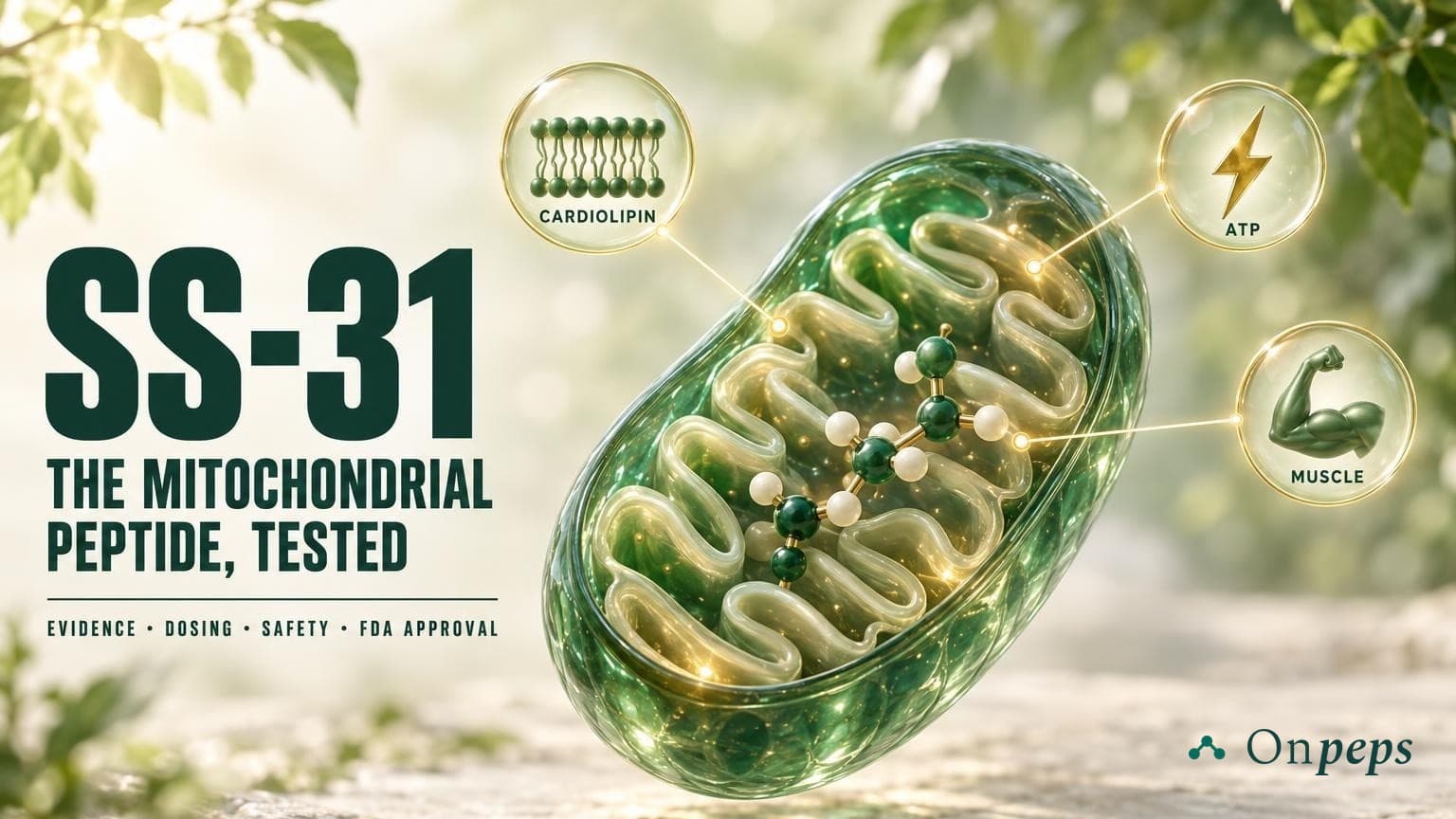
What is SS-31? A synthetic four-amino-acid peptide (D-Arg-Dmt-Lys-Phe-NH2), also called elamipretide, MTP-131 and Bendavia. It concentrates in the inner mitochondrial membrane and binds cardiolipin, the lipid that holds the energy-making machinery together.
Results: Striking in old mice: one dose restored muscle energy production to young levels within an hour. In people, the Barth syndrome trial missed its primary endpoints in the randomised phase, then showed gains in walking and knee strength in a small open-label extension. Large trials in mitochondrial myopathy, heart failure and heart attack were negative.
Dosage: The approved dose is 40 mg under the skin once daily, for Barth syndrome only. Community guides report 1 to 10 mg a day in cycles. No validated protocol exists for healthy adults or for anti-aging.
Safety: In trials, injection-site reactions were nearly universal. The label also warns of serious allergic reactions and notes eosinophil counts rising in the first months. That record belongs to the pharmaceutical product, not to research vials.
Legal Status (November 2026): Approved in the US as Forzinity since 19 September 2025, under accelerated approval, for Barth syndrome in patients weighing at least 30 kg. Research-use vials are not that drug. SS-31 is not among the six peptides in the October 2026 HHS compounding policy.
What Is SS-31, and Why Is Everyone Searching for It Now?
Let's get this straight first. SS-31 is not a fragment of a natural protein and nothing your body makes. It is a designed molecule. The "SS" stands for Szeto-Schiller, after Hazel Szeto and Peter Schiller, who built a family of short peptides that alternate aromatic and positively charged amino acids so they could slip through cell membranes.
The 2004 paper that introduced the family found they concentrate roughly 1,000-fold in the inner mitochondrial membrane and protect cells from oxidative death (Zhao et al., 2004, J Biol Chem, PMID 15178689). SS-31 was the one that went to the clinic, licensed to Stealth BioTherapeutics and renamed elamipretide.
Three things pushed it into the peptide mainstream. First, the September 2025 approval made it the first treatment the FDA has ever approved for Barth syndrome, and the first approved drug that works by binding cardiolipin (FDA, September 2025). Second, the longevity crowd discovered the old-mouse studies. Third, MOTS-c had its own moment after the July 2026 FDA committee vote, and SS-31 is sold right next to it as the second half of a "mitochondrial stack."
On Google Trends (US), interest in "ss31" rose about 150% between the start and end of the past twelve months, peaking in late July 2026. The people searching it are also searching MOTS-c, semax and selank.
SS-31 is the rare gray-market peptide with a real drug behind it. That is exactly why its marketing is easy to overread.
How Does SS-31 Work?
To understand SS-31 you need to understand cardiolipin. Your mitochondria have two membranes. The inner one is folded into ridges called cristae, and that is where the electron transport chain sits, passing electrons along to make ATP, the cell's energy currency.
Cardiolipin is a lipid found almost only in that inner membrane. It acts like scaffolding: it holds the respiratory complexes together in efficient "supercomplexes" and keeps the cristae folded. When cardiolipin is damaged or oxidised, the cristae flatten, electrons leak, ATP output drops, and reactive oxygen species rise.
SS-31 binds cardiolipin with high affinity. In rat kidneys starved of blood flow, pretreatment protected the cristae, stopped the mitochondria swelling, and let ATP recover quickly when blood returned (Birk et al., 2013, J Am Soc Nephrol, PMID 23813215). The same work showed the SS-31/cardiolipin complex blocks cytochrome c from acting as a peroxidase, one of the main ways cardiolipin gets destroyed.
Originally it was described as an antioxidant. The current view is that it is less a scavenger and more a membrane stabiliser, which is how the FDA label describes it: a "mitochondrial cardiolipin binder" that "improves mitochondrial morphology and function" (Forzinity label, 2025).
Two pharmacology facts matter for anyone injecting it. It is absorbed fast, peaking 30 to 60 minutes after a subcutaneous shot with about 92% bioavailability. And it is cleared fast, with essentially the whole dose recovered in urine within 48 hours. That is why the trials dose it every day.
That mechanism also explains why Barth syndrome was the target. Barth syndrome is caused by mutations in the TAZ gene, which remodels cardiolipin. Patients, almost all boys and young men, have abnormal cardiolipin from birth, with heart muscle disease, weak muscles, fatigue and low neutrophil counts. It is the one disease where the drug's target is the disease.
SS-31 vs MOTS-c, MitoQ, Urolithin A and NAD+ Boosters
SS-31 sits in a crowded "mitochondrial health" aisle. Here is how the main options actually line up.
| Compound | What it is | How it is taken | Best human evidence | Status (November 2026) |
|---|---|---|---|---|
| SS-31 (elamipretide) | Synthetic 4-residue peptide that binds cardiolipin | Daily subcutaneous injection | Small Barth syndrome trial plus open-label extension; Phase 3 in mitochondrial myopathy negative | FDA accelerated approval (Forzinity) for Barth syndrome only |
| MOTS-c | 16-residue peptide encoded in mitochondrial DNA | Injection (research vials) | None for the injected peptide | Unapproved; covered by the October 2026 HHS compounding policy; WADA-prohibited |
| MitoQ | Ubiquinone attached to a mitochondria-seeking cation | Oral supplement | Six-week trial in healthy older adults: improved artery dilation | Sold as a supplement |
| Urolithin A | Gut-microbe metabolite of pomegranate and walnut compounds | Oral supplement | Four-week trial in older adults: safe, shifted mitochondrial gene signatures in muscle | Sold as a supplement |
| Nicotinamide riboside | NAD+ precursor | Oral supplement | Six-week crossover trial: raised blood NAD+, well tolerated, no clear functional change | Sold as a supplement |
The supplement rows come from small, short trials in healthy older adults (Rossman et al., 2018, Hypertension, PMID 29661838; Andreux et al., 2019, Nat Metab, PMID 32694802; Martens et al., 2018, Nat Commun, PMID 29599478). None of them is a clinical-outcome study either. They are there for scale.
The MOTS-c row is the one people conflate. MOTS-c works on a different pathway (AMPK, the cell's energy sensor) and none of SS-31's trial data transfers to it. We cover it separately in our MOTS-c guide and in the MOTS-c library entry.
SS-31 has more human data than anything else in this table. Most of it is negative.
What the Evidence Actually Shows
Elamipretide has been in human trials for more than a decade. That is unusual for a peptide sold in research vials, and it means you can see exactly where it worked and where it did not.
The animal data that built the hype
In 27-month-old mice, a single 3 mg/kg injection restored resting and maximal ATP production in skeletal muscle to young levels within an hour, made the muscle more fatigue resistant, and eight days of treatment increased whole-body endurance. Young muscle did not change (Siegel et al., 2013, Aging Cell, PMID 23692570).
Eight weeks of SS-31 in old mice also substantially reversed the stiffening of the heart that comes with age, reducing mitochondrial oxidative stress in heart cells (Chiao et al., 2020, eLife, PMID 32648542). These are the two studies behind most of the anti-aging claims, and they are good studies. They are also mice.
Published human trials
| Trial | Population | Dose | Primary result | Status |
|---|---|---|---|---|
| TAZPOWER, randomised phase (Reid Thompson et al., 2021) | 12 people with Barth syndrome | 40 mg SC daily, 12-week crossover | Neither primary endpoint met (6-minute walk, fatigue) | Published, Genet Med |
| TAZPOWER, open-label extension (Thompson et al., 2024) | 10 entered, 8 reached week 168 | 40 mg SC daily | 6-minute walk up 96 m from extension baseline; no placebo group | Published, Genet Med |
| MMPOWER (Karaa et al., 2018) | 36 adults with primary mitochondrial myopathy | IV infusion, 5 days | Highest dose walked 64.5 m farther vs 20.4 m placebo (p = 0.053) | Published, Neurology |
| MMPOWER-3 (Karaa et al., 2023) | 218 adults with primary mitochondrial myopathy | 40 mg SC daily, 24 weeks | Negative: walk −3.2 m vs placebo, fatigue unchanged | Published, Neurology |
| EMBRACE STEMI (Gibson et al., 2016) | First anterior heart attack, at stenting | IV infusion, 1 hour | Negative: infarct size not reduced | Published, Eur Heart J |
| Daubert et al., 2017 | 36 people with heart failure (EF ≤35%) | Single 4-hour IV infusion | Highest dose cut heart volumes transiently | Published, Circ Heart Fail |
| PROGRESS-HF (Butler et al., 2020) | 71 people with heart failure | 4 or 40 mg SC daily, 4 weeks | Negative: no change in heart volume or function | Published, J Card Fail |
| ReCLAIM-2 (Ehlers et al., 2025) | 176 people with dry AMD and geographic atrophy | 40 mg SC daily, 48 weeks | Primary endpoints missed; slower photoreceptor-layer loss on secondary measures | Published, Ophthalmol Sci |
Read the Barth row carefully. In the randomised crossover, 12 patients got 12 weeks of drug and 12 weeks of placebo, and elamipretide did not beat placebo on walking distance or fatigue (Reid Thompson et al., 2021, Genet Med, PMID 33077895). The improvements came later, in the open-label extension: by week 36 walking distance was up about 96 m, and the gains held to week 168 in the eight who stayed (Thompson et al., 2024, Genet Med, PMID 38602181).
That is real and meaningful for a disease with no treatment. It is also eight people, everyone knew they were on the drug, and there was no comparison group. The FDA ended up approving it on knee extensor strength, a secondary endpoint, which rose a median 63 newtons from baseline by week 168. During the randomised phase it had not moved.
MMPOWER-3 is the result the marketing leaves out. It was the large, pivotal Phase 3 in adults with genetic mitochondrial muscle disease, 218 people for 24 weeks at the same 40 mg daily dose. The difference in walking distance was −3.2 m, and fatigue did not improve (Karaa et al., 2023, Neurology, PMID 37268435). A post hoc analysis suggested people with nuclear-DNA defects might respond, which is a hypothesis, not a result (Karaa et al., 2024, Orphanet J Rare Dis, PMID 39574155).
The heart trials tell the same story. A single infusion in failing hearts shrank heart volumes while the drug was in the blood (Daubert et al., 2017, Circ Heart Fail, PMID 29217757), but four weeks of daily injections changed nothing (Butler et al., 2020, J Card Fail, PMID 32068002). Given at the moment of a heart attack, it did not reduce damage (Gibson et al., 2016, Eur Heart J, PMID 26586786).
Company topline and unpublished
| Program | What the company says | Status |
|---|---|---|
| Barth syndrome confirmatory trial | First site opened in Bristol, UK; required by the FDA as a condition of approval | Running, no data (April 2026 update) |
| Dry AMD, Phase 3 ReNEW | On track; FDA guidance may let a single trial support approval | Running, no data (2026 updates) |
| Barth patients under 30 kg | Meeting with FDA on a path for younger, smaller children | Regulatory discussion |
| POLG-related myopathy | Synopsis for a new pivotal trial to be discussed with FDA | Planning |
These are management's own timelines (Stealth, January 2026; Stealth, April 2026). None has produced data.
And notice what is missing from every table above. There is no trial of SS-31 in healthy people, in normal ageing, in athletes or for energy. Every human study enrolled patients with a diagnosed disease.
The anti-aging case rests on mice. The human case rests on eight men with a rare disease, and the big trials in common conditions were negative.
SS-31 Dosage: What Trials Used vs What the Community Reports
Let's be plain. No validated dosing protocol exists for SS-31 outside Barth syndrome. The only dose with a label is 40 mg under the skin once daily, cut to 20 mg in severe kidney impairment, because the kidneys clear the drug.
| Source | Dose | Schedule | Who |
|---|---|---|---|
| Forzinity label | 40 mg SC | Once daily, ongoing | Barth syndrome, ≥30 kg |
| MMPOWER-3, PROGRESS-HF, ReCLAIM-2 | 40 mg SC (also 4 mg in PROGRESS-HF) | Once daily, 4 to 48 weeks | Patients in disease trials |
| Siegel 2013 (old mice) | 3 mg/kg intraperitoneal | Single dose or 8 days | Mice; roughly 17 mg for a 70 kg adult by standard body-surface conversion |
| Community guides | 1 to 5 mg SC, some up to 10 mg | Daily or 5 days on, 2 off, for 4 to 12 weeks, then a break | Healthy adults; no trial data |
The community range is a fraction of the trial dose. That is not necessarily a mistake, since nobody knows the right dose for a healthy person, but it means the clinical data, positive or negative, does not describe what most people are injecting.
Research vials are sold as lyophilised powder, commonly in sizes from 5 mg up to 50 mg. The arithmetic is simple, and you can check it with our reconstitution calculator and dosage calculator.
| Vial | Bacteriostatic water | Concentration | Dose | Volume | U-100 syringe units |
|---|---|---|---|---|---|
| 10 mg | 2 mL | 5 mg/mL | 1 mg | 0.2 mL | 20 |
| 10 mg | 2 mL | 5 mg/mL | 5 mg | 1.0 mL | 100 |
| 10 mg | 1 mL | 10 mg/mL | 5 mg | 0.5 mL | 50 |
| 50 mg | 2 mL | 25 mg/mL | 5 mg | 0.2 mL | 20 |
| 50 mg | 2 mL | 25 mg/mL | 40 mg | 1.6 mL | 160 (two draws) |
| Forzinity (ready-made) | None | 80 mg/mL | 40 mg | 0.5 mL | 50 |
The last two rows show the gap between a research vial and the drug. At trial dose, a 50 mg research vial lasts barely a day, while a single Forzinity vial holds 280 mg, seven daily doses, and must be discarded 8 days after opening.
The only tested human dose is 40 mg a day in sick patients. Anything else is extrapolation.
SS-31 Side Effects
Here is the good news first. Across trials in hundreds of patients, elamipretide was consistently well tolerated, and most adverse events were mild to moderate (Karaa et al., 2023; Butler et al., 2020). It did not prolong the QT interval at three times the peak approved exposure.
Now the part that gets dropped. In the Barth crossover, every one of the 12 patients on elamipretide had an injection-site reaction, against 8 of 12 on placebo. Redness hit all 12; hardening, itching and pain hit two-thirds to three-quarters (Forzinity label, Table 2). In ReCLAIM-2, adverse events were reported in 86% on drug versus 71% on placebo, driven by the same injection-site reactions (Ehlers et al., 2025, Ophthalmol Sci, PMID 39605874).
The label carries two other warnings worth knowing:
- Hypersensitivity. Serious allergic reactions requiring emergency treatment have been reported, including rashes, eczema-like dermatitis and cough. They can appear minutes to months after starting.
- Eosinophilia. Eosinophil counts, a type of white blood cell, rose frequently with 30 days or more of use, peaking around 90 days and returning to baseline after 6 to 12 months.
Carcinogenicity studies have not been conducted. Standard genetic toxicity tests were negative.
As for the gray market, we found no published case reports of harm specifically tied to research-vial SS-31. That is not the same as safety. A research vial carries none of the label's quality guarantees: identity, dose accuracy, sterility and endotoxin limits are whatever the supplier says they are. Daily injections of a powder you reconstitute yourself multiply those risks every day.
The drug's side-effect profile is mild and well documented. A research vial's is whatever is in the vial.
Is SS-31 Legal? The Regulatory Situation
Elamipretide's road to approval was rocky. An FDA advisory committee voted 10 to 6 in October 2024 that it was effective for Barth syndrome. In May 2025 the FDA issued a complete response letter anyway, then pointed the company to accelerated approval based on knee strength (Pharmaceutical Technology, May 2025).
On 19 September 2025 the FDA granted that accelerated approval. Forzinity is indicated "to improve muscle strength in adult and pediatric patients with Barth syndrome weighing at least 30 kg," and continued approval may depend on a confirmatory trial (FDA, September 2025). It became the first disease-specific treatment for Barth syndrome (Shirley, 2026, Drugs, PMID 41335372).
What that means in practice:
- Off-label prescribing of Forzinity is legal for a physician, as with any approved drug. It is also extraordinarily expensive: Drugs.com lists four vials, 28 daily doses, at about $59,600, which works out to roughly $775,000 a year at list price (Drugs.com). Insurers are unlikely to cover it outside Barth syndrome.
- Research-use vials sold online are not Forzinity. They are not approved, they are labeled not for human use, and the approval says nothing about their contents.
- Compounding is a separate question. Because elamipretide is now the active ingredient of an approved drug, a 503A pharmacy may in principle compound it on prescription, but federal law bars compounding that is "essentially a copy" of a commercially available drug (FDA guidance on essential copies). It is not one of the six peptides in the October 2026 HHS enforcement-discretion policy (HHS, Federal Register, 30 October 2026), and it does not appear on the FDA's Category 2 list (FDA, Category 2 list).
- Sport. We could not confirm whether WADA names elamipretide on its Prohibited List. MOTS-c is named under S4 as an AMPK activator. If you are a tested athlete, ask your anti-doping organisation before using any mitochondrial peptide (WADA 2026 Prohibited List).
For the wider picture on how the FDA is treating research peptides this year, see our July 2026 FDA committee coverage and the epitalon guide, which walks through the HHS policy.
The Honest Take
SS-31 has the best credentials of any peptide in the longevity aisle. It was designed by serious pharmacologists, it has a clear target, its mouse data on ageing muscle and hearts are genuinely impressive, and it has been through more human trials than BPC-157, TB-500 and MOTS-c combined.
But read those trials and the picture changes. In the big randomised studies in common conditions (mitochondrial myopathy, heart failure, heart attack, macular degeneration) it missed its primary endpoints. The one approval came in a disease where the drug's target is literally the broken part, and even there the randomised phase was negative and the benefit showed up in an open-label extension of eight patients.
That is not nothing. Barth syndrome had no treatment, and the FDA made a defensible call for a tiny, desperate population. It is, however, a long way from "the FDA approved the mitochondrial anti-aging peptide."
So if you are buying SS-31 in 2026, be clear about what you are buying: a well-characterised molecule with a mild safety record at 40 mg a day, no evidence of benefit in healthy people, and a product whose contents depend entirely on the seller. Check where it comes from on our vendor boards, where members rate the suppliers they actually use.
Real drug, real target, one rare disease. The approval is earned in Barth syndrome and borrowed everywhere else.
FAQ
What is SS-31?
SS-31 is a synthetic four-amino-acid peptide that targets the inner mitochondrial membrane and binds cardiolipin. As elamipretide (brand name Forzinity), it is FDA approved for Barth syndrome. Research vials sold online are not the approved drug.
What is the SS-31 peptide used for?
Medically, only Barth syndrome, to improve muscle strength. In the peptide community it is used for energy, endurance, recovery and anti-aging, none of which has been tested in a human trial.
What does SS-31 do?
It stabilises cardiolipin, which keeps the energy-making machinery in mitochondria intact and efficient. In old mice, a single dose restored muscle ATP production to young levels. In people, effects have been shown only in patients with Barth syndrome.
Is SS-31 FDA approved?
Yes, but narrowly. Elamipretide received accelerated approval on 19 September 2025 as Forzinity, for Barth syndrome in patients weighing at least 30 kg. Continued approval depends on a confirmatory trial.
Is SS-31 the same as elamipretide?
Same molecule, different products. SS-31 is the research name; elamipretide is the drug name; Forzinity is the approved product. A vial labeled "SS-31, research use only" is not Forzinity, and its identity and purity are unverified.
What is the SS-31 dosage?
The approved dose is 40 mg under the skin once daily for Barth syndrome. Community guides report 1 to 10 mg a day in cycles of 4 to 12 weeks. No validated protocol exists for healthy adults.
What are the side effects of SS-31?
Injection-site reactions (redness, itching, hardening, pain) are very common. The label also warns of serious allergic reactions and a temporary rise in eosinophils. Research vials add contamination and dosing risks.
SS-31 vs MOTS-c: what is the difference?
SS-31 is a designed peptide that binds cardiolipin in the mitochondrial membrane. MOTS-c is a natural peptide encoded in mitochondrial DNA that activates AMPK. SS-31 has human trials and one approval; injected MOTS-c has no published human trial.
How much does SS-31 cost?
Forzinity lists at about $59,600 for a 28-day supply. Research vials cost a tiny fraction of that, which reflects that they are not the same regulated product.
Is SS-31 banned in sports?
We could not confirm that WADA names elamipretide on its Prohibited List. Tested athletes should check with their anti-doping organisation before using it or any other mitochondrial peptide.
Resources
Zhao et al. (2004), J Biol Chem, introduction of the Szeto-Schiller peptides; 1,000-fold concentration in the inner mitochondrial membrane — https://pubmed.ncbi.nlm.nih.gov/15178689/
Birk et al. (2013), J Am Soc Nephrol, SS-31 binds cardiolipin and protects cristae during ischemia — https://pubmed.ncbi.nlm.nih.gov/23813215/
Siegel et al. (2013), Aging Cell, single SS-31 dose restores muscle energetics in aged mice — https://pubmed.ncbi.nlm.nih.gov/23692570/
Chiao et al. (2020), eLife, eight weeks of SS-31 reverses cardiac ageing in old mice — https://pubmed.ncbi.nlm.nih.gov/32648542/
Reid Thompson et al. (2021), Genet Med, TAZPOWER randomised crossover and 36-week extension in Barth syndrome — https://pubmed.ncbi.nlm.nih.gov/33077895/
Thompson et al. (2024), Genet Med, TAZPOWER 168-week open-label extension — https://pubmed.ncbi.nlm.nih.gov/38602181/
Karaa et al. (2018), Neurology, MMPOWER dose-escalation trial in primary mitochondrial myopathy — https://pubmed.ncbi.nlm.nih.gov/29500292/
Karaa et al. (2023), Neurology, MMPOWER-3 Phase 3 trial, primary endpoints not met — https://pubmed.ncbi.nlm.nih.gov/37268435/
Karaa et al. (2024), Orphanet J Rare Dis, post hoc genotype analysis of MMPOWER-3 — https://pubmed.ncbi.nlm.nih.gov/39574155/
Gibson et al. (2016), Eur Heart J, EMBRACE STEMI Phase 2a trial — https://pubmed.ncbi.nlm.nih.gov/26586786/
Daubert et al. (2017), Circ Heart Fail, single-infusion trial in heart failure with reduced ejection fraction — https://pubmed.ncbi.nlm.nih.gov/29217757/
Butler et al. (2020), J Card Fail, PROGRESS-HF Phase 2 trial — https://pubmed.ncbi.nlm.nih.gov/32068002/
Ehlers et al. (2025), Ophthalmol Sci, ReCLAIM-2 Phase 2 trial in dry AMD — https://pubmed.ncbi.nlm.nih.gov/39605874/
Shirley (2026), Drugs, elamipretide first approval profile — https://pubmed.ncbi.nlm.nih.gov/41335372/
Rossman et al. (2018), Hypertension, MitoQ in healthy older adults — https://pubmed.ncbi.nlm.nih.gov/29661838/
Andreux et al. (2019), Nat Metab, urolithin A in older adults — https://pubmed.ncbi.nlm.nih.gov/32694802/
Martens et al. (2018), Nat Commun, nicotinamide riboside in middle-aged and older adults — https://pubmed.ncbi.nlm.nih.gov/29599478/
FDA (2025), Forzinity prescribing information: dose, renal adjustment, adverse reactions, hypersensitivity and eosinophilia, pharmacokinetics — https://www.accessdata.fda.gov/drugsatfda_docs/label/2025/215244s000lbl.pdf
FDA (2025), press announcement, accelerated approval of the first treatment for Barth syndrome — https://www.fda.gov/news-events/press-announcements/fda-grants-accelerated-approval-first-treatment-barth-syndrome
Pharmaceutical Technology (2025), the May 2025 complete response letter and the 2024 advisory committee vote — https://www.pharmaceutical-technology.com/news/fda-rejects-stealth-bios-barth-syndrome-treatment-after-16-5-month-review/
Stealth BioTherapeutics (2026), January pipeline update and strategic priorities; company statement, not peer reviewed — https://finance.yahoo.com/news/stealth-biotherapeutics-provides-commercial-r-130000600.html
Stealth BioTherapeutics (2026), April commercial launch and pipeline update; company statement, not peer reviewed — https://finance.yahoo.com/sectors/healthcare/articles/stealth-biotherapeutics-provides-commercial-launch-120000486.html
Drugs.com (2026), Forzinity price guide, list price for four 3.5 mL vials — https://www.drugs.com/price-guide/forzinity
FDA (2018), guidance on compounded drugs that are essentially copies of a commercially available drug under section 503A — https://www.fda.gov/media/98964/download
HHS (2026), Federal Register, 91 FR 68526, Enforcement Discretion Policy Regarding 503A Compounding Using Certain Peptide Bulk Drug Substances — https://www.federalregister.gov/documents/2026/10/30/2026-22192/enforcement-discretion-policy-regarding-503a-compounding-using-certain-peptide-bulk-drug-substances
FDA (2026), Category 2 bulk drug substances list — https://www.fda.gov/drugs/human-drug-compounding/certain-bulk-drug-substances-use-compounding-may-present-significant-safety-risks
WADA (2026), Prohibited List — https://www.wada-ama.org/en/resources/2026-prohibited-list