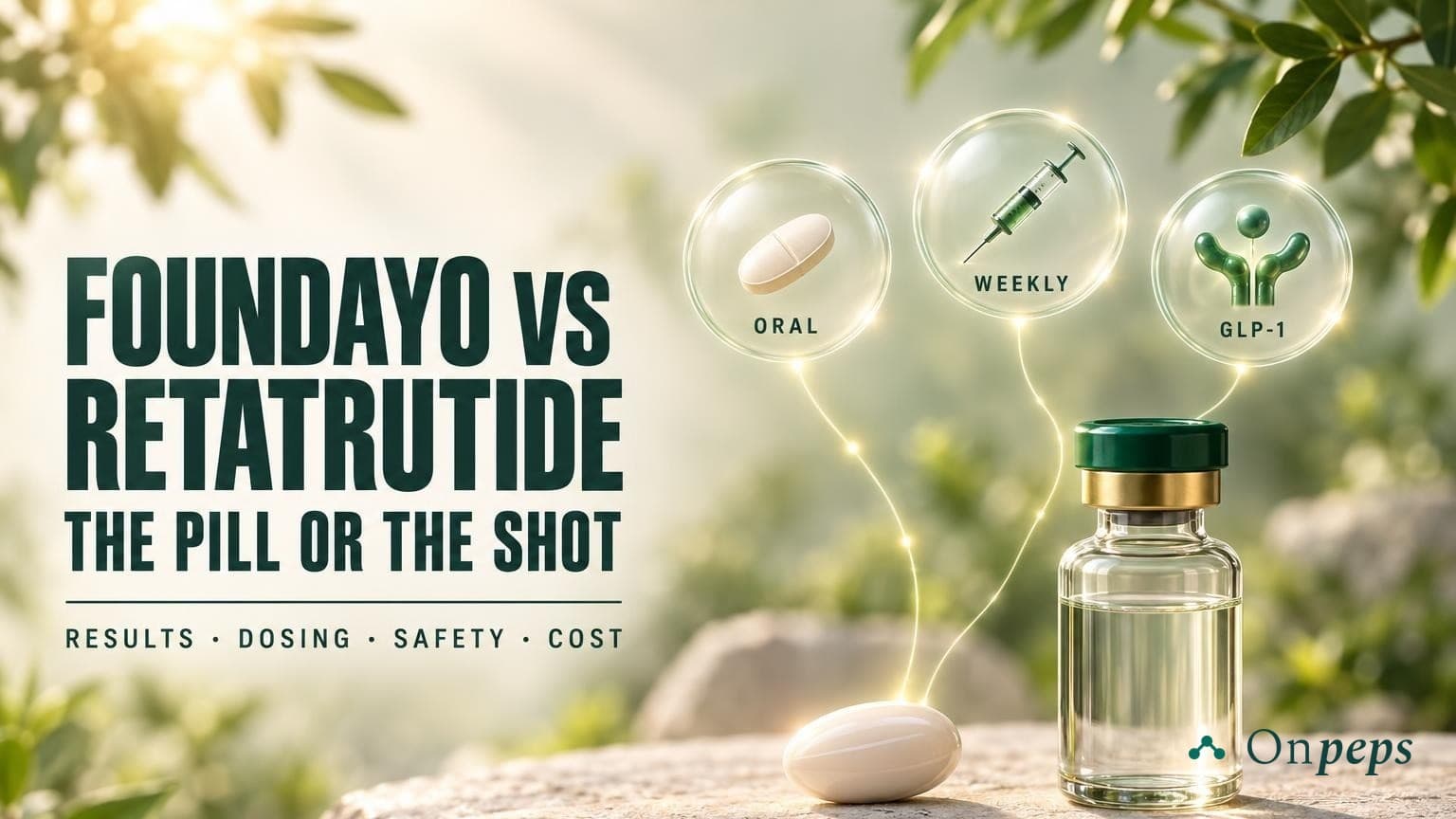
Since spring, search interest in Foundayo has gone from nothing to roughly a third of retatrutide's, and over the past three months it's the only big weight-loss name whose curve is still rising. The searches tell you who's looking: "foundayo vs wegovy", "foundayo cost", "foundayo side effects", and, this autumn, a Martha Stewart TV ad.
A lot of the people typing those words are the same people pricing out a vial of retatrutide. One is a $149 pill you can get with a prescription. The other is the most-hyped injectable in the space, with bigger numbers and no legal way to buy it. So how do they actually compare? Let's dive in.
TLDR
What is Foundayo? The brand name for orforglipron, a once-daily GLP-1 receptor agonist pill from Eli Lilly. It's a small molecule, not a peptide, and that's why it can be swallowed at any time of day with no food or water rules.
Results: 11.2% average weight loss at 72 weeks on the top dose in the main obesity trial, against 2.1% on placebo (12.4% if you count only people who stayed on the drug). Retatrutide's published Phase 2 figure is 24.2% at 48 weeks, and Lilly's unpublished Phase 3 toplines go as high as 28.7%. Nobody has compared the two directly.
Dosage: Foundayo starts at 0.8 mg a day and steps up at least every 30 days through 2.5 and 5.5 mg to a maintenance dose of 9, 14.5, or 17.2 mg. Retatrutide has a trial titration schedule, a set of community protocols, and no approved dose.
Safety: Both cause the usual GLP-1 stomach trouble. Foundayo has a full FDA label, a completed cardiovascular-safety trial, and no liver signal. Retatrutide has a clean-looking trial record and a gray-market record that includes six liver-injury cases in Australia linked to products sold under its name.
Legal Status (October 2026): Foundayo has been FDA-approved since April 1, 2026, and won a positive EU committee opinion on October 15. Retatrutide isn't approved anywhere; Lilly plans to file in early 2027 and is suing people who sell it now.
What Is Foundayo, and Why Is Everyone Searching for It?
Foundayo is orforglipron, a drug that does the same core job as semaglutide (Wegovy) and the GLP-1 half of tirzepatide (Zepbound): it activates the GLP-1 receptor, which slows stomach emptying and turns down appetite. It's taken once a day as a tablet.
What makes it different is chemistry. Every GLP-1 drug before it, including the Wegovy pill, is a peptide. Orforglipron is a non-peptide small molecule, originally discovered by Chugai and developed by Lilly. Peptides get broken down in the gut, so oral semaglutide needs an absorption enhancer and has to be taken on an empty stomach with a sip of water and a 30-minute wait. Orforglipron doesn't. You take it whenever you like.
It's the first GLP-1 weight-loss drug that isn't a peptide. On a peptide site, that's the whole story in one line.
The search spike comes down to four things landing in a row:
- April 1: The FDA approved it for chronic weight management 50 days after filing, under its new Commissioner's National Priority Voucher pilot. The agency called it the first new molecular entity cleared under that program.
- Price: Lilly launched it at $149 a month self-pay for the starting dose through LillyDirect, well under what injectables cost.
- September 30: ACHIEVE-4, the cardiovascular-safety trial, was published in The Lancet (Klein et al., 2026, The Lancet, PMID 42815506).
- This autumn: A national TV campaign called "House Rules" fronted by Martha Stewart, followed by a mini-controversy when viewers noticed the on-screen line saying she doesn't take it. Lilly lists her as a paid partner. The fastest-rising Foundayo search over the past 90 days is the commercial itself.
Then on October 15, the European Medicines Agency's human medicines committee recommended approval in the EU for both obesity and type 2 diabetes. Searches for that jumped too.
How Does Foundayo Work, and How Is That Different from Retatrutide?
Foundayo does one thing: it activates the GLP-1 receptor. Retatrutide does three: GLP-1, GIP, and glucagon.
That gap explains most of the difference in results. GLP-1 activity alone reliably produces weight loss in the low-to-mid teens. Adding GIP (tirzepatide) pushes it to around 20%. Adding the glucagon arm on top, which in animal studies raises energy expenditure rather than just cutting intake, is how retatrutide is aiming for the high 20s (Coskun et al., 2022, Cell Metabolism, PMID 35985340).
The delivery is different too. Retatrutide is a modified peptide with a fatty-acid tail that binds albumin, so one injection lasts a week. Orforglipron is absorbed through the gut like an ordinary pill and is dosed daily. Because it's a small molecule, it's also handled by the liver's CYP3A4 enzymes, so it has drug interactions an injectable peptide doesn't. The label caps the dose at 9 mg if you take a strong CYP3A4 inhibitor.
(For the full retatrutide mechanism, see our retatrutide guide.)
Why does "small molecule" matter for safety?
Because the last two small-molecule GLP-1 pills that got this far both died on the liver. Pfizer dropped lotiglipron in 2023 over raised liver enzymes, then dropped danuglipron in 2025 after a possible case of drug-induced liver injury. That history is why everyone watched orforglipron's liver numbers closely. So far they've held: Lilly has reported no hepatic safety signal in its Phase 3 readouts, and the FDA label carries no liver warning.
Foundayo vs Wegovy Pill vs Zepbound vs Retatrutide
| Drug | How you take it | Receptors | Status (Oct 2026) | Headline weight loss |
|---|---|---|---|---|
| Foundayo (orforglipron) | Pill, daily, any time | GLP-1 | FDA-approved Apr 2026 | 11.2% at 72 weeks (ATTAIN-1) |
| Wegovy pill (oral semaglutide 25 mg) | Pill, daily, empty stomach | GLP-1 | FDA-approved Dec 2025 | 13.6% at 64 weeks (OASIS 4) |
| Zepbound (tirzepatide) | Injection, weekly | GLP-1 + GIP | FDA-approved 2023 | ~21% at 72 weeks (SURMOUNT-1) |
| Retatrutide | Injection, weekly | GLP-1 + GIP + glucagon | Investigational | 24.2% at 48 weeks (Phase 2) |
Here's the caveat that gets dropped in almost every "Foundayo vs" article you'll read: none of these drugs has been tested head-to-head against Foundayo for weight loss. Every number in that table comes from a separate trial with its own population, length, and placebo group. The figures above all use the stricter "treatment-regimen" analysis, which counts everyone who started, including people who quit.
The one direct comparison that exists is in type 2 diabetes. In ACHIEVE-3, orforglipron beat oral semaglutide at the lower 7 and 14 mg diabetes doses on both blood sugar and weight (9.2% vs 5.3% weight loss at 52 weeks). That's real, but it's not a comparison with the 25 mg Wegovy pill.
On published numbers, Foundayo sits slightly below the Wegovy pill and well below the injectables. What it's selling is convenience, price, and a legal prescription, not the biggest result.
What the Evidence Actually Shows
Foundayo has a much deeper evidence base than retatrutide, because it's further along. But the same rule applies to both: a journal paper and a press release aren't the same thing.
Published in peer-reviewed journals
ATTAIN-1, obesity without diabetes (Wharton et al., 2025, NEJM, PMID 40960239). 3,127 adults, 72 weeks, three doses against placebo.
| Dose (trial capsule) | Weight change at 72 weeks |
|---|---|
| Placebo | −2.1% |
| 6 mg | −7.5% |
| 12 mg | −8.4% |
| 36 mg | −11.2% |
On 36 mg, 54.6% lost at least 10% of body weight, 36.0% lost at least 15%, and 18.4% lost at least 20%. Waist size, blood pressure, triglycerides, and non-HDL cholesterol all improved. Between 5.3% and 10.3% quit because of side effects, against 2.7% on placebo.
ATTAIN-2, obesity with type 2 diabetes (Horn et al., 2025, The Lancet, PMID 41275875). 1,613 adults, 72 weeks. Weight fell 9.6% on 36 mg against 2.5% on placebo. People with diabetes lose less on every drug in this class, so the lower number is expected.
ACHIEVE-1, early type 2 diabetes (Rosenstock et al., 2025, NEJM, PMID 40544435). The first Phase 3 readout, showing orforglipron lowered HbA1c and weight against placebo.
ACHIEVE-4, cardiovascular safety (Klein et al., 2026, The Lancet, PMID 42815506). 2,749 adults with type 2 diabetes and heart or kidney disease, followed for a median of two years against insulin glargine. Major cardiovascular events occurred in 4.2% on orforglipron and 5.0% on insulin (hazard ratio 0.84, 95% CI 0.59 to 1.20). That meets the safety bar. It does not show a benefit, because the confidence interval crosses 1. Deaths were 1.4% against 3.2%, but mortality wasn't a controlled endpoint, so don't read that as "it saves lives" either.
Phase 2, obesity (Wharton et al., 2023, NEJM, PMID 37351564). The dose-finding study that set up Phase 3.
Company topline, or announced before the paper
| Trial | What it tested | Reported result | Status |
|---|---|---|---|
| ACHIEVE-3 | vs oral semaglutide 7/14 mg, type 2 diabetes | HbA1c −2.2 vs −1.4 points; weight −9.2% vs −5.3% at 52 weeks | Lilly topline; treat as company data until you've read the paper |
| ATTAIN-MAINTAIN | Switching from Wegovy or Zepbound injections to the pill | Wegovy switchers kept almost all their loss; Zepbound switchers regained more | Topline, Dec 2025 |
ATTAIN-MAINTAIN is the most practically useful trial here, so it's worth being precise. 376 people who had already lost weight on an injectable were moved to orforglipron or placebo for 52 weeks. Over the year, those coming from Wegovy regained about 0.9 kg on average, and those coming from Zepbound about 5.0 kg (Lilly's efficacy analysis). In plain terms: the pill holds a semaglutide-sized result well, and a tirzepatide-sized result less well.
Every trial above was funded by Eli Lilly, and Lilly employees co-authored all of them. That's normal for a drug at this stage, but it's still a limitation.
And retatrutide?
One published Phase 2 obesity trial (24.2% at 48 weeks on 12 mg; Jastreboff et al., 2023, NEJM, PMID 37366315), one published Phase 3 diabetes trial, and four obesity Phase 3 trials known only from Lilly press releases, headlined by 28.3% at 80 weeks in TRIUMPH-1. The numbers are much bigger. The outside scrutiny is much smaller. Our retatrutide guide breaks that down trial by trial.
Dosage: What the Label Says vs What the Community Does
Foundayo has an actual label
This is the biggest practical difference between the two drugs. Foundayo's dose isn't a forum consensus. It's printed in the prescribing information.
| Step | Daily dose | Minimum time before stepping up |
|---|---|---|
| Start | 0.8 mg | 30 days |
| Step 2 | 2.5 mg | 30 days |
| Step 3 | 5.5 mg | 30 days |
| Maintenance | 9 mg, 14.5 mg, or 17.2 mg | Each increase at least 30 days apart, based on response and tolerability |
The 0.8 mg starting dose is getting a lot of searches ("foundayo 0.8 mg tablet" is up 140%). It's a tolerability dose, not a weight-loss dose. It exists to let your gut adjust before the doses that do the work.
If you're comparing the label with the trials, the numbers don't line up, and that confuses people. The trials used capsules at 6, 12, and 36 mg. The approved product is a different tablet formulation, and the ACHIEVE-4 paper states that the 36 mg capsule is equivalent to the 17.2 mg tablet (Klein et al., 2026). So "17.2 mg" on your prescription is the trials' top dose, not half of it.
Two more label rules worth knowing: take one tablet a day, swallowed whole; and if you miss seven or more doses in a row, you restart the titration at a lower dose rather than jumping straight back in.
Retatrutide has a trial schedule and a gray-market practice
In the trials, retatrutide started at 2 mg once weekly and stepped up every four weeks to 4, 9, or 12 mg. Community protocols reportedly start lower, around 0.5 to 1 mg weekly, and many people describe stopping at 4 to 8 mg. No validated retatrutide protocol exists outside a clinical trial. What people do is a description, not a recommendation.
The reconstitution arithmetic is the same as for any lyophilized peptide: concentration equals vial strength divided by the volume of bacteriostatic water you add.
| Vial | BAC water added | Concentration | 2 mg dose on a U-100 syringe |
|---|---|---|---|
| 10 mg | 2 mL | 5 mg/mL | 0.4 mL = 40 units |
| 20 mg | 2 mL | 10 mg/mL | 0.2 mL = 20 units |
| 30 mg | 3 mL | 10 mg/mL | 0.2 mL = 20 units |
Check your own numbers with our reconstitution calculator and dosage calculator, and see the retatrutide dosage chart for the full titration math.
Can you take both, or switch from one to the other?
Taking both means stacking two GLP-1 agonists, and nobody has studied that. Doubling up on the same receptor is a reasonable way to double the nausea without any evidence of extra benefit. There's no protocol for it, validated or otherwise.
Switching is different. ATTAIN-MAINTAIN is the only data on moving from an injection to the pill, and it covers Wegovy and Zepbound, not retatrutide. If someone has lost 25% on a triple agonist, there's no evidence on how much of that a GLP-1-only pill would hold. Given that Zepbound switchers regained more than Wegovy switchers, expecting more regain from a stronger drug is reasonable. It isn't a finding.
Side Effects: What the Trials and the Label Recorded
Foundayo
Stomach first. Nausea, vomiting, diarrhea, and constipation are the common ones, mostly mild to moderate and concentrated in the escalation weeks. In the pooled label data, 8% of people stopped because of side effects (6% on 5.5 mg, 9% on 9 mg, 10% on 17.2 mg) against 3% on placebo. In the two-year ACHIEVE-4 trial, 62.1% reported a gastrointestinal event at some point.
The boxed warning. Like every GLP-1 drug, Foundayo carries a boxed warning for thyroid C-cell tumors based on rodent findings for the class. Human relevance hasn't been established. It's contraindicated if you or a family member have had medullary thyroid carcinoma or MEN 2.
Pancreas and gallbladder. Acute pancreatitis was adjudicated in 6 Foundayo-treated patients across the pooled trials (0.14 per 100 patient-years) against 2 events in one placebo patient. Small numbers, but it's on the label as a warning, along with acute gallbladder disease.
The rest of the label. The other warnings are the standard GLP-1 set: severe GI reactions, kidney injury from dehydration if vomiting or diarrhea is bad enough, hypersensitivity reactions, diabetic retinopathy complications in people with type 2 diabetes, and a risk of inhaling stomach contents under general anesthesia or deep sedation, so tell whoever is sedating you that you take it.
Low blood sugar. Rare on its own. In ACHIEVE-4, clinically significant hypoglycemia occurred in 6.8% on orforglipron against 19.2% on insulin glargine, in people who were also taking other diabetes drugs.
Liver. No signal, which, given the class history above, is the most important negative finding in the whole program.
Retatrutide
The trial record shows the same GI pattern at higher rates (nausea up to 60% in the top-exposure Phase 2 group), plus two things specific to it: a dose-related rise in heart rate and an unusual skin-sensitivity signal in 7% of participants. A recent Medscape analysis of Reddit comments from community users picked up complaints that don't show up much in the trials, like fatigue and insomnia. That's what people wrote, not what was in their vials.
Then there's the gray-market record. On June 19, 2026, Victoria's Chief Health Officer reported six cases of acute liver injury in people who had used unapproved products labelled as retatrutide, with a contaminant suspected rather than the molecule itself.
Foundayo's side effects are a list on a label. Retatrutide's are a list on a label plus whatever was in the vial. Those aren't the same kind of risk.
The Legal Situation
Foundayo is an FDA-approved prescription drug for chronic weight management in adults with obesity, or overweight with at least one weight-related condition. In the US it isn't approved for type 2 diabetes yet. In the EU, the CHMP's October 15 positive opinion covers both obesity and type 2 diabetes. The European Commission makes the final call, usually within a few weeks.
Because Foundayo is approved, commercially available, and not in shortage, there's no legitimate compounded version. Compounding pharmacies can't routinely copy a commercially available approved drug. Orforglipron powder does appear on research-chemical sites labelled "for research use only." That's the same gray market as retatrutide, with the same problems and none of the reasons to bother, since the real thing is a prescription away.
Retatrutide is not approved anywhere. Lilly has said it will file with the FDA in the first quarter of 2027. In August it filed six lawsuits against US businesses selling it, including four online peptide vendors. A separate dispute with the FDA over whether retatrutide should be regulated as a biologic is still unresolved. The FDA has said it can't be used in compounding, and a "research use only" label doesn't protect a seller whose marketing describes human use. Our retatrutide sourcing page covers that in detail.
Neither drug is on the WADA Prohibited List. GLP-1 receptor agonists are on WADA's 2026 Monitoring Program, so tested athletes should expect that to be reviewed.
The Honest Take
Let's get this straight: if the question is "which one causes more weight loss," retatrutide wins on every number anyone has published. It isn't close. A GLP-1-only pill isn't going to match a triple agonist.
But that's not the question most people searching "foundayo vs retatrutide" are actually asking. They're asking whether the extra 10-plus points of weight loss are worth an unapproved drug from an unverified vial, with no label, no pharmacist, and a manufacturer actively suing the seller. That's a personal call, and the honest answer is that the two choices carry different kinds of risk, not just different sizes of result.
Foundayo's strengths are boring and real: a published Phase 3 program in more than 7,000 people, a completed cardiovascular-safety trial, no liver signal in a drug class where liver signals have killed rivals, a defined dose, and a price that starts at $149. Its weaknesses are just as clear: smaller results than the injectables, a GI side-effect rate that pushes about one in ten off the top dose, and regain data suggesting it holds a semaglutide-sized loss better than a tirzepatide-sized one.
Retatrutide may well become the strongest drug in the class. In early 2027 Lilly will file, and eventually there'll be a label. Until then, the trial data describes the molecule. It doesn't describe what's in a gray-market vial.
Foundayo is a moderate drug you can get legally. Retatrutide is a remarkable drug you can't. Most of the decision is in that sentence.
FAQ
What is Foundayo?
Foundayo is Eli Lilly's brand name for orforglipron, a once-daily GLP-1 pill approved by the FDA on April 1, 2026 for chronic weight management in adults with obesity, or overweight plus a weight-related condition.
Is Foundayo a peptide?
No. It's a non-peptide small molecule that activates the GLP-1 receptor. That's why it survives the gut without an absorption enhancer and can be taken with or without food. Every other GLP-1 drug, including the Wegovy pill, is a peptide.
How much does Foundayo cost?
Through LillyDirect self-pay, $149 a month at the 0.8 mg starting dose, rising to about $299 a month at 9 mg and above. Third-party price trackers disagree on the middle doses and on a 45-day refill condition, so confirm with LillyDirect. With commercial insurance that covers it, Lilly's savings card can bring it down to $25. The card excludes Medicare and Medicaid.
Foundayo vs Wegovy pill: which works better?
On published obesity trials, the Wegovy pill's number is slightly higher (13.6% at 64 weeks vs 11.2% at 72 weeks), but they've never been compared head-to-head for weight loss. The Wegovy pill has to be taken on an empty stomach with a 30-minute wait. Foundayo doesn't. In diabetes, orforglipron beat the lower 7 and 14 mg doses of oral semaglutide in ACHIEVE-3.
Foundayo vs retatrutide: which causes more weight loss?
Retatrutide, by a wide margin, on every number published or announced: 24.2% at 48 weeks in Phase 2, against 11.2% at 72 weeks for Foundayo. But Foundayo is approved and retatrutide isn't, and that changes what you're actually getting.
What does the 0.8 mg dose do?
Mostly it gets your stomach used to the drug. It's the first of three 30-day escalation steps before the maintenance doses (9, 14.5, or 17.2 mg) where most of the weight loss happens.
Can I switch from Zepbound or Wegovy to Foundayo?
There's trial data for exactly that. In ATTAIN-MAINTAIN, people switching from Wegovy kept almost all of their weight loss over a year. People switching from Zepbound regained more, about 5 kg on average. The full results haven't been published yet.
Can I take Foundayo and retatrutide together?
There's no study of it, and both hit the GLP-1 receptor, so you'd be stacking the same mechanism twice. Expect more side effects with no evidence of extra benefit.
Is Foundayo approved in Europe?
Not yet. The EMA's CHMP recommended approval on October 15, 2026 for weight management and type 2 diabetes. The European Commission's final decision usually follows within a few weeks.
Does Martha Stewart take Foundayo?
No. Lilly lists her as a paid partner, and the ads carry an on-screen line saying she doesn't take Foundayo.
What are the main Foundayo side effects?
Nausea, vomiting, diarrhea, and constipation, mostly during dose increases. About 8% stopped because of side effects in the label's pooled trials. It carries the class boxed warning for thyroid C-cell tumors and warnings for pancreatitis and gallbladder disease.
Can Foundayo be compounded?
Not legitimately. It's an approved, commercially available drug that isn't in shortage, so compounders can't routinely copy it. "Research use only" orforglipron powder sold online is unapproved product, not Foundayo.
Resources
Wharton et al. (2025), New England Journal of Medicine, ATTAIN-1 Phase 3 obesity trial — https://pubmed.ncbi.nlm.nih.gov/40960239/
Horn et al. (2025), The Lancet, ATTAIN-2 Phase 3 trial in obesity with type 2 diabetes — https://pubmed.ncbi.nlm.nih.gov/41275875/
Rosenstock et al. (2025), New England Journal of Medicine, ACHIEVE-1 Phase 3 trial in early type 2 diabetes — https://pubmed.ncbi.nlm.nih.gov/40544435/
Klein et al. (2026), The Lancet, ACHIEVE-4 cardiovascular safety vs insulin glargine; states 36 mg capsule is equivalent to the 17.2 mg tablet — https://pubmed.ncbi.nlm.nih.gov/42815506/
Wharton et al. (2023), New England Journal of Medicine, orforglipron Phase 2 obesity trial — https://pubmed.ncbi.nlm.nih.gov/37351564/
Wharton et al. (2025), New England Journal of Medicine, OASIS 4 trial of oral semaglutide 25 mg — https://pubmed.ncbi.nlm.nih.gov/40934115/
Jastreboff et al. (2023), New England Journal of Medicine, retatrutide Phase 2 obesity trial — https://pubmed.ncbi.nlm.nih.gov/37366315/
Coskun et al. (2022), Cell Metabolism, retatrutide discovery and glucagon-arm rationale — https://pubmed.ncbi.nlm.nih.gov/35985340/
Eli Lilly (2026), FOUNDAYO prescribing information, dosing, boxed warning, discontinuation and pancreatitis data — https://dailymed.nlm.nih.gov/dailymed/drugInfo.cfm?setid=8ac446c5-feba-474f-a103-23facb9b5c62
FDA (2026), label PDF for FOUNDAYO tablets — https://www.accessdata.fda.gov/drugsatfda_docs/label/2026/220934s003lbl.pdf
FDA (2026), press announcement on the first new molecular entity approved under the National Priority Voucher program — https://www.fda.gov/news-events/press-announcements/fda-approves-first-new-molecular-entity-under-national-priority-voucher-program
Eli Lilly via BioSpace (2026), Foundayo approval announcement, $149 self-pay and $25 savings-card pricing — https://www.biospace.com/press-releases/fda-approves-lillys-foundayo-orforglipron-the-only-glp-1-pill-for-weight-loss-that-can-be-taken-any-time-of-day-without-food-or-water-restrictions
Healio (2026), coverage of the Foundayo approval — https://www.healio.com/news/endocrinology/20260401/fda-approves-orforglipron-an-oral-glp1-for-adults-with-obesity
European Medicines Agency (2026), Foundayo EPAR page and CHMP positive opinion — https://www.ema.europa.eu/en/medicines/human/EPAR/foundayo
pharmaphorum (2026), CHMP backs Foundayo for EU approval — https://pharmaphorum.com/news/chmp-backs-lillys-oral-glp-1-foundayo-eu-approval
Pharmacy Times (2026), ACHIEVE-3 head-to-head results vs oral semaglutide — https://www.pharmacytimes.com/view/orforglipron-outperforms-oral-semaglutide-in-head-to-head-t2d-trial
Pharmaceutical Executive (2025), ATTAIN-MAINTAIN topline results — https://www.pharmexec.com/view/eli-lilly-announces-topline-results-phase-iii-trial-studying-oral-glp-therapy-orforglipron
HCPLive (2026), ACHIEVE-4 results coverage — https://www.hcplive.com/view/achieve-4-orforglipron-non-inferior-to-insulin-glargine-for-cardiovascular-protection-in-t2d
BioSpace (2025), Pfizer drops danuglipron after liver safety concerns — https://www.biospace.com/drug-development/pfizer-drops-lead-obesity-asset-after-liver-safety-concerns-overall-review
Healio (2026), Wegovy pill approval coverage — https://www.healio.com/news/endocrinology/20260213/fda-approves-wegovy-pill-the-first-oral-glp1-to-treat-obesity
nouri (2026), Foundayo and Zepbound LillyDirect self-pay prices by dose — https://joinnouri.com/blog/foundayo-cost
HuffPost (2026), Martha Stewart's Foundayo ad and the "does not take" disclosure — https://www.huffpost.com/entry/martha-stewart-glp-1-ad_l_6aabec41e4b00c07b744fc47
iSpot.tv (2026), Foundayo "Martha's House Rules" TV spot listing — https://www.ispot.tv/ad/SYQK/foundayo-weight-management-marthas-house-rules-medicare-featuring-martha-stewart
Medscape (2026), retatrutide side effects reported by Reddit users — https://www.medscape.com/viewarticle/unexpected-retatrutide-side-effects-reported-reddit-users-2026a10012q5
Victoria Department of Health (2026), health alert on liver toxicity linked to products labelled retatrutide — https://www.health.vic.gov.au/health-alerts/toxicity-linked-to-unapproved-peptide-product-labelled-retatrutide
CNBC (2026), Lilly to file retatrutide for approval in 2027 — https://www.cnbc.com/2026/07/23/eli-lilly-will-file-for-approval-of-retatrutide-obesity-drug-in-2027.html
NPR (2026), Lilly files six lawsuits over black-market retatrutide — https://www.npr.org/2026/08/13/g-s1-138594/eli-lilly-files-6-lawsuits-against-businesses-selling-black-market-obesity-drug
BioSpace (2026), the Lilly–FDA dispute over whether retatrutide is a biologic — https://www.biospace.com/fda/lilly-fda-retatrutide-biologic-dispute-comes-to-a-head-as-submission-nears
WADA (2026), 2026 Monitoring Program — https://www.wada-ama.org/en/resources/2026-monitoring-program