Sermorelin is the growth-hormone peptide your telehealth clinic can actually prescribe. Over the past 90 days Americans searched for it more often than ipamorelin and about 60% as often as tesamorelin, and the interest is not a spike: it has held at the same level for a full year. The searches now breaking out are the ones you would hope for: "sermorelin long-term side effects" and "how does sermorelin work in the body".
Those are good questions, because the sales pitch and the evidence are two different documents. Sermorelin was a real FDA-approved drug for children who were not growing. What it does for a 45-year-old who wants better sleep and less belly fat is a much thinner file. Let's dive in.
TLDR
What is sermorelin? The first 29 amino acids of your own growth-hormone-releasing hormone (GHRH), made synthetically. It tells your pituitary to release its own growth hormone. It was sold as Geref and approved by the FDA in 1990 (as a diagnostic test) and 1997 (to treat children with growth hormone deficiency).
Results: In children with growth hormone deficiency, nightly sermorelin roughly doubled growth speed in the first six months, though less than growth hormone itself. In older adults, small 1990s studies showed it raises GH and IGF-1. Effects on body composition, strength, and wellbeing were small, inconsistent, and mostly seen in men. No trial has tested it for fat loss, sleep, or anti-ageing in healthy adults.
Dosage: The children's label dose was 30 mcg per kg at bedtime. Clinics typically prescribe 200 to 300 mcg at bedtime, often five nights a week. That is far less per kg than any study used. No validated adult protocol exists.
Safety: In the trials, about 1 patient in 6 had injection-site pain, swelling, or redness. Headache, flushing, and dizziness each affected under 1%. Many patients made antibodies to the drug, with no clear consequence. There is no long-term safety data in adults.
Legal Status (October 2026): Prescription-only. No FDA-approved product has been on the market since 2008, but licensed pharmacies can compound it because it was an ingredient in an approved drug that was not pulled for safety. "Research use only" vials are not legal for human use. Prohibited in sport under WADA S2.
What Is Sermorelin, and Why Is It Trending Now?
Your hypothalamus makes a 44-amino-acid hormone called growth-hormone-releasing hormone. Its job is to tell the pituitary gland to release growth hormone (GH). In the early 1980s researchers found that the first 29 amino acids carry the hormone's full activity. Sermorelin is that 29-amino-acid fragment, made in a lab (Prakash and Goa, 1999, BioDrugs, PMID 18031173).
EMD Serono sold it as Geref. The FDA approved a diagnostic version on December 28, 1990, used to test whether a child's pituitary could make GH. A treatment version followed on September 26, 1997, for "idiopathic growth hormone deficiency in children with growth failure" (Federal Register, 4 March 2013, 78 FR 14095).
In 2008 Serono discontinued both products, and the FDA formally withdrew the approvals in June 2009. In 2013, answering a citizen petition, the FDA found that Geref "was not withdrawn from sale for reasons of safety or effectiveness." That one sentence is why sermorelin is still around: it keeps the door open for pharmacies to compound it.
So why the steady search interest now? Three things.
First, it is the legal GHRH. The FDA's compounding committee voted against CJC-1295 in December 2024, and ipamorelin cannot be lawfully compounded either. Clinics that want to sell a "GH peptide" without legal trouble have two choices: tesamorelin, which has a copy rule problem (see our tesamorelin guide), or sermorelin.
Second, the GH-peptide category as a whole is booming. Tesamorelin searches have climbed for a year, and sermorelin's related searches are full of comparisons: "tesamorelin vs sermorelin", "ipamorelin vs sermorelin", "sermorelin vs CJC-1295".
Third, the medical literature is catching up with the market. Two 2026 reviews looked at GH-axis peptides as they are actually used, outside trials, and both reached the same verdict (Dominikowski et al., 2026, Frontiers in Endocrinology, PMID 42395176; Vasylieva et al., 2026, Sexual Medicine Reviews, PMID 42862021). The second one said it plainly: these peptides reliably raise GH and IGF-1, but evidence that this improves sexual function, performance, or quality of life "remains limited."
Sermorelin is legal, old, and well understood in one patient group. The problem is that the patient buying it today is not in that group.
How Does Sermorelin Work?
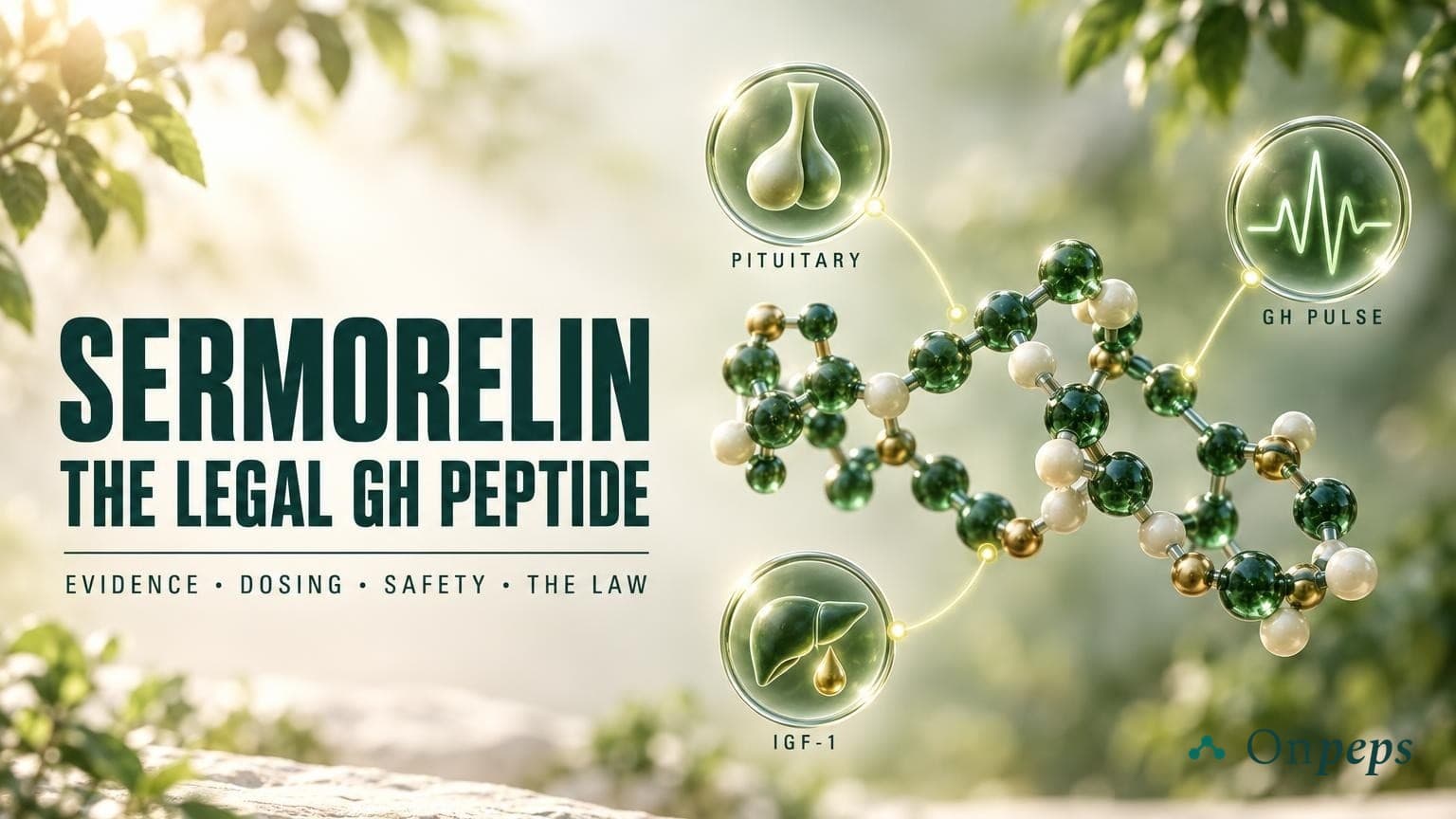
Sermorelin binds the GHRH receptor on cells in your pituitary called somatotrophs. Those cells release a pulse of growth hormone. GH then travels to the liver, which makes IGF-1, the hormone behind most of GH's effects on muscle, bone, and fat.
The difference from injecting growth hormone directly is the feedback loop. With sermorelin your pituitary still does the releasing, and somatostatin, the body's brake on GH, still works. So GH comes in pulses rather than a flat flood, and IGF-1 tends to rise into the normal range rather than past it. That is the theoretical safety argument for GHRH analogues, and it was made explicitly in a 2006 commentary arguing for adult use (Walker, 2006, Clinical Interventions in Aging, PMID 18046908).
Here's the catch that rarely makes the clinic page: sermorelin is extremely short-lived. Its half-life is 11 to 12 minutes, and only about 6% of a subcutaneous dose reaches the bloodstream (Geref prescribing information). One injection produces one GH pulse that lasts roughly two hours (Khorram et al., 1997, JCEM, PMID 9141536). Bedtime dosing is meant to add to the body's own large GH pulse during early sleep.
It also needs a working pituitary. If your pituitary cannot make GH, sermorelin has nothing to release. And glucocorticoids, such as prednisone, blunt the response.
Sermorelin vs Tesamorelin vs CJC-1295 vs Ipamorelin vs Growth Hormone
Clinics and forums treat these as interchangeable "GH peptides". They are not.
| Compound | What it is | Approved? | Adult human evidence | US compounding status (October 2026) |
|---|---|---|---|---|
| Sermorelin | GHRH (1-29), unmodified; half-life about 12 minutes | Was approved (Geref) for children's GH deficiency and diagnosis; discontinued 2008 for commercial reasons | Small 1990s studies in older adults: GH and IGF-1 rise; body composition effects small and inconsistent | Compoundable under 503A as an ingredient in a previously approved drug; Geref is not marketed, so the copy rule does not bite |
| Tesamorelin | Full-length GHRH (1-44) with a stabilising tail | Yes, Egrifta, HIV-associated abdominal fat (2010) | Two Phase 3 RCTs, 806 patients, about 15% visceral fat reduction, all in people with HIV | Eligible as an approved-drug ingredient, but compounded copies of Egrifta are not allowed |
| CJC-1295 | GHRH (1-29) modified to last for days (DAC version) | No, development stopped | Early pharmacology studies only | FDA committee voted against it 0-13 (December 2024); not lawfully compoundable |
| Ipamorelin | Ghrelin-receptor agonist, a different pathway from GHRH | No | No completed efficacy trials in the uses it is sold for | Not on the 503A bulks list; not lawfully compoundable |
| Growth hormone (somatropin) | The hormone itself | Yes, for GH deficiency and other named conditions | Large evidence base in true deficiency | Approved products only; distributing it for anti-ageing or bodybuilding is a federal crime |
Sermorelin vs tesamorelin is the comparison most people search. Tesamorelin is the stronger, longer-lasting molecule, and it is the only one with a large modern randomised trial behind it. Sermorelin is the weaker, shorter-acting one with the easier legal path. Neither has a fat-loss trial in people without HIV. The library entries on tesamorelin, CJC-1295, and ipamorelin cover their records in full.
What the Evidence Actually Shows
Every sermorelin study worth citing is at least 25 years old. That is not a flaw in itself. But it does mean nobody has tested sermorelin with modern methods in the people now using it.
Published, peer-reviewed
| Study | Population | Design | Result | Status |
|---|---|---|---|---|
| Thorner et al., 1996, JCEM (PMID 8772599) | 110 untreated children with GH deficiency (86 analysed) | Open-label, 1 year, 30 mcg/kg nightly | Growth speed rose from 4.1 to 8.0 cm a year at 6 months and 7.2 at 12 months; 74% responded well; no glucose change or excess IGF-1 | Published, the basis of the 1997 approval |
| Ogilvy-Stuart et al., 1997, Clinical Endocrinology (PMID 9231053) | 9 children with GH deficiency after cranial radiation | 1 year GHRH (1-29), then 1 year GH | Growth speed 3.3 to 6.0 cm a year on GHRH; 7.5 cm a year on GH afterwards | Published |
| Corpas et al., 1992, JCEM (PMID 1379256) | 10 healthy men aged about 68, compared with 9 young men | 14 days of 0.5 mg or 1 mg twice daily | At 1 mg twice daily, GH and IGF-1 rose to young-man levels; no body composition measured | Published |
| Vittone et al., 1997, Metabolism (PMID 9005976) | 11 healthy men aged 64 to 76 with low IGF-1 | 6 weeks of 2 mg nightly, no placebo group | Night-time GH rose, IGF-1 did not; 2 of 6 strength tests improved; no change in muscle, fat, weight, or glucose | Published |
| Khorram et al., 1997, JCEM (PMID 9141536) | 19 adults aged 55 to 71 (10 women, 9 men) | Single-blind, 4 weeks placebo then 16 weeks of a close sermorelin analogue at 10 mcg/kg nightly | IGF-1 rose within 2 weeks but drifted back toward baseline by week 16; lean mass, insulin sensitivity, wellbeing, and libido improved in men only; sleep unchanged | Published |
Company topline and unpublished
There is none. No company has run a sermorelin trial in decades, and none is registered for the adult uses clinics sell it for. Everything on a telehealth page about energy, sleep, recovery, or fat loss comes from GH physiology in general, not from sermorelin trials.
What that adds up to
In children who truly lack growth hormone, sermorelin works, but less well than growth hormone itself. The 1999 drug review noted that growth on sermorelin was lower than on daily somatropin at the same dose by weight (Prakash and Goa, 1999).
In older adults, sermorelin reliably raises GH. Whether it raises IGF-1 depends on dose and schedule, and the effect may fade. The Vittone team concluded that "single nightly doses of GHRH are less effective than multiple daily doses" at producing GH and IGF-1 effects. In the Khorram study, IGF-1 was back toward baseline by week 16 even though the injections continued.
The body composition results are the weakest part. Two of the adult studies measured it. One found nothing; the other found a lean mass gain in nine men and none in ten women. Neither found fat loss.
Sermorelin raises growth hormone. That is proven. That raising it fixes the things people buy it for is not.
Dosage: What the Trials Used vs What Clinics Prescribe
Let's be clear about this first: there is no validated sermorelin protocol for adults. The only approved dose was for children, and the drug has not been sold since 2008.
| Source | Dose | Schedule | Approx. dose for a 75 kg adult |
|---|---|---|---|
| Geref children's label / Thorner 1996 | 30 mcg/kg | Once nightly, subcutaneous | 2,250 mcg |
| Corpas 1992 (older men) | 1 mg | Twice daily, 14 days | 2,000 mcg a day |
| Vittone 1997 (older men) | 2 mg | Nightly, 6 weeks | 2,000 mcg |
| Khorram 1997 (sermorelin analogue) | 10 mcg/kg | Nightly, 16 weeks | 750 mcg |
| Typical clinic and forum protocol | 200 to 300 mcg | At bedtime, often 5 nights on, 2 off | 200 to 300 mcg (about 3 to 4 mcg/kg) |
Look at the last row. The dose most clinics prescribe is roughly a tenth of what the children's label and two of the adult studies used, and well under half the lowest dose any study tested. Nobody has studied whether 300 mcg a night does anything measurable to body composition. That does not mean it does nothing. It means you are taking a dose with no trial behind it at all.
Clinics usually check IGF-1 before starting and again after 8 to 12 weeks, and adjust from there. That is the only sensible way to tell whether your dose is doing anything, and it is worth insisting on.
Reconstitution math
Compounded sermorelin usually arrives as a powder. You add bacteriostatic water and draw the dose with a U-100 insulin syringe, where 1 unit is 0.01 mL. If your pharmacy gives you mixing instructions, follow those. The arithmetic for a 300 mcg dose:
| Vial size | Water added | Concentration | 300 mcg dose | Doses per vial |
|---|---|---|---|---|
| 2 mg | 2 mL | 1 mg/mL (1,000 mcg/mL) | 0.30 mL = 30 units | About 6 |
| 5 mg | 2.5 mL | 2 mg/mL | 0.15 mL = 15 units | About 16 |
| 9 mg | 3 mL | 3 mg/mL | 0.10 mL = 10 units | 30 |
| 15 mg | 5 mL | 3 mg/mL | 0.10 mL = 10 units | 50 |
The pharmacy's beyond-use date matters more than the dose count. A 15 mg vial at five doses a week lasts ten weeks, which may be longer than the reconstituted peptide is labelled to stay good. Run your own numbers with the reconstitution calculator and the dosage calculator.
Side Effects
The trial safety record is short and fairly benign. According to the Geref prescribing information, based on 350 patients in clinical trials:
- Injection-site reactions (pain, swelling, redness) in about 1 patient in 6. Three of 350 stopped because of them.
- Headache, flushing, difficulty swallowing, dizziness, hyperactivity, sleepiness, and hives, each in under 1%.
- Antibodies. "A large proportion of patients" developed antibodies to sermorelin at some point. They often disappeared by the next check and did not seem to affect growth or cause reactions.
- Thyroid. Hypothyroidism appeared in 6.5% of trial patients, and untreated hypothyroidism blunts the response. The label advised checking thyroid hormone before and during treatment.
- Lab changes. Phosphorus, alkaline phosphatase, GH, and IGF-1 can rise.
In older adults, the Khorram study reported one side effect, a temporary rise in blood fats that cleared by the end. The Corpas and Vittone studies found no significant adverse effects. But those were 19, 10, and 11 people, for 16 weeks at most.
What about long-term side effects?
This is the question breaking out on Google, and the honest answer is that nobody knows. No study has followed adults on sermorelin for years. The children's trials ran for one to three years.
The theoretical concern is the same as for every GH-raising compound: IGF-1 promotes cell growth, and people with high IGF-1 over long periods have higher rates of some cancers. Geref was never tested for carcinogenicity in long-term animal studies, and its label said so. Tesamorelin, which acts on the same receptor, is contraindicated in active cancer. Sermorelin should be treated the same way, even though its old label did not say so.
Keeping IGF-1 inside the normal range for your age, which is the whole point of a GHRH analogue, is the best protection available. That needs blood tests, not guesswork.
The gray-market record
We could not find a published case report of serious harm attributed specifically to sermorelin. The documented problem is what is sold as sermorelin. In December 2024 the FDA sent a warning letter to Xcel Research LLC, an online "research peptide" seller. The sermorelin page it quoted promised "improved metabolism and the facilitation of weight loss" (FDA warning letter 694608, 10 December 2024). A research vial comes with no prescription, no sterility guarantee, and no proof of what is inside.
The Legal and Regulatory Situation
Sermorelin's legal position is unusual, and better than almost anything else in the peptide aisle.
It is a prescription drug. You need a licensed prescriber. Telehealth prescribing after a consultation and lab work is lawful.
No approved product is on the market. Geref was discontinued in 2008 and its approvals withdrawn effective June 18, 2009, at Serono's request. The FDA's 2013 finding that this was not for safety reasons means a generic could be approved. None is on the market.
Compounding is allowed. Under section 503A, a licensed pharmacy can compound from a bulk substance that is a component of an FDA-approved drug product (FDA, Bulk Drug Substances Used in Compounding Under Section 503A). Sermorelin qualifies through Geref. It is not on the FDA's Category 2 "significant safety risks" list. That is the key difference from CJC-1295 and ipamorelin, which need a place on the 503A bulks list and do not have one.
The copy rule does not bite. Pharmacies cannot routinely compound "essentially a copy" of a commercially available drug. That rule is the problem with compounded tesamorelin, because Egrifta is on sale. The FDA's own guidance says a drug that "has been discontinued and is no longer marketed" does not count as commercially available (FDA guidance, January 2018). Geref has been off the market since 2008, so a compounded sermorelin vial is not copying anything.
The October news changes nothing for sermorelin. The Washington Post reported on 7 October that the administration is preparing a temporary route for restricted peptides through compounding pharmacies (see our explainer on the temporary sale plan). Sermorelin is already compoundable, so it does not need that route.
"Research use only" sermorelin is not legal for people. Selling it with health claims makes it an unapproved new drug, which is exactly what the Xcel letter said.
Sport. WADA bans GHRH and its analogues at all times under S2.2.4, and names sermorelin as an example (WADA 2026 Prohibited List).
The Honest Take
Sermorelin is the most defensible way to buy a GH peptide in the United States. It has a real approval history, a clean safety record in the people it was tested in, a legal compounding route, and a pharmacology that keeps your body's own brakes in place. If you are going to use something in this category, a prescribed, pharmacy-compounded, lab-monitored sermorelin is a long way from a research vial of CJC-1295.
But being legal is not the same as being proven. The benefits clinics sell, better sleep, faster recovery, fat loss, "anti-ageing", have never been tested with sermorelin in healthy adults. The adult studies we do have were tiny, short, and mostly in men over 60, and their body composition results were small and inconsistent. They also used doses between two and a half and ten times higher than the 300 mcg most clinics prescribe.
So here is what that means in practice. If a clinician finds that your IGF-1 is genuinely low and wants to try a GHRH analogue with monitoring, sermorelin is a reasonable, low-risk option to discuss. If you have normal IGF-1 and are buying it for a feeling, you are paying for a drug with no evidence for that feeling, at a dose no one has studied. That is not dangerous, as far as anyone knows. It is just unproven.
The mechanism is real, the safety record is reassuring, and the adult benefit is undemonstrated. All three are true at once.
FAQ
What is sermorelin and what does it do?
Sermorelin is a synthetic copy of the first 29 amino acids of growth-hormone-releasing hormone. It stimulates your pituitary to release its own growth hormone in a short pulse, which then raises IGF-1. It was FDA-approved for children with growth hormone deficiency until 2008.
How does sermorelin work in the body?
It binds the GHRH receptor on pituitary cells, which release a burst of growth hormone lasting about two hours. The liver responds by making IGF-1. Because the pituitary and its feedback brake (somatostatin) stay in charge, GH stays pulsatile rather than constantly high.
Is sermorelin FDA approved?
Not anymore. Geref was approved in 1990 and 1997 and discontinued in 2008 for commercial reasons. The FDA confirmed in 2013 that it was not withdrawn for safety. Today's sermorelin is compounded by pharmacies, which is legal, but compounded drugs are not FDA-approved.
What are the long-term side effects of sermorelin?
They are unknown. No study has followed adults for more than 16 weeks. The theoretical risk is the one shared by all GH-raising drugs: sustained high IGF-1 is linked to some cancers. Regular IGF-1 testing and avoiding use with active cancer are the sensible precautions.
Sermorelin vs tesamorelin: which is better?
Tesamorelin is the more potent, longer-acting molecule and has two large Phase 3 trials, but only in people with HIV. Sermorelin is weaker and shorter-acting, with only small adult studies, but it is easier to compound legally. Neither is proven for fat loss in the general population.
Ipamorelin vs sermorelin: what's the difference?
They work on different receptors. Sermorelin mimics GHRH; ipamorelin mimics ghrelin. Clinics often combine them because the two pathways add together. But ipamorelin is not legally compoundable in the US, and no trial has tested the combination.
What is the usual sermorelin dosage?
Clinics typically prescribe 200 to 300 mcg at bedtime, often five nights a week. The approved children's dose was 30 mcg/kg, and the adult studies used 0.75 to 2 mg a day. No adult dose has been validated.
How long does sermorelin take to work?
GH rises within minutes of each injection, and IGF-1 rose within two weeks in the Khorram study. Clinics usually recheck IGF-1 at 8 to 12 weeks. Any felt effects in healthy adults have not been measured in a controlled trial.
Does sermorelin nasal spray work?
We could not find a published human study of compounded sermorelin nasal spray. Only about 6% of an injected dose reaches the blood, and for peptides in general, absorption through the nose is lower and less predictable than injection. Until a study shows otherwise, treat nasal sermorelin as untested.
Does sermorelin help with weight loss?
There is no trial showing it does. The small adult studies that measured body composition found no fat loss. The FDA cited "facilitation of weight loss" as an unsupported claim in its 2024 warning letter to a research peptide seller.
Is sermorelin safe to take with testosterone?
The combination has not been studied. Many clinics offer sermorelin alongside testosterone replacement, and nothing in the pharmacology suggests a direct interaction. But glucocorticoids do blunt sermorelin's effect, and untreated low thyroid can too, so tell your prescriber about every medication.
Is sermorelin banned in sports?
Yes. WADA prohibits it at all times under S2.2.4, which covers GHRH and its analogues and names sermorelin directly.
Resources
Thorner et al. (1996), Journal of Clinical Endocrinology and Metabolism, Geref International Study Group trial in children — https://pubmed.ncbi.nlm.nih.gov/8772599/
Prakash and Goa (1999), BioDrugs, review of sermorelin in children's GH deficiency — https://pubmed.ncbi.nlm.nih.gov/18031173/
Ogilvy-Stuart et al. (1997), Clinical Endocrinology, GHRH in radiation-induced GH deficiency — https://pubmed.ncbi.nlm.nih.gov/9231053/
Corpas et al. (1992), Journal of Clinical Endocrinology and Metabolism, GHRH (1-29) twice daily in older men — https://pubmed.ncbi.nlm.nih.gov/1379256/
Vittone et al. (1997), Metabolism, single nightly GHRH (1-29) in older men — https://pubmed.ncbi.nlm.nih.gov/9005976/
Khorram et al. (1997), Journal of Clinical Endocrinology and Metabolism, 16 weeks of a GHRH analogue in men and women aged 55 to 71 — https://pubmed.ncbi.nlm.nih.gov/9141536/
Walker (2006), Clinical Interventions in Aging, the case for sermorelin in adult GH insufficiency — https://pubmed.ncbi.nlm.nih.gov/18046908/
Sigalos and Pastuszak (2018), Sexual Medicine Reviews, safety and efficacy of GH secretagogues — https://pubmed.ncbi.nlm.nih.gov/28400207/
Dominikowski et al. (2026), Frontiers in Endocrinology, GH-axis peptides in self-administration — https://pubmed.ncbi.nlm.nih.gov/42395176/
Vasylieva et al. (2026), Sexual Medicine Reviews, peptides in urology and sexual medicine — https://pubmed.ncbi.nlm.nih.gov/42862021/
FDA (2013), Federal Register 78 FR 14095, determination that Geref was not withdrawn for safety or effectiveness — https://www.govinfo.gov/content/pkg/FR-2013-03-04/pdf/2013-04827.pdf
Sermorelin acetate (Geref) prescribing information, FDA revision 2001, as reproduced by RxList — https://www.rxlist.com/sermorelin-acetate-drug.htm
FDA (2024), warning letter 694608 to Xcel Research LLC — https://www.fda.gov/inspections-compliance-enforcement-and-criminal-investigations/warning-letters/xcel-research-llc-694608-12102024
FDA, Bulk Drug Substances Used in Compounding Under Section 503A — https://www.fda.gov/drugs/human-drug-compounding/bulk-drug-substances-used-compounding-under-section-503a-fdc-act
FDA, Certain Bulk Drug Substances for Use in Compounding that May Present Significant Safety Risks (Category 2) — https://www.fda.gov/drugs/human-drug-compounding/certain-bulk-drug-substances-use-compounding-may-present-significant-safety-risks
FDA (2018), guidance on compounded drugs that are essentially copies of a commercially available drug under section 503A — https://www.fda.gov/media/98973/download
WADA, Prohibited List — https://www.wada-ama.org/en/prohibited-list