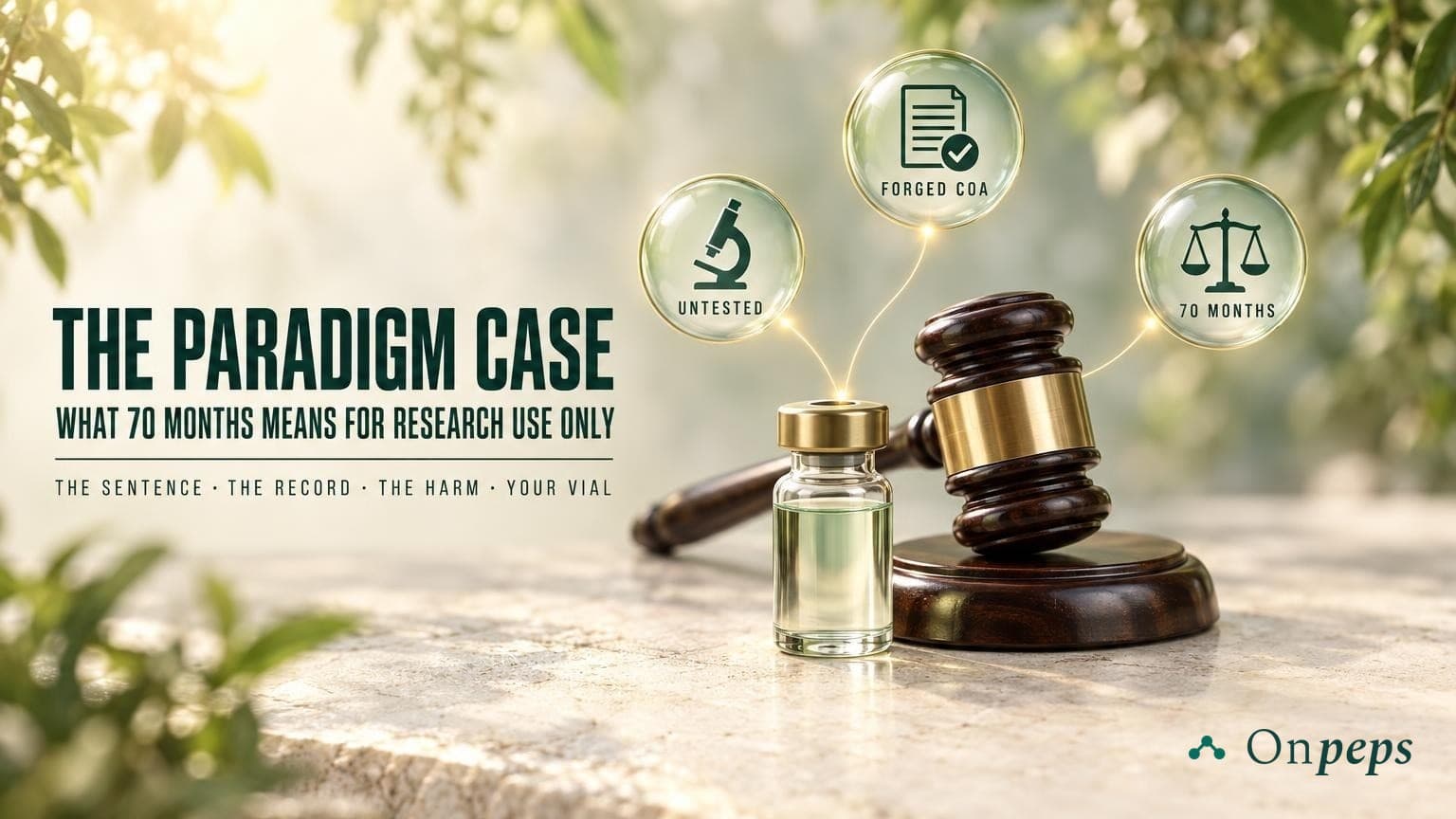
On 30 July 2026 a federal judge in South Bend, Indiana, sent the owner of Paradigm Peptides to prison for 70 months. Two days later, searches for the company hit their highest point of the year, and "daniel murphy paradigm peptides case" became the fastest-rising query attached to the word "peptides" in the United States.
Here's the caveat that gets dropped from most of the coverage. The contamination proven in this case was in SARM pills, not in peptide vials. And the things that put two people in prison (forged lab certificates, a fake "made in the USA" claim, a research-use-only label that the owner admitted was fiction) are not exotic. They are the same trust signals you are asked to rely on every time you buy from a vendor you cannot inspect. So what did the court record establish, what is still unknown, and what should it change about how you buy? Let's dive in.
TLDR
What happened? Matthew Kawa, 48, owner of Paradigm Peptides, was sentenced to 70 months in federal prison. His sister and main employee, Jennifer Stechkober, 32, got 16 months. Both pleaded guilty in December 2025.
What did they sell? Peptides, SARMs, and hCG, to more than 54,000 customers in all 50 states and more than 80 countries between 2019 and 2024, for about $5 million.
What was in the products? Many of the SARMs were testosterone, not the compound on the label. Nothing was tested before sale. No public test results exist for the peptide vials.
The harm: Customers reported chronic acne, suppressed natural testosterone, cardiac problems, and psychological effects up to suicidal ideation. One customer, Daniel Murphy, was diagnosed with steroid-induced psychosis.
Legal Status (September 2026): Selling unapproved drugs for human use is a federal crime whatever the label says. The July 2026 FDA committee vote did not change that, and the FDA sent five more warning letters to research-use-only sellers on 24 August 2026.
What Happened, and Why Is It Trending Now?
Let's get this straight. This is not a story about a regulator sending a stern letter. It is a criminal case that ended in prison time, which is rare in this market.
Kawa ran Paradigm Peptides (legally Paradigm R.E. LLC) through paradigmpeptides.com and shipped from Michigan City, Indiana. The conduct in the case runs from April 2019 to March 2024, when the business was shut down (U.S. Attorney's Office, Northern District of Indiana, 2026).
He pleaded guilty to introducing unapproved new drugs into interstate commerce with intent to defraud and mislead, and to illegally importing merchandise. Stechkober pleaded guilty to the first charge. Judge Cristal C. Brisco sentenced them on 30 July 2026, and told Kawa he had left "an incredible trail of harm" (CBS News, 2026).
On top of the prison terms, the court entered a $5 million money judgment against Kawa and ordered $78,317.52 in restitution, owed jointly by both defendants.
The search spike has a second cause: timing. The sentencing landed one week after the FDA's advisory committee voted to recommend six peptides for pharmacy compounding, the subject of our July 2026 FDA update. BPC-157, one of those six, was among the unapproved drugs Kawa was charged with selling (CBS News, 2026).
The same month Washington moved toward opening one door for peptides, a federal court slammed another one shut.
What Paradigm Claimed vs What the Record Shows
Before it went offline, Paradigm looked like a lot of vendor sites look today. Here is each claim next to what the defendants admitted or prosecutors established.
| What customers were told | What the record shows |
|---|---|
| Manufactured in the company's own US laboratories | Imported from Asia, including China and India |
| Tested to ensure the highest quality, 99% purity | No product was tested before sale |
| Backed by laboratory certificates of analysis | Certificates were forged |
| Licensed and registered with the FDA | False. The FDA had sent warning letters instead |
| SARMs sold as labelled, as dietary supplements | Many were testosterone, a controlled substance |
| For research use only | Kawa admitted he knew the products were sold for human consumption |
Read that last row twice. In his plea, Kawa stated: "I knew that Paradigm's products were being marketed and sold for human consumption" (CBS News, 2026). The disclaimer was on every label, and it counted for nothing.
What the Evidence Actually Shows
A lot of claims are circulating about this case. Some come from the court record, some from reporting, and some from vendors using the case to sell their own products. Those are not equal.
| Finding | Source | Status |
|---|---|---|
| Guilty pleas, 70 and 16 month sentences, $5 million judgment, $78,317.52 restitution | Department of Justice | Established |
| More than 54,000 customers, 50 states, more than 80 countries | Department of Justice | Established (prosecutors' estimate) |
| Many SARMs were actually testosterone | Department of Justice | Established |
| All six SARM products the government tested contained testosterone | CBS News, citing prosecutors | Reported from court filings |
| Certificates of analysis were forged | CBS News and BBC, citing the pleas | Reported from court filings |
| FDA seized SARM products for testing by September 2023 | BBC | Reported |
| 167 victims came forward for restitution | BBC | Reported |
| FDA warning letters in 2020 and 2022 | Department of Justice | Established; only the 2020 letter is in the FDA's public database |
| Paradigm's peptide vials were contaminated or underdosed | None found | Not established |
That last row matters. The peptides were charged as unapproved new drugs, and they were sold with the same forged paperwork and the same absence of testing. But no public document we could find reports what was in the vials.
Untested is not the same as contaminated. It means nobody knows, and that includes the person who sold it.
A note on the warning letters. The public 2020 letter, dated 7 December 2020 and co-signed by the Federal Trade Commission, was about thymosin alpha-1 marketed with COVID-19 claims (FDA, 2020). We could not locate the 2022 letter in the FDA's database, so we are relying on the Department of Justice for its existence.
The Harm Record
The Department of Justice lists what customers reported: skin irritation and chronic acne, drops in natural testosterone that required replacement therapy, cardiac health issues, and stress, anxiety, and psychological problems up to suicidal ideation.
The case has a name attached because of Daniel Murphy, a 32-year-old marketing consultant from Tennessee. He began taking Paradigm's SARMs in January 2023, believing they were a tested dietary supplement (BBC, 2026).
Over the following months he developed insomnia, severe cystic acne, grandiose thinking, and then paranoia. He came to believe his wife was plotting against his business and that his mother-in-law meant to kill him. He had no history of mental illness.
He ran out of product in December 2024 and began to improve. In February 2025 a letter from the Department of Justice told him that Paradigm's SARMs contained testosterone. He had a leftover bottle tested by an independent lab, and it came back positive (CBS News, 2026).
A psychiatrist, Dr Erik Messamore, diagnosed steroid-induced psychosis and gave evidence in the proceedings. Murphy is also suing Paradigm in a civil case, which Kawa is contesting. That suit has not been decided.
Here is the part worth sitting with. By the BBC's account the FDA had seized and tested Paradigm's SARMs by September 2023. Murphy kept taking them for more than a year after that, and nobody told him.
For context, the FDA warns that even genuine SARMs carry risks including heart attack, stroke, liver injury, and psychosis (FDA, 2023). Murphy was exposed to a different drug entirely, at a dose nobody measured.
Why "Research Use Only" Did Not Protect Anyone
The law looks at intended use, not at the label. If the marketing, the dosing guidance, and the customer emails all point at human use, the product is a drug, and an unapproved one.
The FDA made the same point in writing a month after the sentencing. On 24 August 2026 it sent warning letters to five online sellers: NuScience Peptides, Royal Peptides, Peptide Partners, Peak Performance Peptides, and Tex Peptides (McDermott Will and Schulte, 2026).
Every one of them used a research-use disclaimer. The FDA set it aside, pointing to therapeutic marketing language, a peptide dose calculator on the seller's site, and bacteriostatic water sold alongside injectable peptides (FDA, 2026).
State regulators are moving the same way. Ohio's pharmacy board declared research-labelled drugs unlawful for clinics and medical spas in December 2025, and Alabama's medical board barred physicians from dispensing research-grade peptides in June 2026 (McDermott Will and Schulte, 2026).
The disclaimer protects the seller right up until someone checks. It never protected the buyer at all.
What a Certificate of Analysis Can and Cannot Tell You
Paradigm's customers did what careful buyers are told to do. They looked for purity claims and lab certificates. The certificates were fake.
So treat a certificate as a claim to be checked, not as proof. Here is what checking looks like.
Verify it with the lab, not the vendor. A certificate names a laboratory and a report number. Contact the lab or use its lookup page. A PDF on a vendor's site proves nothing on its own.
Match the batch. The lot number on the certificate should match the lot number on your vial. A certificate for a different batch tells you about a different batch.
Look at what was tested. Purity and identity are two tests. Sterility and endotoxin are two more. Most vendor certificates cover only the first two.
Be suspicious of identical numbers. The same 99% figure on every product is a marketing line, not a measurement.
Check what other buyers found. Independent testing paid for by customers is harder to forge than a vendor's own paperwork. Our vendor directory carries community ratings and discussion for that reason.
None of this makes an unapproved product safe. It narrows one risk, which is that the vial is not what the label says. We covered the contaminants that turn up in research-grade peptides in our TB-500 safety piece.
One more thing. Paradigm's site is gone, but CBS News found a similarly named site, on a different domain, selling research peptides with near-identical label design. That company says it has no affiliation with Kawa or the original business. A familiar name is not a track record.
The Legal and Regulatory Situation
| Date | Event |
|---|---|
| April 2019 | Start of the conduct covered by the case |
| 7 December 2020 | FDA and FTC warning letter to Paradigm R.E. LLC |
| 2022 | Second FDA warning letter, per the Department of Justice |
| September 2023 | FDA has seized SARM products for testing, per the BBC |
| March 2024 | Paradigm Peptides shut down |
| February 2025 | Department of Justice letters reach customers |
| 10 December 2025 | Both defendants plead guilty |
| 23 to 24 July 2026 | FDA advisory committee recommends six peptides for compounding |
| 30 July 2026 | Sentencing: 70 months and 16 months |
| 24 August 2026 | FDA warning letters to five more research-use-only sellers |
Two things are happening at once, and they do not contradict each other. The committee vote is about letting licensed pharmacies compound certain peptides on a prescription. It is advisory, and the FDA has not acted on it.
The prosecution and the warning letters are about websites selling unapproved drugs directly to the public. Nothing in the vote touches that. If anything, a legal pharmacy route makes the gray market an easier target.
The Honest Take
It is tempting to file this under "one bad vendor." The record does not support that comfort. Paradigm ran for five years, served 54,000 people, and survived two warning letters. Its customers could not tell it apart from an honest seller, because the signals they were given were the ones a dishonest seller can fake.
It is equally wrong to read it as proof that every vial on the market is poison. The proven adulteration was in SARM pills. What the case proves about peptides is narrower and, in a way, worse: nobody checked, and nobody could have known.
The restitution figure tells its own story. $78,317.52, against $5 million in proceeds. If something goes wrong with a gray-market product, the realistic compensation is close to nothing.
The risk in this market was never only the molecule. It is the distance between what the label says and what anyone has verified.
FAQ
What is the Daniel Murphy Paradigm Peptides case?
It is the federal prosecution of Paradigm Peptides' owner and his sister for selling unapproved, mislabelled drugs. Daniel Murphy is a customer who developed steroid-induced psychosis after taking SARMs that contained testosterone, and who testified about it.
Who was sentenced, and for how long?
Matthew Kawa received 70 months in prison and Jennifer Stechkober received 16 months, each followed by one year of supervised release. They were sentenced on 30 July 2026 in the Northern District of Indiana.
Is Paradigm Peptides still in business?
No. The original business was shut down in March 2024. Sites using a similar name are separate operations, and one has told CBS News it has no connection to the original.
Were Paradigm's peptides contaminated?
That has not been established publicly. The proven adulteration was testosterone in SARM products. The peptides were sold untested and with forged certificates, so their contents are unknown.
What are SARMs, and are they peptides?
No. Selective androgen receptor modulators are small-molecule drugs that act on the same receptor as testosterone. They are usually taken by mouth. Paradigm sold both categories from the same site.
I was a Paradigm customer. What can I do?
The U.S. Attorney's Office has a case page for people who bought between April 2019 and March 2024, with a contact number for its victim witness specialist: United States v. Matthew Kawa. If you have health concerns, tell your doctor exactly what you took and when.
Does "research use only" make a peptide legal to sell?
No. Regulators and courts look at how a product is marketed and used. In this case and in the August 2026 warning letters, the disclaimer was disregarded.
Is it illegal to buy research peptides?
Every action described in this article was taken against sellers, not buyers. That is an observation and not legal advice. Laws differ by state and by compound, and testosterone is a controlled substance.
Did the FDA vote in July 2026 make peptides legal?
No. The committee recommended that six peptides be allowed in pharmacy compounding. The vote is advisory, the FDA has not issued a decision, and it has no bearing on online research-use sales.
How can I tell if a certificate of analysis is real?
Confirm the report directly with the laboratory named on it, and check that the batch number matches your vial. A certificate you cannot verify with the lab should be treated as unverified.
Resources
U.S. Attorney's Office, Northern District of Indiana (2026), Illinois man and Indiana woman sentenced to 70 months and 16 months, press release of 30 July 2026 — https://www.justice.gov/usao-ndin/pr/illinois-man-and-indiana-woman-sentenced-respectively-70-months-and-16-months-prison
U.S. Attorney's Office, Northern District of Indiana (2026), United States v. Matthew Kawa, case and victim information page — https://www.justice.gov/usao-ndin/united-states-v-matthew-kawa
Gilbert, Yamaguchi and Geller (2026), CBS News, Judge sentences peptide vendor to nearly 6 years in prison — https://www.cbsnews.com/news/peptides-seller-prison-sentence-unapproved-drugs/
Clegg (2026), BBC News, syndicated by AOL, He bought a fitness supplement online to bulk up — https://www.aol.com/articles/bought-fitness-supplement-online-bulk-234208000.html
FDA and FTC (2020), Warning letter to Paradigm R.E. LLC, 7 December 2020 — https://www.fda.gov/inspections-compliance-enforcement-and-criminal-investigations/warning-letters/paradigm-re-llc-612014-12072020
FDA (2026), Warning letter to NuScience Peptides LLC, 24 August 2026 — https://www.fda.gov/inspections-compliance-enforcement-and-criminal-investigations/warning-letters/nuscience-peptides-llc-733652-08242026
FDA (2023), FDA warns of use of selective androgen receptor modulators (SARMs) among teens, young adults — https://www.fda.gov/consumers/consumer-updates/fda-warns-use-selective-androgen-receptor-modulators-sarms-among-teens-young-adults
McDermott Will and Schulte (2026), Federal regulators and state boards crack down on RUO peptides — https://www.mcdermottlaw.com/insights/federal-regulators-and-state-boards-crack-down-on-ruo-peptides/
Partnership for Safe Medicines (2026), Peptide vendor sentenced to six years, 3 August 2026 — https://www.safemedicines.org/2026/08/august-3-2026.html
FDA (2026), Meeting of the Pharmacy Compounding Advisory Committee, 23 to 24 July 2026 — https://www.fda.gov/advisory-committees/advisory-committee-calendar/july-23-24-2026-meeting-pharmacy-compounding-advisory-committee-07232026
ONPEPS, FDA peptide update July 2026 — https://www.onpeps.com/blog/fda-peptide-update-july-2026
ONPEPS, Vendor directory and community ratings — https://www.onpeps.com/vendors