Searches for GLOW peptide have doubled in the past year, and the questions climbing fastest are the practical ones: "what does glow peptide do," "how much glow peptide to inject per day," and "glow vs klow." That is the search pattern of people who have a 70 mg vial in the fridge and no instructions.
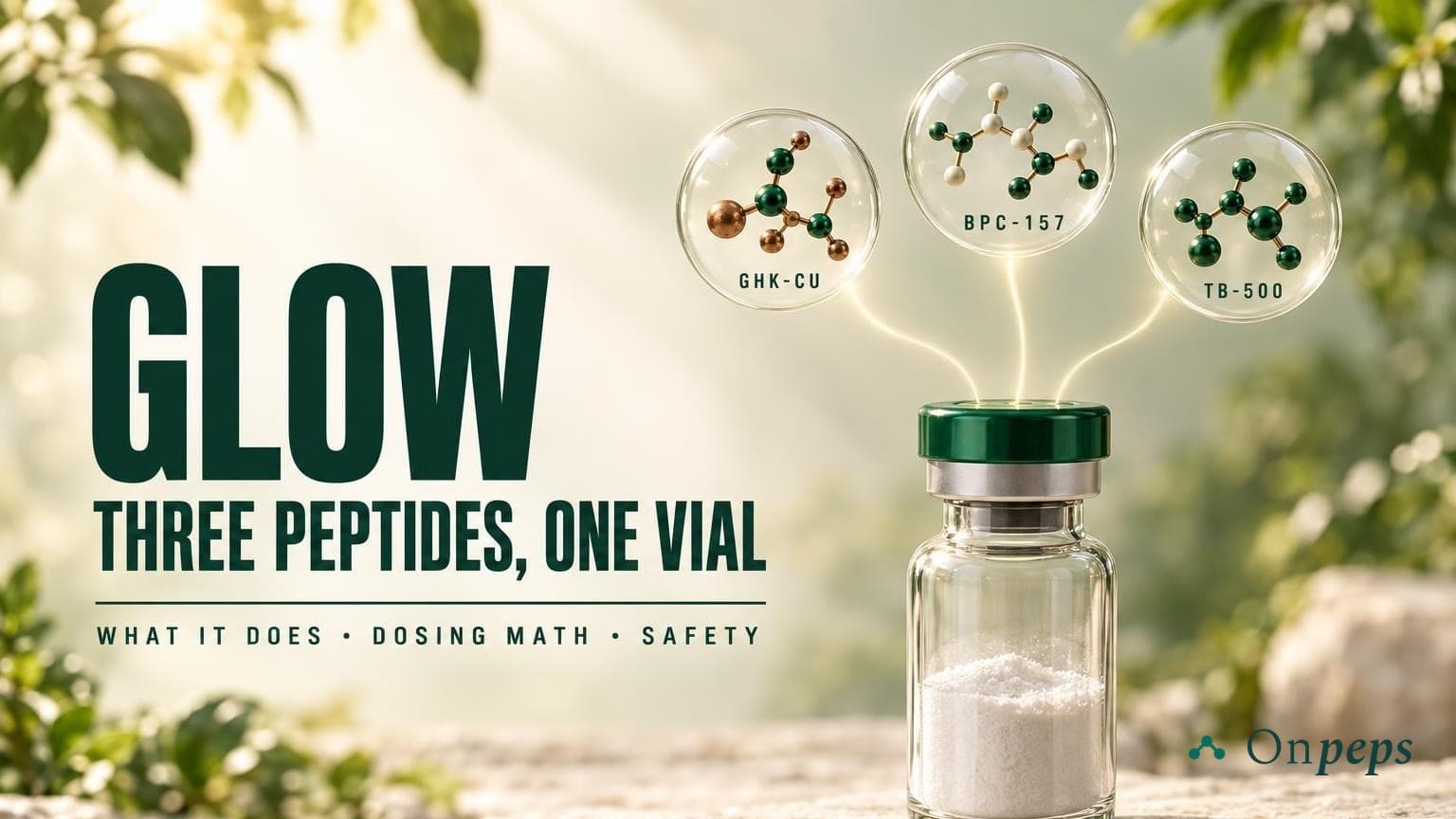
GLOW is not a peptide. It is a vendor name for three peptides in one vial: GHK-Cu, BPC-157, and TB-500. Each has its own evidence record, the blend has none, and a second, unrelated product also sold as "GLOW" makes the name even less useful. So what is actually in the vial, what has each part been shown to do, and what does the arithmetic look like when the ratio is fixed for you? Let's dive in.
TLDR
What is GLOW? A research-vendor blend, most commonly 50 mg GHK-Cu + 10 mg BPC-157 + 10 mg TB-500 in a 70 mg vial ("GLOW 70"). By weight it is 71% copper peptide. KLOW is the same blend plus 10 mg of KPV. A different med-spa product called GLOW contains GHK-Cu, glutathione, and vitamin C instead.
Results: No study of the blend exists. GHK-Cu has three controlled human trials, all topical and mixed. BPC-157's human safety record is two people. TB-500 borrows its reputation from the full-length parent protein. The only study that combined two of the three, a 2026 rat tendon study, found the combination did no better than TB-500 alone.
Dosage: No validated protocol. At a 4 mL reconstitution, every 10 units delivers 1.25 mg GHK-Cu and 250 mcg each of BPC-157 and TB-500. Dosing to the BPC-157 sets your copper and TB-500 doses whether you like them or not.
Safety: Roughly 8 mg of elemental copper per vial, injected past the gut's regulation, with no human study of what that does. TB-500 is contraindicated in active or suspected cancer. Three pro-angiogenic signals in one syringe, untested together.
Legal Status (September 2026): Nothing in the vial is approved. BPC-157 and TB-500 sit on the FDA's Category 2 list; a July 2026 advisory committee recommended both for compounding against FDA staff advice, and nothing has changed since. The nomination for injectable GHK-Cu was withdrawn in April 2026, so the form in GLOW is not under review at all. BPC-157 and TB-500 are WADA-prohibited.
What Is GLOW, Exactly?
Let's get this straight first. GLOW has no inventor, no paper, and no molecule. It is a label that research-use-only vendors put on a lyophilized mix of three separately made peptides, and it stuck because it is easier to type than "GHK-Cu BPC-157 TB-500 blend."
| Component | What it is | Typical amount per vial | Share of the vial by weight |
|---|---|---|---|
| GHK-Cu | Copper-binding tripeptide found in human plasma | 50 mg | 71% |
| BPC-157 | 15-amino-acid fragment of a gastric protein | 10 mg | 14% |
| TB-500 | 7-amino-acid fragment of thymosin beta-4 | 10 mg | 14% |
The 50/10/10 split is the most common listing, which is why you see it sold as "GLOW 70." It is not a standard. Some sellers offer smaller vials at different ratios under the same name. Check the milligrams printed on the vial you actually have, because every dosing number below depends on them.
By weight, GLOW is a copper peptide vial with two repair peptides added. Nearly three-quarters of what you inject is GHK-Cu.
The other GLOW
Here's the complication that gets dropped. Compounding pharmacies and med spas sell an injectable or topical "GLOW" that contains GHK-Cu, reduced glutathione, and ascorbic acid, marketed for skin brightening and pigmentation. It shares one ingredient and a name with the research-vendor blend and nothing else. If someone tells you GLOW "is legal to compound," they are usually talking about that product, because none of its three ingredients is on the FDA's negative list. The BPC-157 and TB-500 version is a different legal animal, as we'll get to.
Why it is trending now
Three things are pushing the searches. The KLOW blend went viral over the summer and pulled its three-peptide sibling along with it. The July 2026 FDA advisory vote on BPC-157 and TB-500 put both names in mainstream news for the first time. And the tri-blend is cheaper per vial than buying three peptides separately, which is the whole commercial point of it.
How Does GLOW Work?
It doesn't have a mechanism. It has three, from three compounds that were never designed to be used together.
GHK-Cu. A tripeptide that binds copper and delivers it into cells. The 1980 founding paper in Nature described its effects in culture as ranging from growth stimulation "to outright toxicity" depending on concentration (Pickart et al., 1980, Nature, PMID 7453802). A 1982 study found that three chemically unrelated copper carriers all induced new blood-vessel growth, but only when bound to copper (Raju et al., 1982, JNCI, PMID 6182332). Whether the peptide or the copper is doing the work is still unsettled, which matters when you are injecting 50 mg of it.
BPC-157. A 2025 systematic review of 36 studies tallied its proposed pathways: it raises VEGF expression, activates the ERK and AKT signalling cascades, increases growth hormone receptor expression in tendon fibroblasts, and increases nitric oxide production (Vasireddi et al., 2025, HSS Journal, PMID 40756949). Every one of those was measured in rodents or cells.
TB-500. The seven-amino-acid actin-binding region of thymosin beta-4. A 2024 study found it is rapidly broken down into a smaller metabolite, Ac-LKKTE, which retained activity in the experimental models, and stated that the biological effects of TB-500 itself have not been documented (Rahaman et al., 2024, Journal of Chromatography B, PMID 38382158). Full-length thymosin beta-4 promotes cell migration and angiogenesis; the fragment is assumed to do the same.
Put the three together and you get the vendor story: copper for collagen, BPC-157 for tendons, TB-500 for cell migration. It sounds like a mechanism. It is three claims placed side by side, and the one thing they genuinely share is that all three push new blood-vessel growth.
GLOW vs KLOW vs the Wolverine Stack
| Name | Contents | Typical vial | Ratio adjustable? | What's different |
|---|---|---|---|---|
| Wolverine stack | BPC-157 + TB-500 | Two vials, 10 mg + 10 mg | Yes | The original recovery pairing; you set each dose |
| GLOW | GHK-Cu + BPC-157 + TB-500 | 70 mg (50/10/10) | No | Wolverine stack with 50 mg of copper peptide on top |
| KLOW | GHK-Cu + BPC-157 + TB-500 + KPV | 80 mg (50/10/10/10) | No | GLOW plus a tripeptide never tested in a human |
| GHK-Cu alone | GHK-Cu | 50 mg | Yes | The copper without the prohibited peptides |
| Med-spa "GLOW" | GHK-Cu + glutathione + vitamin C | Varies by pharmacy | No | Different product, same name, skin-brightening claims |
The honest comparison is that GLOW is the Wolverine stack with copper on top, and the two peptides people actually feel, BPC-157 and TB-500, are the same two they would get from the stack in a ratio they control. We laid out how those two differ in our TB-500 vs BPC-157 article, and the four-peptide version in the KLOW guide.
What the Evidence Actually Shows
The blend's reputation is borrowed from three evidence records that look nothing like each other.
Published
| Study | What was tested | Result | Status |
|---|---|---|---|
| Bishop et al., 1992, J Vasc Surg (PMID 1495150) | Topical GHK-Cu cream vs placebo, 86 patients with venous leg ulcers | No difference from placebo | Published RCT |
| Miller et al., 2006, Arch Facial Plast Surg (PMID 16847171) | Topical GHK-Cu after laser resurfacing, 13 patients | No objective improvement; higher patient-reported satisfaction | Published RCT |
| 2016 topical serum trial, 40 women | GHK-Cu in a nanocarrier serum vs control serum | Reduced wrinkle depth and volume | Published RCT (see the GHK-Cu library entry) |
| Mokhtar et al., 2026, Aesthet Surg J (PMID 42619529) | Systematic review of GHK-Cu in aesthetic medicine | Mixed; restricted to topical and aesthetic use | Published review |
| Lee and Burgess, 2025, Altern Ther Health Med (PMID 40131143) | Intravenous BPC-157, two healthy adults | No adverse effects at 10 and 20 mg | Published pilot, no controls |
| Biçer et al., 2026, Jt Dis Relat Surg (PMID 42542926) | BPC-157, TB-500, and both together after Achilles transection, 32 rats | TB-500 alone significantly improved load to failure and histology; BPC-157 alone did not reach significance; the combination did not outperform TB-500 alone | Published animal study |
| Rahaman et al., 2024, J Chromatogr B (PMID 38382158) | TB-500 metabolism in vitro and in rats | Rapid breakdown to Ac-LKKTE; effects of the parent "not documented" | Published analytical study |
| Mayfield et al., 2026, Am J Sports Med (PMID 41476424) | Primer on injectable peptides for sports physicians | For BPC-157, "indications, dosing, frequency, and duration of treatment remain unknown" | Published review |
| Mendias et al., 2026, Sports Med (PMID 41966639) | Safety and efficacy of approved and unapproved peptides for musculoskeletal injury | Human data for unapproved peptides described as scarce | Published review |
Read that Biçer study twice, because it is the closest anyone has come to testing GLOW. Two of the three components, at a 1-to-6 BPC-157-to-TB-500 ratio rather than GLOW's 1-to-1, injected into the abdomen of rats, and the combination group was significant on one histology score and nothing else. It is not evidence for the blend. It is the only evidence that touches it.
Registered, no results
| Trial | What it tests | Status |
|---|---|---|
| NCT07437586 | Topical GHK-Cu gel vs vehicle in standardised punch-biopsy wounds, 60 participants | Recruiting; primary completion scheduled February 14, 2027 |
| NCT07487363 | TB-500 for cardiovascular biomarkers in stable atherosclerotic disease | Recruiting since February 5, 2026; primary completion scheduled February 14, 2027 |
Neither is testing a blend, and the first human TB-500 trial in history is measuring heart biomarkers, not tendons.
Unpublished
Everything about the blend itself. No pharmacokinetic study, no interaction study, no dose-finding, no safety series, no registered trial. Vendor pages that describe "synergy" are describing an idea.
| Component | Best human evidence | Injected in humans, controlled? | ONPEPS grade |
|---|---|---|---|
| GHK-Cu | Three topical RCTs, mixed results | No | C |
| BPC-157 | Two-person IV safety pilot | No | C |
| TB-500 | Borrowed from full-length thymosin beta-4 | No | D |
| GLOW blend | None | No | — |
Three thin evidence records in one vial do not add up to one strong one. They add up to three thin records plus an unknown: what the three do to each other.
GLOW Dosage: How Much to Inject Per Day
Here's the part behind the fastest-rising search. There is no validated dose and no trial has ever given the blend to anyone. What exists is arithmetic, and it is worth doing carefully because the fixed ratio makes it unusual.
What the trials used
Nothing, for the blend. For the parts: the rat tendon study used 10 mcg/kg per day of BPC-157 and 60 mcg/kg per day of TB-500, intraperitoneally, for four weeks (Biçer et al., 2026). The two-person BPC-157 pilot used 10 and 20 mg intravenously, once (Lee and Burgess, 2025). Every human GHK-Cu trial was a cream. None of that translates to a subcutaneous blend dose.
The reconstitution math
Start with the vial. At 50/10/10 mg, the concentration of each component depends on how much bacteriostatic water you add.
| BAC water added | Per 10 units (0.1 mL) | Per 20 units (0.2 mL) | Doses of 20 units in the vial |
|---|---|---|---|
| 2 mL | 2.5 mg GHK-Cu · 500 mcg BPC-157 · 500 mcg TB-500 | 5 mg GHK-Cu · 1 mg each of the others | 10 |
| 4 mL | 1.25 mg GHK-Cu · 250 mcg BPC-157 · 250 mcg TB-500 | 2.5 mg GHK-Cu · 500 mcg each of the others | 20 |
| 5 mL | 1 mg GHK-Cu · 200 mcg BPC-157 · 200 mcg TB-500 | 2 mg GHK-Cu · 400 mcg each of the others | 25 |
Now the problem. Say you dose the way the BPC-157 community does, at 250 mcg twice a day. At 4 mL that is 10 units, twice daily. Fine. But look at what rides along.
Your TB-500 becomes 500 mcg a day, which is 3.5 mg a week, delivered daily instead of in the twice-weekly 2 to 2.5 mg shots that TB-500 protocols use. Your GHK-Cu becomes 2.5 mg a day, injected, of a compound whose only human trials were creams. That is about 0.4 mg of elemental copper a day going in under the skin.
Or dose it the other way. Decide that 1 mg of injected GHK-Cu a day is all the copper you want, and at 4 mL you are drawing 8 units. Your BPC-157 drops to 200 mcg a day, below what most protocols use, and the "healing" part of the vial is now the minority of your dose.
Whatever number you pick, you are choosing a dose for one peptide and accepting whatever that implies for the other two. That is the fixed-ratio problem, and no chart fixes it.
Run your own numbers in the reconstitution calculator and the dosage calculator, entering each component separately. Treat the vial as a multi-dose sterile vial: discard 28 days after first puncture, new needle for every draw. At 4 mL and 10 units a day, a 70 mg vial would last 40 days, so the discard date arrives before the powder runs out.
What the community reports
Reported protocols cluster around 10 to 20 units daily at a 4 mL reconstitution, subcutaneous near the injury or in the abdomen, for four to eight weeks, then a break. Some split it morning and evening because of BPC-157's short half-life. Almost nobody adjusts for the fact that neither the TB-500 nor the GHK-Cu needs daily dosing.
Reported effects are what you would expect from a BPC-157 and TB-500 combination: less joint and tendon pain from week three onward, and skin or hair changes that people attribute to the copper. None of it is controlled, and a blend makes it impossible to say which component did what. That is a description of what people are doing, not a recommendation.
Side Effects and Safety
The copper load
GHK-Cu is about 16% copper by weight, so a 50 mg vial carries roughly 8 mg of elemental copper. Spread over four weeks that is modest next to the 10 mg per day oral upper limit for adults. But injected copper bypasses the gut, which is where the body regulates how much copper it absorbs, and no human study has measured what weeks of subcutaneous copper peptide do to copper status. A 2016 cell study found GHK-Cu produced fewer toxicity markers in skin cells than copper salts at the same copper concentration (Li et al., 2016, Scientific Reports, PMID 27892491), which says something about the chelate and nothing about a month of injections. Unknown, not reassuring.
TB-500 and angiogenesis
TB-500 promotes new blood-vessel growth, which is the mechanism behind its benefits and exactly why it is not appropriate for anyone with active or suspected cancer. Thymosin beta-4 expression is elevated in several cancer types in preclinical models (Xing et al., 2021, Frontiers in Endocrinology, PMC8724243), though which way the causation runs is unclear. Full discussion in our TB-500 side effects article. In a blend you can't leave it out.
BPC-157
Injection-site reactions, occasional nausea, headache, and dizziness at higher doses are what the community reports. Nothing from controlled human data, because there isn't any beyond two people.
The interaction nobody has tested
GHK-Cu, with its copper, is angiogenic. TB-500 is angiogenic. BPC-157 raises VEGF and nitric oxide. Three pro-angiogenic signals in one syringe is a plausible reason the blend "works" for tendons, and an equally plausible reason for caution in anyone with a tumour history. Both can be true. Neither has been measured. The one animal study that combined two of the three found no advantage over TB-500 alone, which is at least a hint that "synergy" is not a given.
Product quality
A single-peptide vial can be identity-tested against one expected mass. A three-peptide vial needs three identities confirmed and three quantities measured, and a certificate of analysis reporting "99% purity" for the blend tells you almost nothing about whether the ratio on the label is the ratio in the powder.
This is not a theoretical concern in 2026. On July 30, the founder of Paradigm Peptides was sentenced to 70 months in federal prison after admitting he forged certificates of analysis and sold products that were not what the label said (U.S. Department of Justice, Northern District of Indiana). On June 17, the FDA issued a warning letter to a vendor called Wholesale Peptide for selling injectable peptides as unapproved drugs, ruling that "research use only" on the label did not matter once the product page described what the peptide does in the body. Ask what was tested, by which lab, for which batch. If the answer is one purity number, that is not a test of a blend. Community-verified vendor experiences are collected on our vendor boards.
Who should not use it
Anyone with active or suspected cancer, because of TB-500. Anyone pregnant or breastfeeding, because no safety data exist for any component. Anyone with Wilson's disease or another copper-handling disorder, because of the GHK-Cu load. Tested athletes, because two of the three components are prohibited.
Legal Status (September 2026)
None of the three components is approved for human use anywhere. Here is where each one stands.
BPC-157 and TB-500. Both were placed on the FDA's list of bulk substances that "may present significant safety risks" (Category 2) in 2023, which means no US pharmacy may compound them. On July 23, 2026, the FDA's Pharmacy Compounding Advisory Committee reviewed BPC-157 (for ulcerative colitis) and TB-500 (for wound healing) and recommended both for the 503A bulks list by 8 votes to 6, against the recommendation of the FDA's own scientists, who found the human evidence insufficient for every substance reviewed. The votes are advisory, nothing has been added to the list, and no pharmacy has a lawful basis to compound either today. Our July 2026 FDA update has the full record.
GHK-Cu. This is the part that gets misreported. GHK-Cu was nominated for the bulks list, and the FDA's nominations document records that the nominations were withdrawn on April 22, 2026, then partially reinstated on May 5 when one nominator clarified it wished to withdraw only the injectable route. The result is that GHK-Cu "except for injectable routes of administration" sits in Category 1, under evaluation, with an advisory committee review expected before the end of February 2027. Injectable GHK-Cu, which is the only form that exists in GLOW, is not before the committee at all. Our GHK-Cu library entry tracks the docket.
For athletes. BPC-157 and TB-500 are on the 2026 WADA Prohibited List, BPC-157 under S0 as a non-approved substance and TB-500 under S2 by name. GHK-Cu is not named. A blend that contains prohibited substances is a prohibited blend.
Selling it. The June 2026 Wholesale Peptide warning letter and the Paradigm sentencing are the two most recent reminders that the agency and the courts read the vendor's marketing, not the disclaimer.
The Honest Take
GLOW is a convenient way to buy three research peptides at once, and the two that people actually feel, BPC-157 and TB-500, are the same two they would feel from the Wolverine stack. The copper adds a skin-and-collagen story with topical-only evidence and an injected copper load nobody has studied. And the name adds confusion, because a different GLOW with different ingredients is being compounded in clinics under a different legal status.
The blend's real cost isn't the price. It's that it takes the one thing you could control, the dose of each peptide, and locks it to a ratio a vendor chose. Nearly three-quarters of every injection is copper peptide, whether you wanted it at that dose or not.
If you're going to use these compounds, the case for buying them separately is stronger than the case for buying them mixed. If you already have the vial, do the arithmetic for each component before you draw the first dose, and know that the number you land on is a choice, not a protocol.
FAQ
What is GLOW peptide?
A vendor-named blend of three peptides: GHK-Cu, BPC-157, and TB-500, most commonly 50/10/10 mg in a 70 mg vial. It is not a single compound and has no study of its own.
What does GLOW peptide do?
Nobody has measured what the blend does. Its components have separately been shown to promote blood-vessel growth and tissue repair in animals and cells. Community reports describe less tendon and joint pain and skin changes, none of it controlled.
What is in GLOW peptide?
50 mg GHK-Cu, 10 mg BPC-157, and 10 mg TB-500 in the common research-vendor version. A separate compounded product also called GLOW contains GHK-Cu, glutathione, and vitamin C. Check the label.
What is GLOW 70?
The 70 mg vial: 50 + 10 + 10 mg. The number is the total peptide mass, not a dose.
What is the difference between GLOW and KLOW?
KPV. KLOW adds 10 mg of KPV to the same three peptides, for an 80 mg vial. KPV has never been given to a human in any study. Everything else is identical.
How much GLOW peptide should you inject per day?
There is no validated dose. Reported community protocols are 10 to 20 units daily at a 4 mL reconstitution, for four to eight weeks. Because the ratio is fixed, that sets all three doses at once: 20 units at 4 mL is 2.5 mg GHK-Cu and 500 mcg each of BPC-157 and TB-500.
How do you reconstitute a 70 mg GLOW vial?
Commonly with 4 mL of bacteriostatic water, which gives 1.25 mg GHK-Cu and 250 mcg each of BPC-157 and TB-500 per 10 units. Use the reconstitution calculator for your own vial and refrigerate after mixing.
What are the benefits of GLOW peptide?
The claimed benefits are tendon and injury recovery, gut support, and skin and collagen improvement. Each is borrowed from one component's animal or topical data. No benefit has been demonstrated for the blend.
Does GLOW peptide have side effects?
Injection-site reactions are the most reported. The real concerns are theoretical: an injected copper load with no human data, an untested three-way interaction, and TB-500's angiogenic mechanism in anyone with a tumour history.
Is GLOW peptide legal or FDA approved?
Not approved. BPC-157 and TB-500 are on the FDA's Category 2 list and cannot be lawfully compounded; the July 2026 advisory vote did not change that. Injectable GHK-Cu's nomination was withdrawn in April 2026. The blend is sold as a research chemical.
Is GLOW banned by WADA?
In practice, yes. BPC-157 and TB-500 are on the 2026 Prohibited List, so any blend containing them is prohibited for tested athletes.
Resources
Pickart et al. (1980), Nature, the GHK founding paper — https://pubmed.ncbi.nlm.nih.gov/7453802/
Raju et al. (1982), JNCI, copper carriers and angiogenesis — https://pubmed.ncbi.nlm.nih.gov/6182332/
Bishop et al. (1992), Journal of Vascular Surgery, GHK-Cu venous ulcer RCT — https://pubmed.ncbi.nlm.nih.gov/1495150/
Miller et al. (2006), Archives of Facial Plastic Surgery, GHK-Cu after laser resurfacing — https://pubmed.ncbi.nlm.nih.gov/16847171/
Li et al. (2016), Scientific Reports, skin toxicity biomarkers of copper compounds — https://pubmed.ncbi.nlm.nih.gov/27892491/
Mokhtar et al. (2026), Aesthetic Surgery Journal, GHK-Cu systematic review — https://pubmed.ncbi.nlm.nih.gov/42619529/
Vasireddi et al. (2025), HSS Journal, BPC-157 systematic review — https://pubmed.ncbi.nlm.nih.gov/40756949/
Lee and Burgess (2025), Alternative Therapies in Health and Medicine, BPC-157 IV pilot — https://pubmed.ncbi.nlm.nih.gov/40131143/
Biçer et al. (2026), Joint Diseases and Related Surgery, BPC-157 and TB-500 in rat Achilles healing — https://pubmed.ncbi.nlm.nih.gov/42542926/
Rahaman et al. (2024), Journal of Chromatography B, TB-500 metabolites — https://pubmed.ncbi.nlm.nih.gov/38382158/
Xing et al. (2021), Frontiers in Endocrinology, thymosin beta-4 in cancer — https://pmc.ncbi.nlm.nih.gov/articles/PMC8724243/
Mayfield et al. (2026), American Journal of Sports Medicine, injectable peptide primer — https://pubmed.ncbi.nlm.nih.gov/41476424/
Mendias et al. (2026), Sports Medicine, approved and unapproved peptides for musculoskeletal injury — https://pubmed.ncbi.nlm.nih.gov/41966639/
ClinicalTrials.gov, NCT07437586, topical GHK-Cu gel for acute wound healing — https://clinicaltrials.gov/study/NCT07437586
ClinicalTrials.gov, NCT07487363, TB-500 for cardiovascular biomarkers — https://clinicaltrials.gov/study/NCT07487363
FDA, Pharmacy Compounding Advisory Committee meeting, July 23–24, 2026 — https://www.fda.gov/advisory-committees/advisory-committee-calendar/july-23-24-2026-meeting-pharmacy-compounding-advisory-committee-07232026
FDA, bulk drug substances that may present significant safety risks (Category 2) — https://www.fda.gov/drugs/human-drug-compounding/certain-bulk-drug-substances-use-compounding-may-present-significant-safety-risks
FDA, bulk drug substances nominated under section 503A, updated May 14, 2026 (GHK-Cu withdrawal record) — https://www.fda.gov/media/94155/download
FDA, warning letter to Wholesale Peptide, June 17, 2026 — https://www.fda.gov/inspections-compliance-enforcement-and-criminal-investigations/warning-letters/wholesale-peptide-729447-06172026
U.S. Department of Justice, Northern District of Indiana, Paradigm Peptides sentencing, July 30, 2026 — https://www.justice.gov/usao-ndin/pr/illinois-man-and-indiana-woman-sentenced-respectively-70-months-and-16-months-prison
WADA 2026 Prohibited List — https://www.wada-ama.org/en/resources/2026-prohibited-list