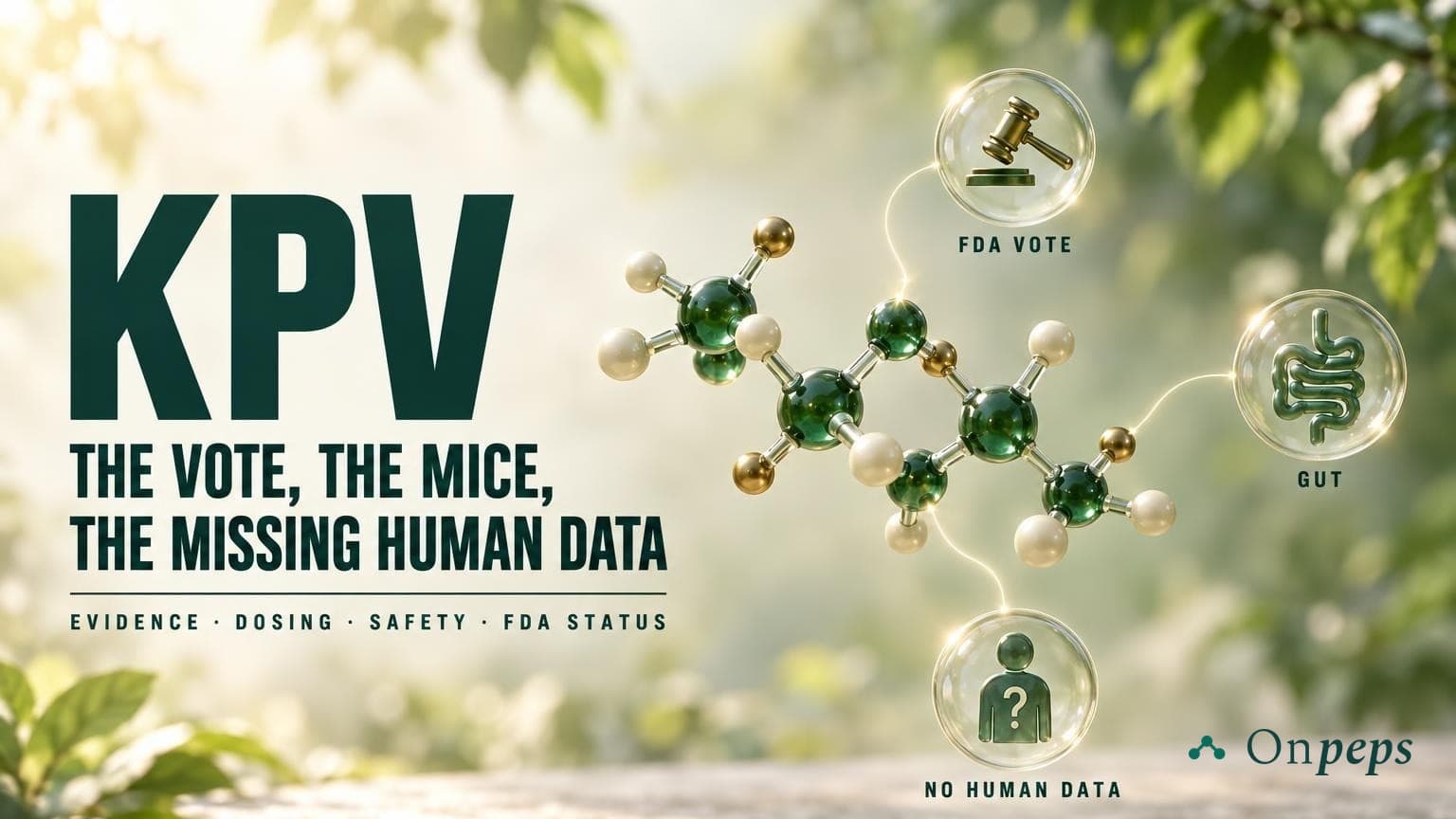
Searches for KPV have nearly tripled in a year, and the fastest-rising question attached to it is "what is kpv peptide used for." The spike came in the week of 23 July 2026, when an FDA advisory committee voted, against the agency's own scientists, to recommend KPV for pharmacy compounding. Since then it has been sold as a gut peptide, a skin peptide, an anti-inflammatory you inject, swallow, or spray, and one quarter of a four-peptide blend called KLOW.
Here is the caveat that gets dropped from almost every one of those listings. KPV has never been given to a human being in a published study, by any route, for any condition. The FDA looked and said so in writing. So what is it, what did the mice actually show, what did the committee actually vote on, and what does that leave you with if a vial is already in your fridge? Let's dive in.
TLDR
What is KPV? The three-amino-acid tail of alpha-melanocyte-stimulating hormone (lysine-proline-valine, residues 11 to 13). It keeps the parent hormone's anti-inflammatory activity and loses the tanning, appetite, and sexual effects, because it does not act through melanocortin receptors.
Results: A consistent anti-inflammatory signal in cells and in mouse models of colitis and skin inflammation, going back to 1994. Human evidence: none. Zero trials, zero case series, zero registered studies.
Dosage: No validated protocol exists. Mice got it in drinking water or by injection. The community reports 250 to 1,000 mcg subcutaneously once or twice daily, or 500 mcg oral capsules; none of that traces to a study.
Safety: Nothing is known from humans. The FDA found no adverse-event reports, no toxicology, no pharmacokinetics. The plausible expectation is low toxicity for three natural amino acids; the measurement of that expectation has never been done.
Legal Status (September 2026): Not approved anywhere. On 23 July 2026 the FDA's Pharmacy Compounding Advisory Committee voted 8 to 6, with one abstention, to recommend KPV for the 503A bulks list as a 0.1 percent topical cream. The vote is advisory, the FDA has not acted, and injectable or oral KPV was never on the table.
What Is KPV, and Why Is Everyone Suddenly Searching for It?
Let's get this straight first. KPV is not a designer drug and not a fragment of a healing protein like BPC-157 or TB-500. It is the last three residues of alpha-melanocyte-stimulating hormone (alpha-MSH), the same 13-amino-acid hormone that darkens skin, suppresses appetite, and gave the peptide world Melanotan II and PT-141.
In the 1990s researchers noticed that alpha-MSH calmed inflammation as well as tanning skin, and that the two jobs lived in different parts of the molecule. The anti-inflammatory activity sat in the C-terminal tripeptide, Lys-Pro-Val. The pigment activity did not (Macaluso et al., 1994, J Neurosci, PMID 8158274; Luger and Brzoska, 2007, Ann Rheum Dis, PMID 17934097). That separation is the whole idea behind KPV: keep the quiet part, drop the loud part.
The reason it is trending is not a study. It is a vote. On 23 and 24 July 2026 the FDA's Pharmacy Compounding Advisory Committee (PCAC) met to consider seven peptides for the list of substances that compounding pharmacies may use. FDA staff recommended against all seven. The committee recommended six of them anyway, KPV included, and the search curve for "peptides" hit its 90-day high the next day (ONPEPS, FDA peptide update July 2026; Medscape).
Two smaller things kept the curve up afterwards. KPV is one of the four peptides in KLOW, whose own searches grew fivefold this year, and in January a Science Advances paper built an oral KPV prodrug that releases only in inflamed tissue, which vendor copy has been quoting ever since (Cheng et al., 2026, Sci Adv, PMID 41533788).
KPV is trending because a committee voted for it, not because anyone tested it. Those are two different kinds of news.
How Does KPV Work?
The honest answer is that nobody knows the target. The FDA's July 2026 evaluation puts it flatly: KPV "does not appear to interact with the melanocortin receptors" and its "molecular targets are unknown" (FDA briefing document, PCAC, July 2026). Getting and colleagues showed in 2003 that neither blocking nor deleting the MC2, MC3, and MC4 receptors removed KPV's anti-inflammatory effect (Getting et al., 2003, J Pharmacol Exp Ther, PMID 12750433), and mice with a non-functional MC1 receptor still responded to it in colitis (Kannengiesser et al., 2008, Inflamm Bowel Dis, PMID 18092346). Whatever it binds, it is not the receptor its parent hormone uses.
What is characterised is the route in and the pathway down. In the gut, KPV is carried into cells by PepT1, a transporter for small peptides that normally lives in the small intestine and gets switched on in the colon during inflammatory bowel disease. Once inside, nanomolar concentrations of KPV blocked activation of NF-kappaB and the MAP kinase pathway, and cut the release of inflammatory cytokines in human intestinal cells and T cells (Dalmasso et al., 2008, Gastroenterology, PMID 18061177).
That PepT1 detail matters more than it sounds. It means KPV is drawn preferentially into the tissue that is inflamed, because that is where the transporter is expressed. It also means that in a healthy colon, with little PepT1, there is less reason to expect KPV to do much of anything. A decade of nanoparticle and hydrogel work has been built on exploiting that route to get KPV to an inflamed colon by mouth (Xiao et al., 2017, Mol Ther, PMID 28143741; Zhao et al., 2022, Acta Biomater, PMID 35245681).
In skin, the picture is thinner. KPV and its parent reduce inflammatory signalling in keratinocytes and immune cells, and the melanocortin peptides have been proposed for wound healing on that basis, but the 2019 review that lays out the case describes itself as offering the arguments "pro and contra," which is what authors write when the case is not yet made (Böhm and Luger, 2019, Exp Dermatol, PMID 30661264). Separately, alpha-MSH and KPV kill Staphylococcus aureus and Candida in a dish (Cutuli et al., 2000, J Leukoc Biol, PMID 10670585), which is where the "antimicrobial" claim in vendor copy comes from.
The mechanism is real down to the pathway. The receptor is unknown, and every step of it was mapped in cells and mice.
KPV vs BPC-157 vs TB-500 vs KdPT
KPV is usually sold next to BPC-157 as a "gut stack," and it has a sister molecule, KdPT, that most listings never mention. Here is how they line up.
| Compound | What it is | Strongest evidence | Human data | Regulatory position (Sept 2026) |
|---|---|---|---|---|
| KPV | 3-residue tail of alpha-MSH | Mouse colitis, mouse skin inflammation | None, by any route | PCAC recommended (topical), FDA has not acted |
| BPC-157 | 15-residue fragment of a gastric protein | Rodent tendon, gut and vascular models | Two people in published reports | PCAC recommended (ulcerative colitis), FDA has not acted; WADA-prohibited |
| TB-500 | 7-residue fragment of thymosin beta-4 | Borrowed from full-length thymosin beta-4 trials | None for the fragment itself | PCAC recommended (wound healing), FDA has not acted; WADA-prohibited |
| KdPT | Lys-D-Pro-Thr, a tripeptide derived from interleukin-1beta | Phase IIa RCT in mild-to-moderate ulcerative colitis | Randomized, double-blind, placebo-controlled | Investigational; not marketed |
KdPT is the interesting row. It is a different tripeptide from a different parent, developed by a German company, and it is the only member of this family to reach a proper human trial: oral KdPT added to standard therapy produced higher remission rates than placebo at weeks 2 and 4 in ulcerative colitis, with a high placebo response muddying the primary endpoint and an excellent safety record (Kucharzik et al., 2017, Inflamm Bowel Dis, PMID 28092306). Its results do not transfer to KPV. But it shows what the path from mouse colitis to a human readout looks like, and that KPV has not walked it.
What the Evidence Actually Shows
There is no company behind KPV, so there is no topline to compare against the papers. The split that matters is between what has been published and what is claimed in product copy with no study behind it.
Published
| Finding | Model | Source | Status |
|---|---|---|---|
| KPV injected intraperitoneally reduced IL-1-induced ear inflammation; effect persisted with the spinal cord cut, so the action is peripheral | Mice | Macaluso et al., 1994, PMID 8158274 | Peer-reviewed, animal |
| Nanomolar KPV blocked NF-kappaB and MAPK signalling; oral KPV in drinking water reduced DSS- and TNBS-induced colitis | Human cell lines; mice | Dalmasso et al., 2008, PMID 18061177 | Peer-reviewed, cell and animal |
| KPV produced earlier recovery, less weight loss and less colonic inflammation in DSS colitis and in transfer colitis; effect persisted in mice lacking a working MC1 receptor | Mice | Kannengiesser et al., 2008, PMID 18092346 | Peer-reviewed, animal |
| KPV, delivered through PepT1, prevented colitis-associated tumour formation in wild-type mice and did nothing in mice without PepT1 | Mice | Viennois et al., 2016, PMID 27458604 | Peer-reviewed, animal |
| KPV in hyaluronic-acid nanoparticles, taken orally, eased ulcerative colitis at a far lower dose than free KPV | Mice | Xiao et al., 2017, PMID 28143741 | Peer-reviewed, animal, formulation study |
| KPV does not permeate intact human skin; iontophoresis or microneedling gets it through | Human cadaver skin, in vitro | Pawar et al., 2017, PMID 28343991 | Peer-reviewed, ex vivo |
| An oral KPV prodrug that releases in inflamed tissue reached 3.8 times the colon concentration of free KPV and worked at a 20-fold lower dose; it also accumulated in inflamed lungs | Mice | Cheng et al., 2026, Sci Adv, PMID 41533788 | Peer-reviewed, animal, formulation study |
| KPV at 100 micrograms per mL reduced fat accumulation in liver cells exposed to oleic acid, via reduced ROS and PPAR-gamma signalling | HepG2 cells | Lee et al., 2026, Cytotechnology, PMID 42064835 | Peer-reviewed, cell culture only |
Claimed, with no study
| Claim | Where it appears | Evidence | Status |
|---|---|---|---|
| Heals leaky gut, treats IBD or IBS in people | Vendor and clinic pages | Mouse colitis only | No human data |
| Speeds wound healing, clears psoriasis or eczema | The PCAC nomination; clinic pages | Mouse skin inflammation; cell work | No human data; the nominator submitted none |
| Protects against nerve damage or stroke | Vendor pages catalogued by the FDA | None found for KPV | No data |
| Works as an injectable, oral capsule or nasal spray | Most of the market | Mice drank it or were injected; plain oral KPV is digested unless formulated to survive | No human pharmacokinetics by any route |
The FDA's own literature search, run for the July meeting, is the cleanest summary of the human record: the agency "did not identify data, such as clinical studies, on the use of KPV in humans," and on safety "has not identified any clinical studies or human exposure data for KPV via any route of administration." The nomination cited nine references, and "none were studies of KPV administered in humans" (FDA briefing document). No trial is registered on ClinicalTrials.gov.
The mouse colitis signal is consistent across three labs and eighteen years. The human signal is a blank page, and the FDA checked.
KPV Dosage: What the Studies Used vs What People Report
Say it plainly: there is no validated KPV protocol for humans, because there has never been a human study to validate one. Everything below is either an animal figure or a community figure, and you should know which is which.
What the studies used
Dalmasso's mice got KPV dissolved in their drinking water. Macaluso's mice got it by intraperitoneal injection. The nanoparticle and prodrug studies used oral doses that were deliberately tiny, because the point of the formulation was to make a small amount arrive where it mattered. None of those doses converts to a human number, and the FDA found no pharmacokinetic study of KPV in any species by any route.
What the community reports
The figures that circulate on forums and clinic pages are 250 to 1,000 mcg subcutaneously, once or twice a day, usually for four to eight weeks, and 500 mcg oral capsules once or twice daily for "gut" goals. Some protocols split the difference and inject in the morning and swallow at night. None of these numbers has a source you can read; they are convention, and the convention started with a vendor.
Two things about the injectable route are worth knowing before you follow it. A tripeptide in plasma is expected to last minutes, not hours; there is no measurement, but the class behaves that way. And subcutaneous injection skips the one thing that made the mouse data plausible, the PepT1 transporter in the inflamed colon, which is a gut-lumen uptake route. Injecting KPV to treat the gut assumes it gets there from the blood, and no study has shown that.
The reconstitution math
Vials are commonly 5 mg or 10 mg of lyophilised powder. The arithmetic for a 500 mcg dose on a standard 100-unit insulin syringe:
| Vial | Bacteriostatic water added | Concentration | Volume for 500 mcg | Syringe units |
|---|---|---|---|---|
| 5 mg | 2 mL | 2.5 mg/mL | 0.20 mL | 20 |
| 10 mg | 2 mL | 5 mg/mL | 0.10 mL | 10 |
| 10 mg | 3 mL | 3.33 mg/mL | 0.15 mL | 15 |
| 10 mg | 5 mL | 2 mg/mL | 0.25 mL | 25 |
Check your own numbers with the reconstitution calculator and the dosage calculator.
Now the wrinkle the vendor sheets leave out. The FDA's characterisation review reports KPV free base as soluble in water only up to 0.7 mg/mL, while the acetate salt dissolves at 5 mg/mL (FDA briefing document). Every row in that table is above 0.7 mg/mL. If your powder dissolves clear at those concentrations, you are most likely holding the acetate, whether or not the label says so. If it does not fully dissolve, you are drawing up less peptide than you calculated, and the FDA noted that vendor labels routinely fail to say which form is in the vial.
No human dose exists. The community number is a convention, and the solubility figure is the one line of the FDA review that should change how you reconstitute.
KPV Side Effects
There is no side-effect profile for KPV, and the reason is not that it is clean. It is that nobody has recorded one. The FDA searched its adverse-event database and the medical literature through December 2025 and found no reports at all, and it says in the same paragraph that this "does not imply that the substance is safe or lacks toxicities." Compounders operating under 503A are not required to report adverse events, and research-chemical buyers report to no one.
What is known is structural. KPV is three ordinary amino acids from a hormone every person makes, and its parent has a long safety record in its own right. That is a good reason to expect low toxicity from the molecule. It is not a measurement of it. The FDA found no acute, repeat-dose, genotoxicity, or reproductive toxicity study of KPV in any animal, which means the standard preclinical safety package that precedes a first human dose has never been assembled.
The community reports are what you would expect from any injectable: redness or a small welt at the site, and occasional mild nausea or loose stools in the first week on oral capsules. Nothing systemic has been described. With an unreported population, absence of description is not absence of effect.
Three concerns are theoretical and worth naming. KPV modulates immune signalling, so someone with an active infection or an autoimmune condition is running an experiment on a different baseline. The FDA raised immunogenicity from aggregated or impure product, which is a question about the vial rather than the peptide. And the route matters: the FDA's one safety argument for KPV was that it barely penetrates skin, so a topical cream would have little systemic exposure. An injection removes that argument entirely.
Then there is the vial itself. For KPV specifically, the FDA found public certificates of analysis with no impurity limits, no aggregation data, and no microbial testing, and inconsistent naming that leaves a buyer unsure whether they hold the free base, the acetate, or something else sold under the same three letters. Endotoxin and sterility are the injection risks that have nothing to do with KPV's pharmacology and everything to do with where you bought it. See the KPV sourcing and quality page for what can and cannot be verified.
Nothing bad has been recorded because nothing has been recorded. Keep those two facts apart.
The Legal and Regulatory Situation
KPV is approved nowhere. It has no marketing authorisation in any country, no USP monograph, and is not a component of any approved drug. It is not on the WADA Prohibited List by name; the list's catch-all for non-approved substances covers any drug with no approval anywhere, which is where KPV sits, so a tested athlete should treat it as prohibited.
In the United States the history runs like this. In September 2023 the FDA placed KPV in Category 2 of its interim compounding policy, the category for nominated substances that may present significant safety risks, with the shortest entry on the list: the agency had "not identified any human exposure data" by any route. By April 2026 it appeared as nominated but withdrawn, because the nominator, Wells Pharmacy Network, had pulled the nomination (FDA Category 2 page).
The FDA proceeded to evaluate it anyway, and on 23 July 2026 the PCAC took it up alongside BPC-157, TB-500, and MOTS-c. The agency's position was that KPV "is not well-characterized," that the extent of its use in compounding is unknown, and that there is no information on its use in humans from which to conclude anything about safety or effectiveness. The committee voted 8 to 6, with one abstention, to recommend KPV free base and acetate for the 503A bulks list for wound healing and inflammatory conditions (FDA meeting page; RAPS).
Three things follow, and each is smaller than the headlines.
First, the vote is advisory. The bulks list is amended by rulemaking, which has not begun, and until it does no US pharmacy has a lawful basis to compound KPV in any form. Nothing has been added to the list as of this article's date.
Second, the nomination was for "cream and gel, 0.1% for topical administration." That is the product the committee discussed and the product that would become compoundable if the FDA ever acts. Injectable, oral, and nasal KPV, which is nearly everything the market sells, were never before the committee. A seller citing the July vote for an injectable is citing a recommendation for a different product by a different route that the FDA has not adopted.
Third, research-use-only KPV from a peptide vendor was never part of any of this. It sits where it always has: sold for laboratory research, not for human use, with the buyer carrying every consequence of using it otherwise. See the KPV cost and access page for what an advisory vote does and does not buy.
The committee recommended a cream for wounds. The market sells an injection for the gut. The FDA has approved neither.
The Honest Take
KPV is one of the purer cases in the peptide world. There is no failed trial to explain away and no small positive trial to over-read. There is a clean mechanism to the pathway, a consistent animal signal in colitis from three separate labs, a sister tripeptide that showed the path to a human readout can be walked, and, for KPV itself, a blank where the human data should be.
The July vote changed none of that. Eight people on an advisory committee decided the risk of a topical cream was low enough to let pharmacies make it on prescription, over the objection of the scientists who had reviewed the file. That is a judgment about access, not a finding of effect, and it concerned a product most people searching for KPV will never see.
If you are using it for gut inflammation, the mouse data says the oral route through an inflamed colon is the one with a mechanism behind it, and it also says plain KPV needs help surviving digestion. If you are injecting it, you are betting on distribution nobody has measured. If you feel better on it, you have generated the first human observation of KPV. It is one, it is uncontrolled, and it is yours.
FAQ
What is KPV peptide used for?
In published research, for reducing inflammation in mouse models of colitis and skin inflammation, and as a test molecule for oral drug-delivery systems. In the market, it is sold for gut health, inflammatory bowel disease, wound healing, psoriasis, and eczema. None of the market uses has a human study behind it.
What does KPV peptide do?
In cells it inhibits NF-kappaB and MAP kinase signalling and reduces inflammatory cytokine release. In mice it reduces chemically induced colitis and skin inflammation. What it does in a person has not been measured.
Is KPV the same as alpha-MSH?
No. KPV is the last three amino acids of alpha-MSH. It keeps the anti-inflammatory activity and loses the pigmentation, appetite, and sexual effects, because it does not act through melanocortin receptors.
What did the FDA vote on in July 2026?
Whether KPV should be added to the 503A bulks list, which would let compounding pharmacies prepare it on prescription. The committee voted 8 to 6 with one abstention in favour, for a 0.1 percent topical cream, against the FDA's recommendation. The vote is advisory and the FDA has not acted on it.
Is KPV legal?
It is not approved anywhere. In the US it cannot lawfully be compounded, and research-use-only vials are sold for laboratory use, not for people. The July vote did not change that.
Is KPV FDA approved?
No. It is not an approved drug, not a component of one, and not on the list of substances pharmacies may compound.
What is the KPV dosage?
There is no validated human dose. The community convention is 250 to 1,000 mcg subcutaneously once or twice daily, or 500 mcg oral capsules. Those numbers come from vendors and forums, not from any study.
Is KPV better taken orally or injected?
For gut inflammation, the only mechanism with data behind it is oral uptake through the PepT1 transporter in an inflamed colon. Plain oral KPV is digested unless formulated to survive, which the research formulations do and a plain capsule does not. Injection has no data by any measure.
Does KPV have side effects?
None have been recorded, and none have been looked for. The FDA found no adverse-event reports and no toxicology studies. Community reports describe injection-site redness and occasional mild nausea on oral capsules.
Can you stack KPV with BPC-157?
People do, and KLOW bundles them with GHK-Cu and TB-500. No study has tested the combination. Both were before the FDA committee on the same day, for different uses, and neither is approved.
Is KPV banned by WADA?
It is not named on the 2026 Prohibited List, but the list's catch-all for non-approved substances covers any drug with no approval anywhere. A tested athlete should assume it is prohibited.
Has KPV ever been tested in humans?
No. The FDA's own search for the July 2026 meeting found no clinical studies and no human exposure data by any route, and no trial is registered.
Resources
Macaluso et al. (1994), J Neurosci, KPV's peripheral anti-inflammatory action in mice — https://pubmed.ncbi.nlm.nih.gov/8158274/
Cutuli et al. (2000), J Leukoc Biol, antimicrobial activity of alpha-MSH peptides in vitro — https://pubmed.ncbi.nlm.nih.gov/10670585/
Getting et al. (2003), J Pharmacol Exp Ther, KPV's effect is independent of melanocortin receptors — https://pubmed.ncbi.nlm.nih.gov/12750433/
Luger and Brzoska (2007), Ann Rheum Dis, alpha-MSH-related peptides as anti-inflammatory drugs — https://pubmed.ncbi.nlm.nih.gov/17934097/
Dalmasso et al. (2008), Gastroenterology, PepT1-mediated KPV uptake reduces intestinal inflammation — https://pubmed.ncbi.nlm.nih.gov/18061177/
Kannengiesser et al. (2008), Inflamm Bowel Dis, KPV in two mouse models of IBD — https://pubmed.ncbi.nlm.nih.gov/18092346/
Brzoska et al. (2008), Endocr Rev, biochemistry and anti-inflammatory effects of alpha-MSH and related tripeptides — https://pubmed.ncbi.nlm.nih.gov/18612139/
Viennois et al. (2016), Cell Mol Gastroenterol Hepatol, PepT1, colitis-associated cancer and KPV — https://pubmed.ncbi.nlm.nih.gov/27458604/
Kucharzik et al. (2017), Inflamm Bowel Dis, phase IIa trial of the sister tripeptide KdPT in ulcerative colitis — https://pubmed.ncbi.nlm.nih.gov/28092306/
Xiao et al. (2017), Mol Ther, oral nanoparticle KPV in ulcerative colitis mice — https://pubmed.ncbi.nlm.nih.gov/28143741/
Pawar et al. (2017), J Pharm Sci, KPV permeation through human skin — https://pubmed.ncbi.nlm.nih.gov/28343991/
Böhm and Luger (2019), Exp Dermatol, melanocortin peptides for wound healing, pro and contra — https://pubmed.ncbi.nlm.nih.gov/30661264/
Zhao et al. (2022), Acta Biomater, KPV-binding hydrogel in an inflamed colon — https://pubmed.ncbi.nlm.nih.gov/35245681/
Cheng et al. (2026), Sci Adv, inflammation-triggered oral KPV prodrug — https://pubmed.ncbi.nlm.nih.gov/41533788/
Lee et al. (2026), Cytotechnology, KPV and lipid accumulation in HepG2 cells — https://pubmed.ncbi.nlm.nih.gov/42064835/
FDA (2026), Briefing document, KPV-related bulk drug substances, Pharmacy Compounding Advisory Committee, 23 July 2026 — https://www.fda.gov/media/193346/download
FDA (2026), Presentation slides, PCAC meeting 23 to 24 July 2026 — https://www.fda.gov/media/193773/download
FDA (2026), Meeting page, July 23 to 24, 2026 Pharmacy Compounding Advisory Committee — https://www.fda.gov/advisory-committees/advisory-committee-calendar/july-23-24-2026-meeting-pharmacy-compounding-advisory-committee-07232026
FDA (2026), Category 2 bulk drug substances page, KPV entry — https://www.fda.gov/drugs/human-drug-compounding/certain-bulk-drug-substances-use-compounding-may-present-significant-safety-risks
Federal Register (2026), Notice of the July 2026 PCAC meeting, docket FDA-2025-N-6895 — https://www.federalregister.gov/documents/2026/04/16/2026-07361/pharmacy-compounding-advisory-committee-notice-of-meeting-establishment-of-a-public-docket-request
Medscape (2026), FDA expert panel backs compounding of six peptides — https://www.medscape.com/viewarticle/fda-expert-panel-backs-compounding-six-peptides-2026a1000pgw
RAPS (2026), FDA advisory committee backs two controversial peptides — https://www.raps.org/resource/fda-advisory-committee-backs-two-controversial-peptides.html
PBS News (2026), FDA advisory panel recommends easing access to 6 out of 7 popular peptides — https://www.pbs.org/newshour/health/watch-live-day-2-of-fda-advisory-panel-meeting-to-consider-use-of-peptides
ClinicalTrials.gov, studies listing KPV peptide as an intervention (none registered) — https://clinicaltrials.gov/search?intr=KPV%20peptide
WADA (2026), Prohibited List — https://www.wada-ama.org/en/resources/2026-prohibited-list
ONPEPS, KPV library entry, sourcing and cost pages — https://www.onpeps.com/peptides/kpv
ONPEPS, FDA peptide update July 2026 — https://www.onpeps.com/blog/fda-peptide-update-july-2026