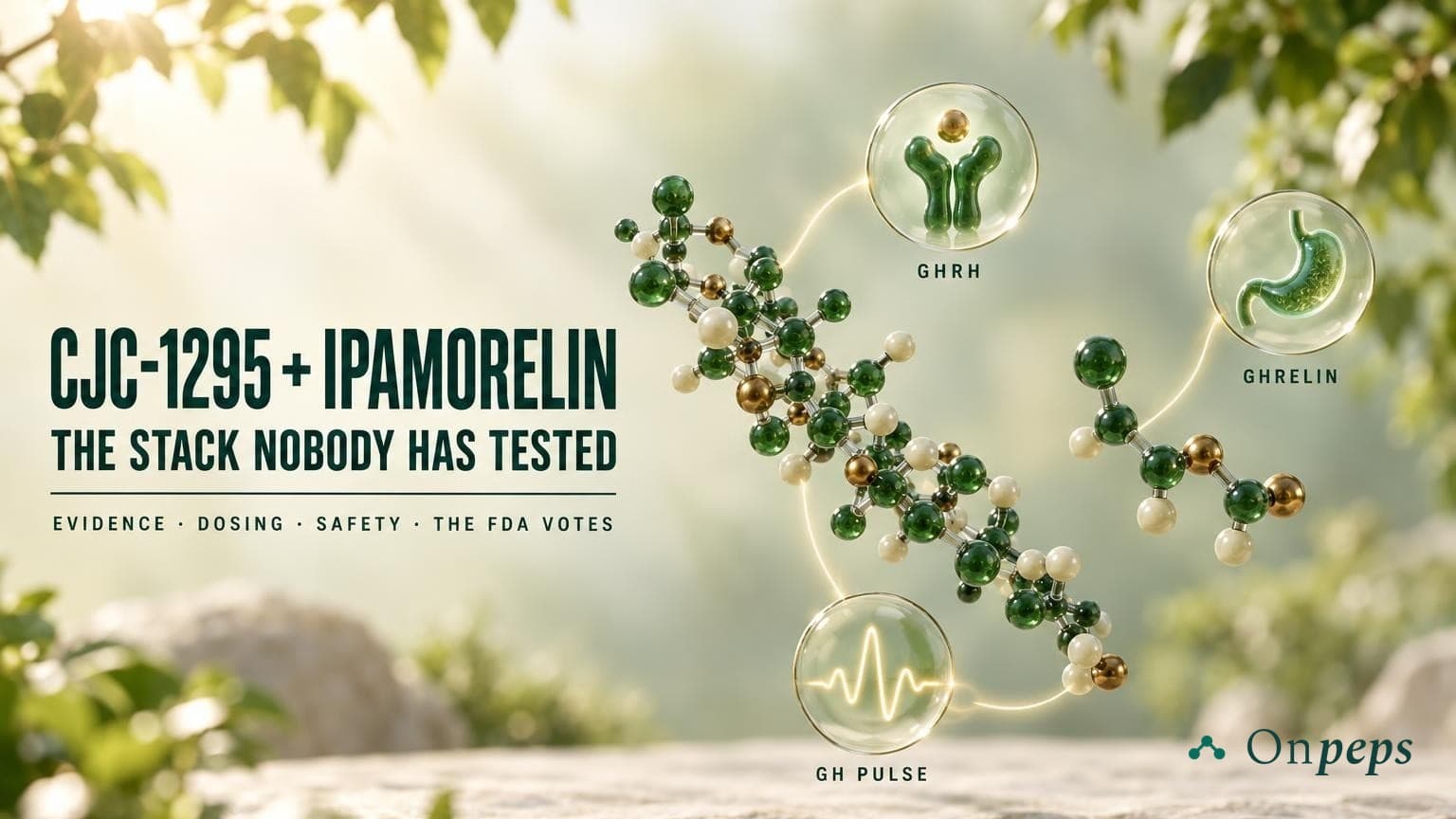
Search for "ipamorelin" in the US and the thing people look for alongside it is not ipamorelin. "CJC ipamorelin" scores 98 on Google Trends against the compound's own 100, and the queries rising fastest over the past 90 days are all about the pair: does CJC 1295 and ipamorelin work, CJC1295 ipamorelin dosage, CJC 1295 ipamorelin before and after. Ipamorelin is now one of the three most-searched gray-market peptides in the US, behind retatrutide and BPC-157, and almost nobody searches for it on its own.
The stack has a tidy pharmacological story: two molecules, two receptors, one bigger growth-hormone pulse. It also has something rarer in this space, which is a paper trail. Each half was put in front of the FDA's compounding advisory committee in late 2024, five weeks apart, and each was voted down without a single vote in favour. What the science says, what the committee saw, and the empty space between the two is what this article is about. Let's dive in.
TLDR
What is it? Two peptides injected together, usually from the same vial. CJC-1295, most often the short-acting version without DAC (also sold as Mod GRF 1-29), is a modified fragment of growth-hormone-releasing hormone. Ipamorelin is a five-amino-acid ghrelin-receptor agonist. Both make your pituitary release your own growth hormone, through two different receptors.
Results: Each half raises growth hormone and IGF-1 in healthy volunteers. No study has ever given the combination to a human, and no study of either compound has measured muscle, fat, recovery or sleep in a person. The only patient trials, one per compound, ended in a negative result and a halted programme.
Dosage: The community protocol is 100 to 300 mcg of each, one to three times a day, on an empty stomach, usually before bed, for 8 to 12 weeks or indefinitely. The trials used intravenous ipamorelin at 0.03 mg/kg in hospital and weekly CJC-1295 DAC at 30 to 60 mcg/kg. No validated protocol for the stack exists.
Safety: Headache, flushing, hunger, water retention and injection-site reactions are the common complaints. The open questions are blood glucose, long-term IGF-1, and a 2020 finding of DNA damage in pituitary cells. CJC-1295's only patient trial was stopped after a death. Ipamorelin's ileus trial had two.
Legal Status (September 2026): Neither compound is approved anywhere. The FDA's Pharmacy Compounding Advisory Committee voted 0 to 12 against ipamorelin on October 29, 2024 and 0 to 13 against CJC-1295 on December 4, 2024. Neither was among the twelve peptides pulled from Category 2 in April 2026, and neither was on the July 2026 agenda. Ipamorelin acetate still sits in Category 2 for 503B outsourcing facilities. Both are named on the WADA Prohibited List under S2.
What Is the CJC-1295 + Ipamorelin Stack, and Why Is It Trending Now?
Your pituitary releases growth hormone in pulses, mostly at night. Two signals turn the tap on. Growth-hormone-releasing hormone (GHRH) comes down from the hypothalamus and acts on the GHRH receptor. Ghrelin, the hunger hormone, comes up from the stomach and acts on a separate receptor, GHS-R1a. A third signal, somatostatin, turns the tap off. The stack is built to push both "on" buttons at once.
CJC-1295 is the GHRH half. ConjuChem, a Montreal biotech, took the first 29 amino acids of GHRH, swapped four of them so enzymes would stop chopping it up within minutes, and then bolted on a reactive group that binds the peptide permanently to albumin in your blood. That group is the "drug affinity complex", or DAC, and it gives the compound a half-life of 5.8 to 8.1 days (Teichman et al., 2006, JCEM, PMID 16352683). The version sold for stacking with ipamorelin is the same fragment without the DAC. It is short-acting, it has never been studied in a human, and its first appearance in the literature is a vial seized by Norwegian customs (Henninge et al., 2010, Drug Testing and Analysis, PMID 21204297).
Ipamorelin is the ghrelin half. Novo Nordisk built it in the late 1990s as a five-residue compound that kept the potency of the older GHRPs and lost their side effects. In pigs it released growth hormone at 200 times the effective dose without touching ACTH, cortisol or prolactin, where GHRP-2 and GHRP-6 raised all three (Raun et al., 1998, European Journal of Endocrinology, PMID 9849822). That selectivity is the entire basis of its reputation as the "clean" secretagogue.
Three things explain the search graph.
First, the regulatory whiplash. US search interest in ipamorelin climbed through 2025 and peaked in the week of April 12, 2026, the week HHS Secretary Robert F. Kennedy Jr. announced twelve peptides were coming off the FDA's Category 2 list. Plenty of people read that as "peptides are legal now". CJC-1295 and ipamorelin were not on the list, for a reason we get to below.
Second, the clinics. "CJC/Ipa" is the default growth-hormone offer at telehealth and longevity practices, usually pitched at people in their thirties and forties for fat loss, muscle, sleep and recovery. The FDA's own 2024 review noted that compounded ipamorelin was "increasingly being marketed by medical spas and wellness clinics" in injectable, nasal and oral forms.
Third, the medicine caught up with the market. A 2026 review in Frontiers in Endocrinology catalogued the online protocols for CJC-1295, ipamorelin and their relatives and set out a triage framework for doctors who now see these patients (Dominikowski et al., 2026, Frontiers in Endocrinology, PMID 42395176). Doctors writing an algorithm for a product is a sign it has arrived, not a sign it works.
How Does the Stack Work?
The mechanism is the one thing about this stack that is straightforward.
Studies in the 1990s showed that GHRH given together with one of the older ghrelin-receptor peptides such as GHRP-6 released more growth hormone than either alone. The community protocol borrows that pharmacology: both signals in one syringe, on an empty stomach so food does not blunt the pulse, at bedtime to line up with the biggest natural pulse of the night.
What each half does alone in people has been measured.
Ipamorelin, given as a single intravenous infusion to 40 healthy men, produced one episode of growth-hormone release that peaked at 40 minutes and faded within hours, with a half-life of about two hours (Gobburu et al., 1999, Pharmaceutical Research, PMID 10496658). That is a pulse, exactly as advertised. It is also the whole human pharmacodynamic record for the compound.
CJC-1295 with DAC, given as a single subcutaneous injection to healthy adults, raised mean growth hormone two- to ten-fold for six days or more and IGF-1 1.5- to three-fold for nine to eleven days. After repeated doses IGF-1 stayed above baseline for up to 28 days (Teichman et al., 2006, PMID 16352683). A companion study that sampled blood every 20 minutes overnight found the pulses kept their size and frequency, but the trough level between pulses rose 7.5-fold, taking mean growth hormone up 46% and IGF-1 up 45% (Ionescu and Frohman, 2006, JCEM, PMID 17018654).
Notice the mismatch. The version with human data is the week-long DAC form. The version in the stack is the short-acting form, chosen precisely because it does not produce that sustained trough elevation. The argument for it is that a brief GHRH signal plus a brief ghrelin signal gives a bigger, cleaner, more "natural" pulse. That may be right. It is a hypothesis about a molecule that has never been given to a person under observation.
Both halves raise growth hormone. That is the entire proven claim, and it was proven for each half alone.
CJC-1295 + Ipamorelin vs Tesamorelin vs Sermorelin vs MK-677 vs Growth Hormone
These get sold as a menu of interchangeable "GH peptides". The evidence behind each is very different.
| Compound | Class | Human evidence for body composition | Approved? | US compounding status (September 2026) |
|---|---|---|---|---|
| CJC-1295 without DAC (Mod GRF 1-29) | Short-acting GHRH 1-29 analogue | None. Never studied in humans in any form | No | PCAC voted 0 to 13 against, December 2024. Not lawfully compoundable |
| CJC-1295 with DAC | Albumin-bound GHRH analogue, week-long half-life | GH and IGF-1 rise in 63 healthy adults, mostly single dose. No body-composition outcome. Patient trial halted after a death | No | Same vote. Not lawfully compoundable |
| Ipamorelin | Selective ghrelin-receptor agonist | One GH pulse in 40 men. Negative ileus trial. No body-composition outcome | No | PCAC voted 0 to 12 against, October 2024. Category 2 for 503B facilities. Not lawfully compoundable |
| Tesamorelin | Full-length GHRH 1-44 analogue, stabilised | Two Phase 3 RCTs, 806 patients: visceral fat down about 15%, all in HIV lipodystrophy | Yes, Egrifta, since 2010 | Approved-drug ingredient; the "essentially a copy" rule applies |
| Sermorelin | Unmodified GHRH 1-29 | None for fat loss or muscle | Was (Geref, paediatric GH deficiency); withdrawn 2008 | Compounded on its history as an approved ingredient |
| MK-677 (ibutamoren) | Oral ghrelin mimetic | Two-year RCT in 65 older adults: fat-free mass +1.1 kg vs −0.5 kg on placebo, no change in strength or function, appetite and fasting glucose up | No | PCAC voted 0 to 11 against, October 2024. Category 2 |
| Growth hormone (somatropin) | The hormone itself | Improves body composition in diagnosed GH deficiency | Yes, for named conditions | Approved product only; distributing it for any non-approved use is a federal offence |
The MK-677 row deserves a second look, because it is the closest anyone has come to testing the idea behind the stack in a controlled trial. A ghrelin mimetic, taken daily for a year by healthy older adults, restored growth hormone and IGF-1 to young-adult levels and added about a kilogram of fat-free mass. It did not change strength or physical function. It increased appetite, body weight went up 2.7 kg against 0.8 kg on placebo, fasting glucose rose, insulin sensitivity fell, and cortisol went up (Nass et al., 2008, Annals of Internal Medicine, PMID 18981485). That is what a year of a ghrelin-receptor agonist looks like when someone actually measures it. Ipamorelin acts on the same receptor.
What the Evidence Actually Shows
The published record for the two compounds is small enough to list in full.
Published, peer-reviewed
| Study | What it tested | Who or what | Result | Status |
|---|---|---|---|---|
| Raun et al., 1998, European Journal of Endocrinology (PMID 9849822) | Ipamorelin discovery | Rat pituitary cells, rats, pigs | GH release matching GHRP-6, with no ACTH or cortisol rise at 200 times the effective dose | Published, animal |
| Gobburu et al., 1999, Pharmaceutical Research (PMID 10496658) | Ipamorelin pharmacokinetics | 40 healthy men, single IV infusion, five doses | Single GH pulse peaking at 0.67 h; half-life about 2 h; dose-proportional | Published |
| Lall et al., 2001, Biochemical and Biophysical Research Communications (PMID 11162489) | Ipamorelin vs growth hormone on fat | GH-deficient and normal mice, 2 to 9 weeks | Ipamorelin increased body fat, fat-pad weight, leptin and food intake; GH decreased fat | Published, animal |
| Beck et al., 2014, International Journal of Colorectal Disease (PMID 25331030) | Ipamorelin for postoperative ileus | 117 adults after bowel resection, IV 0.03 mg/kg twice daily up to 7 days | Time to first tolerated meal 25.3 vs 32.6 h, p = 0.15. No significant difference on any endpoint | Published, negative |
| NCT01280344 | Second ipamorelin ileus trial | 320 adults, Phase 2, sponsor Helsinn | Completed May 2014. No results posted, never published | Unpublished |
| Teichman et al., 2006, JCEM (PMID 16352683) | CJC-1295 DAC ascending dose | Healthy adults aged 21 to 61, two trials of 28 and 49 days | GH 2- to 10-fold for 6+ days; IGF-1 1.5- to 3-fold for 9 to 11 days; half-life 5.8 to 8.1 days | Published |
| Ionescu and Frohman, 2006, JCEM (PMID 17018654) | CJC-1295 DAC and GH pulsatility | Healthy men aged 20 to 40, single dose of 60 or 90 mcg/kg | Pulses preserved; trough GH up 7.5-fold; mean GH +46%; IGF-1 +45% | Published |
| NCT00267527 | CJC-1295 DAC in HIV-associated visceral obesity | Phase 2, ConjuChem; 192 enrolled per contemporary reports | Terminated July 17, 2006 after a participant's death. Data never published | Unpublished |
| Ben-Shlomo et al., 2020, Journal of Clinical Investigation (PMID 32673291) | Long-acting GHRH analogue and pituitary DNA damage | Mouse pituitary cells; mice injected for 8 weeks | DNA damage in GH-producing cells in culture and in living mice, with pituitary enlargement | Published, mechanistic |
Unpublished, marketing, or absent
| Claim | Where it comes from | Status |
|---|---|---|
| The combination releases more GH than either alone | Extrapolated from 1990s studies of GHRH plus older GHRPs | Never measured for this pair, in anyone |
| Muscle gain, fat loss, faster recovery, better sleep, better skin | Clinic pages, forum threads, "before and after" posts | No human study of either compound has measured any of them |
| The no-DAC version gives a cleaner, more natural pulse | Community pharmacology | The no-DAC form has never been given to a person under observation |
| Safe, based on years of prescribing | Industry presentation to the FDA committee in December 2024 citing 449,184 dispensed CJC-1295 prescriptions | Dispensing counts are not safety data. The committee did not accept the argument |
Read the two tables together and the shape of the problem is clear. Every human study is a pharmacology study: it measures hormone levels, not outcomes. Every outcome anyone is paying for lives in the second table. The 2026 Frontiers review reached the same conclusion, describing the stacking practice as driven largely by anecdotal rationale.
The stack's scientific case is an extrapolation from hormone curves to body composition, and nobody has ever checked whether the extrapolation holds.
Dosage: What the Trials Used vs What the Community Runs
What the trials used
Nothing in the clinical record resembles how the stack is used. Ipamorelin's patient trial gave 0.03 mg/kg intravenously twice a day, in hospital, to people recovering from bowel surgery: about 2.4 mg per dose for an 80 kg adult, roughly ten times a community dose, through a drip. CJC-1295's volunteer trials gave 30 to 90 mcg/kg of the DAC form, 2.4 to 7.2 mg for the same adult, as a single or weekly injection. The no-DAC form has no trial dose because it has no trial.
What the community runs
The pattern that repeats across clinic protocols, vendor pages and forum threads, and that the 2026 review catalogued:
- 100 to 300 mcg of CJC-1295 (no DAC) and 100 to 300 mcg of ipamorelin per injection, almost always in a 1:1 ratio, often from a pre-mixed blend vial.
- One to three injections a day. Before bed is the constant. Post-workout and on waking are the common additions.
- On an empty stomach, at least two hours after eating, because insulin and fatty acids blunt the growth-hormone response.
- Eight to twelve weeks, then a break, although a large share of users run it continuously.
- Users of the DAC form instead inject 1 to 2 mg once or twice a week.
The 1:1 ratio, the 200 to 300 mcg figure and the bedtime timing all trace back to forum convention, not to any dose-finding study. Nobody has tested whether 100 mcg would do the same, or whether three times a day does more than once.
The reconstitution arithmetic
Research-labelled product comes as lyophilised powder, as separate 5 mg vials or as a 5 mg/5 mg blend (10 mg in total), and you add bacteriostatic water yourself. Concentration is milligrams divided by millilitres, the dose in millilitres is the dose you want divided by that concentration, and on a U-100 insulin syringe 1 mL is 100 units.
| Vial | Bacteriostatic water | Concentration | 100 mcg | 200 mcg | 300 mcg |
|---|---|---|---|---|---|
| 5 mg single peptide | 2 mL | 2.5 mg/mL | 0.04 mL (4 units) | 0.08 mL (8 units) | 0.12 mL (12 units) |
| 5 mg single peptide | 2.5 mL | 2 mg/mL | 0.05 mL (5 units) | 0.1 mL (10 units) | 0.15 mL (15 units) |
| 5 mg / 5 mg blend (10 mg total) | 2 mL | 5 mg/mL total, 2.5 mg/mL of each | 0.04 mL (4 units) gives 100 mcg of each | 0.08 mL (8 units) gives 200 mcg of each | 0.12 mL (12 units) gives 300 mcg of each |
| 5 mg / 5 mg blend (10 mg total) | 3 mL | 3.33 mg/mL total, 1.67 mg/mL of each | 0.06 mL (6 units) gives 100 mcg of each | 0.12 mL (12 units) gives 200 mcg of each | 0.18 mL (18 units) gives 300 mcg of each |
With 2 mL of water a 200 mcg dose is 8 units on the syringe, and a one-unit misread is a 12% error; more water makes the volume easier to measure. A blend vial also fixes the ratio, so a different split means separate vials. Run your own numbers through the reconstitution calculator and the dosage calculator rather than copying a row, and read the CJC-1295 sourcing page before trusting the label: the FDA counted at least five different substances and nine names circulating under that one product name.
There is no validated protocol for this stack. The only trial doses that exist were a hospital drip for a bowel condition and a weekly shot of a different molecule.
Side Effects
What the trials recorded
The FDA pooled the CJC-1295 DAC volunteer studies for its December 2024 review, and the numbers are higher than the "well tolerated" line in the abstracts suggests. In the first trial, adverse events occurred in 33 of 35 people on the drug against two of seven on placebo: injection-site reactions in about 70%, transient hives in nearly 30%, headache in 63% against 14% on placebo, diarrhoea in 43% and in everyone at the highest dose, and flushing with a transient drop in blood pressure in around 30%. The pulsatility study recorded a dose-dependent rise in heart rate. Increased heart rate and systemic vasodilatory reaction are the two effects the FDA named when it put CJC-1295 in Category 2.
Ipamorelin's record is thinner and gentler. A single intravenous dose in healthy men produced nothing notable. In the ileus trial, people on ipamorelin had more low potassium (12.5% vs 3.4%), insomnia (10.7% vs 5.2%) and high glucose at discharge (14.3% vs 8.6%) than people on placebo.
What the community reports
Hunger, above everything. Ipamorelin is a ghrelin mimetic and ghrelin is the hunger hormone, so a wave of appetite twenty minutes after the injection is the pharmacology working as designed. After that: water retention and puffy hands, tingling fingers, headache, sleepiness after the dose, vivid dreams, and injection-site redness. None of it has been quantified in a study.
The two trials that ended in deaths
CJC-1295's only trial in patients was a Phase 2 study in HIV-associated visceral obesity. On July 13, 2006, about two hours after his eleventh weekly dose, a participant in Argentina reported chest discomfort, an ECG confirmed a heart attack, and he died within the hour. The attending physician put it down to pre-existing, silent coronary artery disease and judged it unrelated to the drug. ConjuChem stopped the trial on July 17, 2006, the data were never published, and the compound has not been in development since.
In ipamorelin's 117-patient ileus trial, two people in the ipamorelin group died. Both had had bowel resections for colon cancer and developed anastomotic leaks, a known surgical complication. The FDA's 2024 review said it was "unclear whether the two deaths were related to ipamorelin" but that their occurrence "raises safety concerns about the use of ipamorelin in compounding".
Two readings are both correct. Neither death is evidence that the drug killed anyone. And both are the reason the safety record is so thin, because in each case the trial that could have told us more is the trial that stopped.
The mechanistic concerns
Blood glucose. Growth hormone opposes insulin. The FDA flagged glucose intolerance as a class concern for anything that stimulates GH release, the ileus trial saw more hyperglycaemia on ipamorelin, and the year-long MK-677 trial measured a rise in fasting glucose and a fall in insulin sensitivity (Nass et al., 2008, PMID 18981485). If you run this stack and never check a fasting glucose, you are skipping the one test the pharmacology tells you to run.
IGF-1 and cancer. IGF-1 is a growth factor, every GH-axis drug carries a theoretical concern about feeding an existing tumour, and every approved one is contraindicated in active malignancy. For these two compounds the concern is unaddressed in any species over any relevant timeframe. The mechanistic concern is real and the clinical evidence for harm is absent. Those are two separate facts.
The pituitary. A 2020 study in the Journal of Clinical Investigation, using a long-acting GHRH analogue that the FDA's review identified as CJC-1295 DAC, found DNA damage in mouse growth-hormone cells in culture and, after eight weeks of injections, in the pituitaries of living mice, with enlargement of the gland (Ben-Shlomo et al., 2020, PMID 32673291). With no carcinogenicity studies, the FDA concluded, the potential for pituitary hyperplasia and tumours with long-term use is unknown. The mechanism that makes the compound work is the mechanism that produced the damage.
Appetite and fat. The one controlled comparison of ipamorelin against growth hormone, in mice, found that ipamorelin increased body fat, leptin and food intake while growth hormone decreased fat (Lall et al., 2001, PMID 11162489). That is not a paradox. It is a ghrelin mimetic doing what ghrelin does.
The gray-market harm record
ONPEPS has not identified a published case series, FDA warning letter or health-department alert tying a specific harm to research-labelled CJC-1295 or ipamorelin, and we say so rather than implying one. What has been documented is the product problem. Anti-doping laboratories analysing black-market growth-promoting products have repeatedly found contents that do not match the label (Krug et al., 2018, Growth Hormone and IGF Research, PMID 29864719). And on July 30, 2026, the owner of Paradigm Peptides, a US research-chemical vendor with roughly 54,000 customers, was sentenced to 70 months in prison after admitting he forged the lab certificates his customers relied on. His products were adulterated SARMs rather than peptides, but the certificate problem is the same across the market, which is why the vendor boards exist.
The compounds' own side effects are mostly mild and mostly what more growth hormone feels like. The serious questions, glucose, IGF-1 and the pituitary, are the ones nobody has run the study to answer.
The Legal and Regulatory Situation
Most peptide regulatory stories are about a compound the FDA has never looked at. This one is about two it looked at closely.
2023: Category 2
On September 29, 2023, the FDA moved CJC-1295, ipamorelin acetate and more than a dozen other peptides into Category 2 of its interim 503A compounding policy, the list of substances it says raise significant safety concerns. For ipamorelin it cited immunogenicity, unnatural amino acids, "serious adverse events including death when ipamorelin was administered intravenously for improving gastric motility", and no safety information at all for the subcutaneous route anyone actually uses. For CJC-1295 it cited immunogenicity, impurities, and "serious adverse events associated with CJC-1295 including increased heart rate and systemic vasodilatory reaction".
2024: the lawsuit and the two votes
Evexias Medical Centers and Farmakeio, a Texas clinic network and compounding pharmacy, sued the FDA over the lack of process behind those placements. The suit covered AOD-9604, CJC-1295, ipamorelin acetate and thymosin alpha-1, and it settled in September 2024 with the FDA agreeing to put all four through its Pharmacy Compounding Advisory Committee (PCAC), the expert panel that advises on what pharmacies may compound. The nominators withdrew their nominations along the way, which took the substances out of 503A Category 2, but the FDA reviewed both compounds anyway, "on its own initiative".
On October 29, 2024, the committee took up ipamorelin. The FDA's review found no safety data for the subcutaneous route, the two deaths in the ileus trial, a class concern about glucose, and an acetate form that was not well characterised. The committee voted 0 to 12, with one abstention, against placing ipamorelin free base on the list, and 0 to 12 with one abstention against ipamorelin acetate. The same meeting voted 0 to 11 against MK-677 and unanimously against kisspeptin-10.
On December 4, 2024, the committee took up CJC-1295 in five forms: free base, acetate, and three DAC salts. The FDA's review found no studies of effectiveness in humans for any use, injection-site haemorrhage and necrosis in rats and dogs at every dose tested, the pituitary DNA-damage finding, and a marketplace in which at least five substances and nine names circulated under one product name. Evexias, Farmakeio and their counsel spoke in the open hearing. The committee voted 0 to 13 against the free base and each DAC form, and 1 to 12 against the acetate. The one recorded comment was on the lack of evidence for effectiveness.
2026: the thaw that skipped them
On April 15, 2026, Secretary Kennedy confirmed twelve peptides had been removed from Category 2, among them BPC-157, TB-500, MOTS-c, injectable GHK-Cu, Semax, KPV and Epitalon. Seven went before PCAC on July 23 and 24, 2026, and six were recommended for the compounding list; our July 2026 FDA update covers that meeting. The remaining five are scheduled for a meeting before the end of February 2027.
CJC-1295 and ipamorelin are on neither list. They were not removed in April because they had already been through the committee and lost, and they are on neither the July nor the February 2027 agenda. The FDA's current 503A category document, updated May 14, 2026, lists neither compound in any category. On the 503B side, for outsourcing facilities, ipamorelin acetate remains in Category 2.
What that means in practice
A US pharmacy may compound a substance only if it is the ingredient of an approved drug, has a USP monograph, or is on the 503A bulks list. Neither compound qualifies, and the advisory committee has recommended against adding either. No pharmacy in the United States has a lawful basis to compound CJC-1295 or ipamorelin, and a telehealth prescription does not create one. The Ohio Board of Pharmacy has named CJC/ipamorelin in its guidance and summarily suspended pharmacies for compounding it. A research-use-only vial is an unapproved drug sold under a disclaimer the FDA has said does not survive marketing copy aimed at human use.
In sport, WADA's Prohibited List names ipamorelin among growth hormone secretagogues and CJC-1295 among GHRH analogues, both under S2, prohibited at all times, and both are detectable in urine (Memdouh et al., 2021, Drug Testing and Analysis, PMID 34665524).
This stack is not in a gray area. Each half has been individually put before the FDA's expert committee and rejected without a vote in favour, and the 2026 reversal that freed a dozen other peptides did not include either of them.
The Honest Take
CJC-1295 and ipamorelin do what the pharmacology says. Each one, alone, raises growth hormone and IGF-1 in healthy adults, and that has been measured properly. The idea of combining a GHRH analogue with a ghrelin mimetic is sound, and nobody serious disputes it.
Everything after that is inference. The combination has never been tested in a human. The short-acting CJC-1295 that goes into the syringe has never been tested in a human in any form. Neither compound has a single study measuring muscle, fat, recovery or sleep in a person, and the one long trial of a related compound found a kilogram of lean mass, no change in strength, more hunger and worse glucose. The two patient trials that were run ended with a negative result and a death, and both programmes were abandoned by the companies that owned them.
Then there are the votes. This is not a compound the regulator has ignored. It is two compounds the regulator's expert panel examined, in public, with the industry making its best case in the room, and rejected 0 to 12 and 0 to 13. The April 2026 thaw that put BPC-157 and TB-500 on a path to legal compounding left these two exactly where they were, and no meeting is scheduled to revisit them.
If you are going to use CJC/ipamorelin anyway, the things the evidence tells you to do are few and specific: get a fasting glucose and an IGF-1 before you start and again at three months, do not use it with any cancer history, use enough water that you can actually measure the dose, and buy from a source whose certificates other people have checked.
FAQ
Does CJC-1295 and ipamorelin work?
Each raises growth hormone and IGF-1 in healthy adults; that is proven. Whether the combination does anything to your muscle, fat, sleep or recovery has never been measured in a human study. The closest controlled evidence, a two-year trial of an oral ghrelin mimetic, found about a kilogram of extra lean mass and no change in strength.
What is the right CJC-1295 ipamorelin dosage?
There is no validated dose. The community convention is 100 to 300 mcg of each, one to three times a day, on an empty stomach, with the bedtime injection considered essential. The only trial doses on record are a hospital IV dose of ipamorelin for bowel recovery and weekly injections of the long-acting DAC form, neither of which resembles the stack.
Should I use CJC-1295 with DAC or without DAC with ipamorelin?
The community uses the no-DAC form, on the theory that a short GHRH signal plus a short ghrelin signal gives a natural pulse rather than a week-long elevation. The human data all belong to the DAC form; the no-DAC form has never been studied in people. Whichever you pick, you are choosing between a molecule with a small evidence base and one with none.
What results should I expect, and how long does it take?
Nobody can tell you from data, because no study has measured results. The "before and after" posts online are uncontrolled and usually come with a training and diet change. The hormone response is immediate; any body-composition change from a GH-axis drug, where it has been measured with other compounds, takes months and is modest.
Is CJC-1295 ipamorelin the best peptide for muscle growth?
No peptide has good human evidence for muscle growth in healthy adults. Among the GH-axis options, tesamorelin has the strongest trial record, at about 1.4 kg of lean mass in people with HIV lipodystrophy. For a healthy person the evidence does not identify a "best", because none of them has been shown to work for that purpose.
Is CJC-1295 + ipamorelin legal or FDA approved?
Neither is approved anywhere in the world. In the US, the FDA's advisory committee voted 0 to 12 against ipamorelin in October 2024 and 0 to 13 against CJC-1295 in December 2024, so neither can lawfully be compounded, and neither was among the peptides freed from Category 2 in April 2026. Possession is not a crime for an individual in most jurisdictions, but the vials are unapproved drugs and both compounds are banned in sport.
Can a telehealth clinic or compounding pharmacy prescribe CJC/ipamorelin?
A doctor can write anything on a prescription pad, but a US pharmacy has no lawful basis to fill it, because neither compound is an approved-drug ingredient, has a USP monograph, or is on the 503A bulks list. State boards of pharmacy, Ohio's among them, have suspended pharmacies for doing exactly this. A pharmacy label on the vial does not change the substance's status.
What are the side effects of CJC-1295 ipamorelin?
Hunger, headache, flushing, water retention, tingling hands, sleepiness after the dose, and injection-site redness are the common ones. In the CJC-1295 DAC trials, headache affected 63% of volunteers and diarrhoea 43%. The concerns worth blood tests are rising fasting glucose and IGF-1. The concerns nobody has data on are long-term cancer risk and the pituitary DNA-damage finding.
Does ipamorelin make you hungry or gain fat?
It can. Ipamorelin acts on the ghrelin receptor, and ghrelin is the hunger hormone. In the only controlled comparison against growth hormone, in mice, ipamorelin increased body fat, leptin and food intake. The year-long human trial of a different ghrelin mimetic recorded increased appetite and a 2.7 kg weight gain. If your goal is fat loss, the pharmacology is working against you.
How does CJC/ipamorelin compare with tesamorelin/ipamorelin?
Tesamorelin is a full-length GHRH analogue with two Phase 3 trials and an FDA approval for visceral fat in HIV lipodystrophy, so the GHRH half of that stack has real evidence behind it; our tesamorelin guide covers what that evidence does and does not transfer to. The ipamorelin half is the same in both stacks, with the same absent evidence and the same lost vote. No study has tested either combination.
Resources
Raun et al. (1998), European Journal of Endocrinology, ipamorelin discovery and selectivity — https://pubmed.ncbi.nlm.nih.gov/9849822/
Gobburu et al. (1999), Pharmaceutical Research, ipamorelin pharmacokinetics in 40 healthy men — https://pubmed.ncbi.nlm.nih.gov/10496658/
Lall et al. (2001), Biochemical and Biophysical Research Communications, ipamorelin vs growth hormone on body fat in mice — https://pubmed.ncbi.nlm.nih.gov/11162489/
Beck et al. (2014), International Journal of Colorectal Disease, ipamorelin for postoperative ileus, 117 patients — https://pubmed.ncbi.nlm.nih.gov/25331030/
ClinicalTrials.gov, NCT01280344, second ipamorelin ileus trial, 320 patients, no results posted — https://clinicaltrials.gov/study/NCT01280344
Teichman et al. (2006), Journal of Clinical Endocrinology and Metabolism, CJC-1295 DAC ascending-dose trials — https://pubmed.ncbi.nlm.nih.gov/16352683/
Ionescu and Frohman (2006), Journal of Clinical Endocrinology and Metabolism, GH pulsatility on CJC-1295 DAC — https://pubmed.ncbi.nlm.nih.gov/17018654/
ClinicalTrials.gov, NCT00267527, CJC-1295 in HIV patients with visceral obesity, terminated — https://clinicaltrials.gov/study/NCT00267527
Henninge et al. (2010), Drug Testing and Analysis, identification of CJC-1295 in a seized preparation — https://pubmed.ncbi.nlm.nih.gov/21204297/
Ben-Shlomo et al. (2020), Journal of Clinical Investigation, DNA damage in pituitary cells under long-acting GHRH stimulation — https://pubmed.ncbi.nlm.nih.gov/32673291/
Nass et al. (2008), Annals of Internal Medicine, two-year trial of the oral ghrelin mimetic MK-677 in 65 older adults — https://pubmed.ncbi.nlm.nih.gov/18981485/
Dominikowski et al. (2026), Frontiers in Endocrinology, review of GH-axis peptides and self-administration protocols — https://pubmed.ncbi.nlm.nih.gov/42395176/
Krug et al. (2018), Growth Hormone and IGF Research, analysis of black-market growth-promoting products — https://pubmed.ncbi.nlm.nih.gov/29864719/
Memdouh et al. (2021), Drug Testing and Analysis, detection of GHRH analogues including CJC-1295 — https://pubmed.ncbi.nlm.nih.gov/34665524/
FDA (2024), briefing document for the October 29, 2024 Pharmacy Compounding Advisory Committee meeting, ipamorelin-related bulk drug substances — https://www.fda.gov/media/182088/download
FDA (2024), transcript of the October 29, 2024 PCAC afternoon session, ipamorelin vote — https://www.fda.gov/media/185414/download
FDA (2025), final summary minutes of the December 4, 2024 PCAC meeting, CJC-1295 votes — https://www.fda.gov/media/185642/download
FDA (2026), safety risks associated with certain bulk drug substances nominated for compounding, Category 2 entries — https://www.fda.gov/drugs/human-drug-compounding/safety-risks-associated-certain-bulk-drug-substances-nominated-use-compounding
FDA (2026), bulk drug substances nominated under section 503A by category, updated May 14, 2026 — https://www.fda.gov/media/94155/download
FDA (2026), July 23–24, 2026 Pharmacy Compounding Advisory Committee meeting — https://www.fda.gov/advisory-committees/advisory-committee-calendar/july-23-24-2026-meeting-pharmacy-compounding-advisory-committee-07232026
McDermott Will and Schulte (2026), PCAC backs majority of peptides in two-day public meeting, including the Ohio enforcement note — https://www.mcdermottlaw.com/insights/bulk-list-bound-pcac-backs-majority-of-peptides-in-two-day-public-meeting/
Hyman, Phelps and McNamara, FDA Law Blog (2026), FDA's Pep(tide) Rally, on the April 2026 changes and the Evexias lawsuit — https://www.thefdalawblog.com/2026/04/fdas-peptide-rally-what-compounders-and-industry-need-to-know-post-1-of-2/
ProPublica (2026), An FDA reversal on peptides could open the market to unsafe drugs, April 3, 2026 — https://www.propublica.org/article/peptide-safety-fda-compounding-pharmacies
aidsmap (2006), Lipodystrophy study halted after patient death, the contemporary report of the CJC-1295 trial termination — https://www.aidsmap.com/news/jul-2006/lipodystrophy-study-halted-after-patient-death
US Department of Justice (2026), Paradigm Peptides owner sentenced to 70 months — https://www.justice.gov/usao-ndin/pr/illinois-man-and-indiana-woman-sentenced-respectively-70-months-and-16-months-prison
WADA (2026), The Prohibited List, section S2 — https://www.wada-ama.org/en/resources/2026-prohibited-list
ONPEPS peptide library, ipamorelin entry with sourcing and cost pages — https://www.onpeps.com/peptides/ipamorelin
ONPEPS peptide library, CJC-1295 entry with sourcing and cost pages — https://www.onpeps.com/peptides/cjc-1295