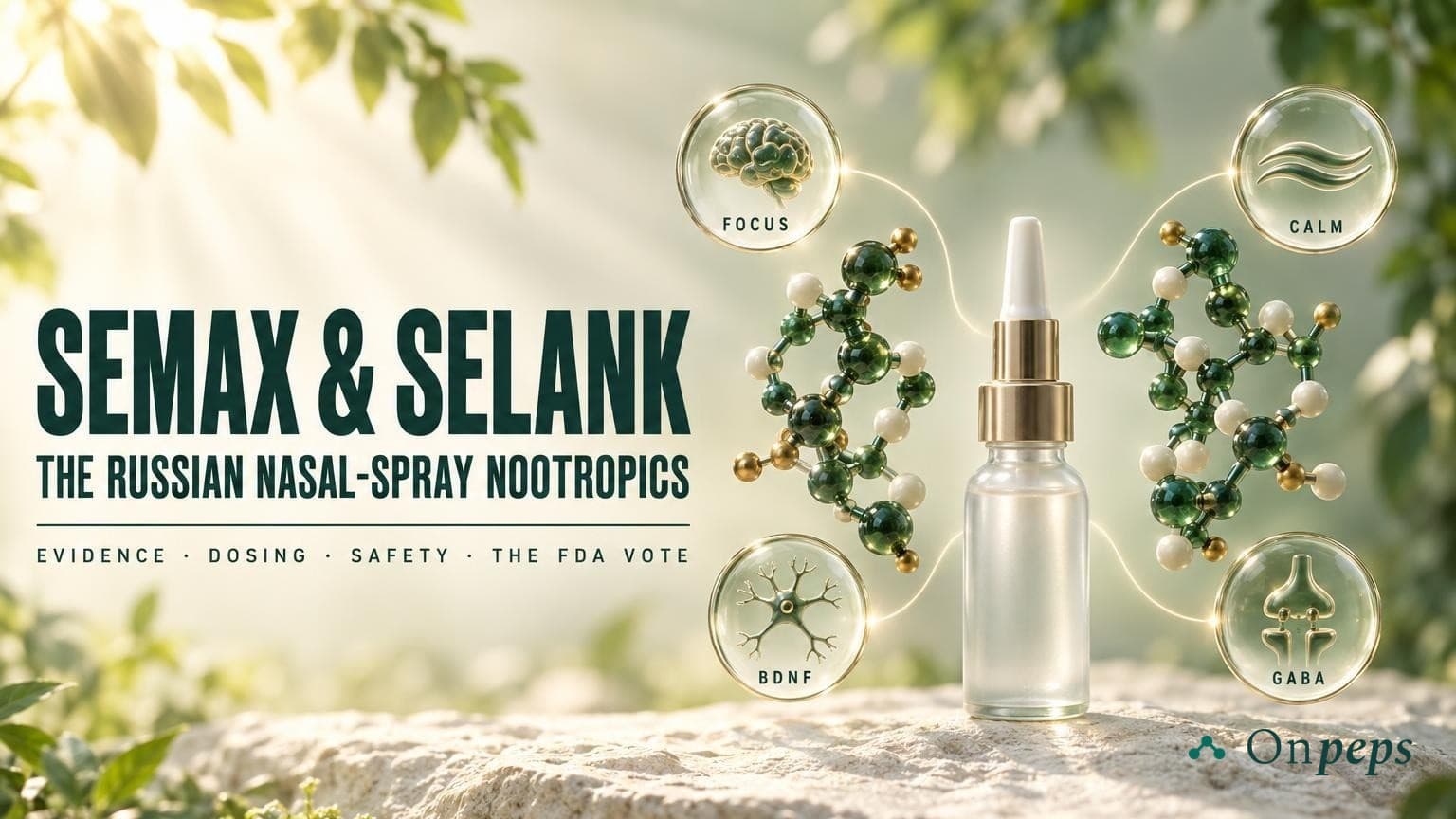
Semax and Selank are two short peptides from the same Moscow laboratory, sold in the same tiny glass bottles, and searched for in the same breath. Over the past twelve months US search interest in Semax has roughly doubled, and the single most common thing people type alongside it is "selank". The pitch is simple: one drop in the nose for focus, one for calm, no prescription, no jitters, no benzodiazepine hangover.
The reality is more interesting and less tidy. Both are real, registered medicines in Russia. Almost none of the evidence behind them has been tested outside Russia, the US has never approved either, and a July FDA advisory vote on Semax has been widely misread as a green light. Let's dive in.
TLDR
What are Semax and Selank? Two synthetic seven-amino-acid peptides developed at the Institute of Molecular Genetics of the Russian Academy of Sciences. Semax is built from a fragment of the stress hormone ACTH and is registered in Russia as a nootropic and stroke drug. Selank is built from tuftsin, a fragment of an antibody, and is registered in Russia as an anti-anxiety drug. Both are given as nasal drops.
Results: Semax has small, mostly unblinded Russian trials in stroke, optic nerve disease and cerebrovascular insufficiency, plus two resting-state brain-scan studies in healthy volunteers. Selank has three small Russian trials in anxiety disorders, compared against or added to benzodiazepines. There is no placebo-controlled trial of either for focus, memory or productivity in healthy people.
Dosage: The Russian labels use 50 mcg drops of Semax 0.1% (roughly 400 to 900 mcg a day for mental fatigue, 3 to 5 days) and 2 drops of Selank 0.15% in each nostril three times a day for 14 days. Community protocols run longer and often inject. No validated protocol exists for healthy users.
Safety: The labels list mild nasal irritation (Semax) and an unpleasant taste (Selank) as the main side effects. The Semax label itself says not to use it with anxiety disorders, acute psychiatric conditions or a history of seizures. The FDA found no human pharmacokinetic data for Semax by any route and no safety data at all for injecting it.
Legal Status (September 2026): Not FDA-approved. An FDA advisory committee voted in July to recommend Semax for the compounding list (a reported 8 to 5, one abstention), against the advice of FDA staff; nothing has been added yet. Selank was not on the agenda and sits in no FDA review category. Neither is named on the WADA Prohibited List.
What Are Semax and Selank, and Why Are They Trending Now?
Both come out of the same Soviet-era research programme on "regulatory peptides": short, stable fragments of natural hormones that could be put in the nose and reach the brain. Both are now made by one company, Peptogen, a spin-off of the Institute of Molecular Genetics in Moscow.
Semax is Met-Glu-His-Phe-Pro-Gly-Pro. The first four amino acids are positions 4 to 7 of adrenocorticotropic hormone (ACTH), the hormone that tells your adrenal glands to make cortisol. The last three, Pro-Gly-Pro, were bolted on to slow its breakdown. The literature usually calls it an "ACTH(4-10) analogue". The key point is that it has none of ACTH's hormonal activity: it does not raise cortisol. In Russia it is a prescription drug in two strengths, 0.1% for cognitive and memory problems after vascular brain disease, head injury or surgery, and 1% for the acute phase of moderate-to-severe ischaemic stroke.
Selank is Thr-Lys-Pro-Arg-Pro-Gly-Pro. The first four amino acids are tuftsin, a small immune-signalling fragment of the IgG antibody, with the same Pro-Gly-Pro tail. It was registered in Russia in 2009 as an anxiolytic for generalised anxiety, neurasthenia, panic, sleep problems and adjustment disorders, and it has been sold over the counter there since August 2017.
Three things explain the search graph.
First, the FDA vote. On July 24, 2026, the FDA's Pharmacy Compounding Advisory Committee reviewed Semax for the list of substances US pharmacies may compound, and a majority voted in favour. The headlines said "FDA panel backs Semax." The detail is in the Legal section below, and it matters.
Second, the broader peptide wave. Semax and Selank ride the same interest that has made BPC-157 and TB-500 mainstream. On Google, "semax" now sits alongside "mots c", "epitalon" and "klow" in its list of rising related searches, and "what is semax peptide used for" is up 140% in the past 90 days.
Third, the pairing itself. Vendors sell them as a set, stimulant and sedative in one box, and "semax and selank" is one of the most common searches for either.
Two genuinely registered drugs, from a real research institute, with a decades-long paper trail. Nearly all of it in one country, one language and one research network. That is the whole Semax and Selank story.
How Do Semax and Selank Work?
Neither one has a single, confirmed receptor target in humans. What exists is a set of mechanisms shown mostly in rats, cell cultures and blood samples.
Semax: the BDNF story
Semax's headline mechanism is brain-derived neurotrophic factor (BDNF), the protein that supports the growth and survival of neurons and is central to learning. In rats, a single intranasal dose raised BDNF protein in the hippocampus by up to 1.4-fold and increased activation of its receptor, trkB, alongside better performance on a learning task (Dolotov et al., 2006, Brain Research, PMID 16996037). The same group found specific Semax binding sites in the rat basal forebrain and a rapid rise in BDNF there (Dolotov et al., 2006, Journal of Neurochemistry, PMID 16635254).
Other rat work shows effects on dopamine and serotonin systems and, in stroke models, on the expression of immune and blood-vessel genes. Semax also boosted amphetamine-driven dopamine release in the rat striatum (Eremin et al., 2004, Eksperimental'naia i Klinicheskaia Farmakologiia, PMID 15188751). The FDA called the same finding in mice "concerning", because that response is typical of drugs of abuse.
Selank: the GABA and enkephalin story
Selank is described as an anxiolytic that works partly through the same system as benzodiazepines. In rat brain membranes it acted as a positive allosteric modulator of GABA binding, meaning it made the calming neurotransmitter GABA bind more strongly, but at a site that appears to differ from where diazepam binds (Vyunova et al., 2018, Protein and Peptide Letters, PMID 30255741). In rats, Selank and GABA shifted the expression of many of the same neurotransmission genes in the same direction (Volkova et al., 2016, Frontiers in Pharmacology, PMID 26924987).
The second proposed mechanism is protecting the body's own opioid peptides. In human serum, both Selank and Semax inhibited the enzymes that break down enkephalins, with Semax the stronger of the two (Kost et al., 2001, Bioorganicheskaia Khimiia, PMID 11443939). That is a test-tube finding, not a measured effect in a living person.
The half-life problem
Both peptides are destroyed fast. Semax given in the nose to rats reached the brain within two minutes, but was rapidly chopped down, mostly to Pro-Gly-Pro (Shevchenko et al., 2006, Bioorganicheskaia Khimiia, PMID 16523722). The Russian Selank label states 92.8% nasal bioavailability and a plasma level that falls away within about five minutes. That is why the labels use several doses a day, and why the effects, if real, are thought to come from downstream signalling rather than the peptide sitting around.
Semax is pitched as the "BDNF peptide" and Selank as the "non-addictive benzo". Both labels come from animal and test-tube work. Neither mechanism has been measured in the brain of a healthy person taking a normal dose.
Semax vs Selank vs the Obvious Alternatives
People reach for these as alternatives to prescription stimulants and anti-anxiety drugs. Here is how they line up.
| Compound | What it is | Registered where? | Best human evidence | US status |
|---|---|---|---|---|
| Semax | ACTH(4-7) fragment + Pro-Gly-Pro, nasal | Russia, prescription (0.1% and 1% drops) | Small, mostly non-blinded Russian trials in stroke and optic nerve disease | Not approved. Advisory committee voted for compounding in July 2026; no FDA action yet |
| Selank | Tuftsin + Pro-Gly-Pro, nasal | Russia, over the counter since 2017 (0.15% drops) | Three small Russian trials in anxiety disorders, vs or with benzodiazepines | Not approved. Not under FDA review, in no compounding category |
| Phenazepam | Benzodiazepine | Russia, prescription | Standard anxiolytic; the comparator in the Selank trials | Not approved |
| Phenibut | GABA-B agonist | Russia, prescription | Old Russian clinical use; dependence and withdrawal documented | Not approved; sold online as a "supplement" |
| Modafinil | Wakefulness-promoting agent | US, EU and elsewhere | Large RCTs for narcolepsy, sleep apnoea, shift-work disorder | FDA-approved, Schedule IV controlled substance |
The pattern is worth noticing. Two other Russian drugs people import alongside Semax and Selank, phenibut and phenazepam, turned out to carry real dependence problems once used outside a Russian clinic. A 2021 review in the Journal of Clinical Pharmacology grouped phenibut and Selank together as "poorly studied Russian drugs" with GABA-related mechanisms that are sold to US consumers without evaluation (Doyno and White, 2021, PMID 34396551). That is not evidence that Selank is addictive. It is a reason to be wary of the "zero dependence" claim, which comes from its developers.
What the Evidence Actually Shows
Here is the full human record as it appears on PubMed. It is split into what has been published as a trial and what is closer to supporting data.
Semax
| Study | Who | Design | Finding | Status |
|---|---|---|---|---|
| Gusev et al., 1997, Zh Nevrol Psikhiatr, PMID 11517472 | 110 acute stroke patients (30 Semax, 80 controls) | Controlled, not randomised or blinded | Faster recovery of motor and general neurological deficits at 12 to 18 mg a day | Published, Russian |
| Gusev et al., 2018, Zh Nevrol Psikhiatr, PMID 29798983 | 110 post-stroke rehab patients | Semax vs no Semax subgroups, open | Higher plasma BDNF and better Barthel index scores with Semax (6 mg a day, two 10-day courses) | Published, Russian |
| Gusev et al., 2005, Zh Nevrol Psikhiatr, PMID 15792140 | 187 patients with cerebrovascular insufficiency | Comparative, open | Reported fewer strokes and TIAs; well tolerated | Published, Russian |
| Polunin et al., 2000, Vestn Oftalmol, PMID 10741256 | Optic nerve disease | Controlled, open | Better visual recovery added to standard therapy | Published, Russian |
| Serdiuk et al., 2007, Zh Nevrol Psikhiatr, PMID 18379501 | 27 motor neurone disease patients | Open-label | No effect on disease course; improved quality-of-life score | Published, Russian |
| Lebedeva et al., 2018, Bull Exp Biol Med, PMID 30225715 | 24 healthy volunteers (14 Semax 1%, 10 placebo) | Resting-state fMRI, single dose | Changed a brain network map within 20 minutes; no cognitive outcome measured | Published |
| Panikratova et al., 2020, Dokl Biol Sci, PMID 32342318 | 52 healthy volunteers (Semax, Selank or placebo) | Resting-state fMRI, single dose | Changed amygdala connectivity; no cognitive outcome measured | Published |
The FDA's own review for the July meeting is blunt about this. It found the cerebral-ischaemia trials were "published in Russian" and, because full English references were not available, did not consider them. It concluded there was insufficient evidence of effectiveness for any of the uses it was nominated for (cerebral ischaemia, migraine and trigeminal neuralgia), and it found no human pharmacokinetic studies by any route (FDA, 2026, Semax briefing document, pp. 24, 29, 38).
Selank
| Study | Who | Design | Finding | Status |
|---|---|---|---|---|
| Zozulia et al., 2008, Zh Nevrol Psikhiatr, PMID 18454096 | 62 patients with GAD or neurasthenia | Selank (30) vs medazepam (32) | Similar anti-anxiety effect; Selank also reduced fatigue | Published, Russian |
| Medvedev et al., 2014, Zh Nevrol Psikhiatr, PMID 25176261 | 60 patients with anxiety-phobic and somatoform disorders | Selank vs phenazepam | "Pronounced" anti-anxiety effect lasting a week after the last dose | Published, Russian |
| Medvedev et al., 2015, Zh Nevrol Psikhiatr, PMID 26356395 | 70 patients with anxiety disorders | Phenazepam alone (30) vs phenazepam + Selank (40) | Faster response and fewer benzodiazepine side effects with the add-on | Published, Russian |
| Uchakina et al., 2008, Zh Nevrol Psikhiatr, PMID 18577961 | Patients with anxiety-asthenic disorders | Immune markers over 14 days | Shifts in cytokine balance | Published, Russian |
No Selank trial compared it with a placebo. Every one of them compared it with, or added it to, a benzodiazepine, which makes a placebo effect impossible to separate out, and all of them come from groups connected to the drug's developers.
For stroke, Semax has a real but weak record: open trials, one country, outcomes the FDA could not assess. For "focus" in healthy people, it has two brain scans and no cognitive result. For anxiety, Selank has three trials without a placebo arm. That is the evidence, all of it.
Semax and Selank Dosage: The Labels vs the Community
No validated protocol exists for using either in healthy people. What does exist is two sets of numbers that are often mixed up.
What the Russian labels say
| Product | Strength | Per drop | Label regimen | Course |
|---|---|---|---|---|
| Semax 0.1% | 1 mg/mL | 50 mcg | Mental fatigue: 2 to 3 drops per nostril, 2 to 3 times in the first half of the day (400 to 900 mcg a day). Vascular cognitive problems: 2 to 3 drops per nostril, 4 times a day | 3 to 5 days for fatigue; 10 to 14 days for vascular problems |
| Semax 1% | 10 mg/mL | 500 mcg | Acute stroke only: 6,000 to 20,000 mcg a day, in hospital | 10 days |
| Selank 0.15% | 1.5 mg/mL | Not stated | 2 drops per nostril, 3 times a day | 14 days, repeatable after 1 to 3 weeks |
The Selank label does not give a drop volume. If you assume the 50 microlitre drop that Peptogen specifies for its Semax 1% bottle, the label regimen works out to about 900 mcg a day. Treat that as an estimate.
What the community reports
Community protocol sites list intranasal Semax at about 600 to 1,500 mcg a day, split morning and early afternoon, in 10 to 14 day courses or 4 to 6 week cycles. Selank is listed at 600 to 2,700 mcg a day intranasally, or 250 to 500 mcg a day injected under the skin, often 4 weeks on and 4 weeks off (PeptideDosingProtocols, 2026). Many users also inject Semax.
Here's the caveat that gets dropped. Every Russian clinical study used the nose. The FDA found no safety data at all for Semax injected under the skin (FDA, 2026, Semax briefing document, p. 43). Injecting either one is a community invention, not a studied route.
Reconstitution arithmetic
Research vendors sell both as freeze-dried powder, which buyers dissolve into a spray bottle or a syringe. The maths is the same as for any peptide. Always measure your spray pump's actual output rather than trusting the 0.1 mL figure; pumps vary.
| Use | Vial | Water added | Concentration | Dose | Volume |
|---|---|---|---|---|---|
| Semax, nasal spray | 10 mg | 10 mL | 1 mg/mL (same as 0.1% drops) | 100 mcg per 0.1 mL spray | 3 sprays = 300 mcg |
| Selank, nasal spray | 10 mg | 6.7 mL | 1.5 mg/mL (same as 0.15% drops) | 150 mcg per 0.1 mL spray | 2 sprays = 300 mcg |
| Semax, injection | 10 mg | 2 mL | 5 mg/mL | 300 mcg | 0.06 mL = 6 units on a U-100 syringe |
| Selank, injection | 5 mg | 2 mL | 2.5 mg/mL | 250 mcg | 0.10 mL = 10 units on a U-100 syringe |
Run your own numbers through the reconstitution calculator and the dosage calculator rather than copying a table. The labels also say to keep the solution at or below 10°C and to use an opened bottle within 30 days (Semax) or 15 days (Selank). A homemade spray with no preservative will not keep that long.
Semax and Selank Side Effects
On paper both are extremely mild. The Russian labels list only mild nasal irritation with long-term Semax use, and an unpleasant taste plus possible allergic reactions with Selank. Neither label reports an overdose.
There is more in the fine print.
Semax's own contraindications. The Russian label says not to use Semax with anxiety disorders, acute psychiatric conditions, a history of seizures, in pregnancy or breastfeeding, or under 18 (except its paediatric attention-deficit use). The anxiety contraindication is worth dwelling on, since the most popular way to take Semax is stacked with Selank, a drug for anxiety.
Overstimulation. Given the dopamine findings in rats, restlessness, irritability and poor sleep are the effects users most often describe with Semax. That is anecdote, not trial data, but it is consistent with the label's advice to take it in the first half of the day.
Bleeding. In rats, five days of intranasal Semax increased the blood's anticoagulant and clot-dissolving activity and reduced clot weight in a thrombosis model (Cherkasova et al., 2001, Bulletin of Experimental Biology and Medicine, PMID 11687836). Selank showed the strongest anticoagulant effect of the peptides tested in a lab blood-clotting study (Rogozinskaya and Lyapina, 2017, Bulletin of Experimental Biology and Medicine, PMID 29181670). The FDA raised this as a possible bleeding risk for Semax, particularly alongside other drugs that increase bleeding. It has not been measured in people. If you take blood thinners, it is a reason for caution.
Immunogenicity and purity. The FDA's safety entry for both says compounded versions "may pose risk for immunogenicity" because of aggregation and peptide impurities. The Semax review added that the certificates of analysis it saw lacked endotoxin data (FDA, 2026, Semax briefing document, pp. 41 to 44).
The gray-market harm record
It is thin, which is not the same as clean. The FDA found one consumer report in its adverse event database: eye pain and burning, with hospitalisation, after using Semax 0.1% nasal drops bought online (FDA, 2026, Semax briefing document, p. 38). Belgium's national public health laboratory has found Semax and Selank in seized, unlabelled preparations, and warned that "research peptide" nootropics are freely sold online as injectable powders and sprays (Vanhee et al., 2020, Drug Testing and Analysis, PMID 31667971).
The labelled side-effect profile is genuinely mild. The problem is that the label describes a pharmaceutical product, used in the nose, for two weeks. A vendor powder, injected for months, is none of those things.
Is Semax Legal? The FDA Vote Explained
Neither peptide is approved by the FDA, and no company has ever applied.
The July vote was about compounding, not approval. A US pharmacy can only compound a drug from a raw ingredient that has a USP monograph, is part of an approved drug, or is on the "503A bulks list." Semax has none of those. On July 24, 2026, the Pharmacy Compounding Advisory Committee reviewed it, and secondary reports put the vote at 8 in favour, 5 against, 1 abstention (McDermott Will and Schulte, 2026; LumaLex Law, 2026). FDA has not yet posted official minutes.
Three details the headlines left out:
FDA staff recommended against it. The briefing documents state that FDA proposed that Semax, in both forms, "NOT be included" on the list.
The people who nominated it had withdrawn. Both nominators, Wells Pharmacy Network and LDT Health Solutions (for the International Peptide Society), had pulled out, and FDA presented Semax anyway.
The vote is advisory. Nothing is added to the list until FDA runs a notice-and-comment rulemaking. As of September 23, 2026, no proposed rule has been published and FDA has made no enforcement-discretion statement about Semax.
Selank is in a stranger place. It was not on the July agenda and is not scheduled for the next meeting. FDA removed it from its "Category 2" safety list in September 2024, after the nominator said it had meant to nominate a different substance. Since then it has sat in none of FDA's review categories, which also means the interim policy that tolerates some Category 1 substances does not cover it. The FDA's safety page still says the agency "lacks important information regarding any safety issues raised by selank acetate administered to humans."
What about the February announcement? In February 2026, HHS Secretary Robert F. Kennedy Jr. said publicly that around 14 restricted peptides would become accessible again. Many sites say Semax and Selank were named. We could not find any written HHS or FDA document listing them. What FDA actually did, in April, was clear out the withdrawn nominations and schedule the advisory meetings (Federal Register, April 16, 2026).
Sport. Neither peptide is named on the 2026 WADA Prohibited List. Section S0 bans substances with no approval from any government health authority, but both are approved by Russia's Ministry of Health, so whether S0 captures them is unresolved. Tested athletes should treat them as a risk until WADA says otherwise.
For the full July vote, see our FDA peptide update.
The Honest Take
Semax and Selank are not scams. They are real drugs, made by a real company, prescribed and sold legally in Russia for years. The molecules are simple, the labelled side effects are mild, and the mechanisms are plausible.
But the evidence behind them has never left home. It is small, mostly open-label, almost entirely in Russian journals, and largely produced by the groups that developed and sell the drugs. The FDA could not assess the Semax trials at all. The "focus" and "memory" benefits people buy them for have never been tested against a placebo in healthy adults.
If you are going to try them anyway, the most defensible version is the one closest to the labels: the nasal route, the labelled strengths, short courses, and no Semax if anxiety or seizures are part of your history. The least defensible version is injecting an unverified powder for months because a stack chart said so.
The July vote did not change the science. It changed the headlines. Semax is exactly as well-studied as it was in June.
FAQ
What is Semax peptide used for?
In Russia, Semax 0.1% is prescribed for memory and concentration problems after stroke, head injury, surgery or vascular brain disease, for optic nerve disease, and for mental fatigue under stress. Semax 1% is used in the acute phase of ischaemic stroke. In the US it is used off-label as a focus nootropic, which has not been tested in trials.
What does Semax do in the brain?
In rats, it raises levels of BDNF, a growth factor for neurons, and affects dopamine and serotonin systems. In healthy humans, two brain-scan studies showed changes in resting brain networks within 20 minutes of a dose, but they did not measure memory or attention.
What is the difference between Semax and Selank?
Semax is built from a fragment of ACTH and is marketed as stimulating and cognitive. Selank is built from tuftsin, an immune peptide, and is marketed as calming. Both come from the same Moscow institute and share the same Pro-Gly-Pro tail.
Can you take Semax and Selank together?
People do, but no trial has tested the combination. Note that the Semax label lists anxiety disorders as a contraindication. That makes the "Semax for focus, Selank for the anxiety it causes" logic a stack built around a warning.
Is Semax legal in the US?
It is not FDA-approved and cannot currently be lawfully compounded. An FDA advisory committee voted in July 2026 to recommend adding it to the compounding list, but FDA has not acted. Vendors sell it as a "research chemical, not for human use."
Is Selank addictive like benzodiazepines?
Its developers and label say it causes no dependence, and it has no reported withdrawal syndrome. That claim has not been tested independently or in long-term use. It appears to act on the GABA system in a different way from benzodiazepines, but phenibut, another GABA-acting Russian drug sold as "non-addictive", is a reminder not to take "non-addictive" on trust.
Nasal spray or injection?
Every clinical study used the nose, and the labels only describe nasal drops. The FDA found no safety data for injecting Semax. The nose is the only route with any human record.
How long do the effects last?
Both peptides disappear from the blood within minutes. Users report Semax effects over a few hours. In one trial, Selank's anti-anxiety effect lasted about a week after the last dose, but that was in patients with anxiety disorders, not healthy users.
Can I take Semax or Selank with an SSRI?
There are no interaction studies. The Selank label says it can be combined with other psychiatric drugs, but that is the manufacturer's statement, not trial data. Talk to whoever prescribes your SSRI before adding either.
Are Semax and Selank banned in sport?
Neither is named on the 2026 WADA Prohibited List. Whether they fall under the S0 "non-approved substances" category is unresolved, because both are approved in Russia. Athletes subject to testing should avoid them.
Is Semax FDA approved?
No. Neither Semax nor Selank has been approved by the FDA for any use, and no application has ever been filed.
Resources
Dolotov et al. (2006), Brain Research, Semax regulates BDNF and trkB in rat hippocampus — https://pubmed.ncbi.nlm.nih.gov/16996037/
Dolotov et al. (2006), Journal of Neurochemistry, Semax binding sites and BDNF in rat basal forebrain — https://pubmed.ncbi.nlm.nih.gov/16635254/
Eremin et al. (2004), Eksperimental'naia i Klinicheskaia Farmakologiia, Semax and amphetamine-induced dopamine release — https://pubmed.ncbi.nlm.nih.gov/15188751/
Shevchenko et al. (2006), Bioorganicheskaia Khimiia, kinetics of intranasal Semax — https://pubmed.ncbi.nlm.nih.gov/16523722/
Kost et al. (2001), Bioorganicheskaia Khimiia, Semax and Selank inhibit enkephalin-degrading enzymes — https://pubmed.ncbi.nlm.nih.gov/11443939/
Vyunova et al. (2018), Protein and Peptide Letters, Selank and GABA receptor binding — https://pubmed.ncbi.nlm.nih.gov/30255741/
Volkova et al. (2016), Frontiers in Pharmacology, Selank and GABAergic gene expression — https://pubmed.ncbi.nlm.nih.gov/26924987/
Gusev et al. (1997), Zhurnal Nevrologii i Psikhiatrii, Semax in acute ischaemic stroke — https://pubmed.ncbi.nlm.nih.gov/11517472/
Gusev et al. (2005), Zhurnal Nevrologii i Psikhiatrii, Semax in cerebrovascular insufficiency — https://pubmed.ncbi.nlm.nih.gov/15792140/
Gusev et al. (2018), Zhurnal Nevrologii i Psikhiatrii, Semax, BDNF and stroke rehabilitation — https://pubmed.ncbi.nlm.nih.gov/29798983/
Polunin et al. (2000), Vestnik Oftalmologii, Semax in optic nerve disease — https://pubmed.ncbi.nlm.nih.gov/10741256/
Serdiuk et al. (2007), Zhurnal Nevrologii i Psikhiatrii, Semax in motor neurone disease — https://pubmed.ncbi.nlm.nih.gov/18379501/
Lebedeva et al. (2018), Bulletin of Experimental Biology and Medicine, Semax and the default mode network — https://pubmed.ncbi.nlm.nih.gov/30225715/
Panikratova et al. (2020), Doklady Biological Sciences, Selank and Semax functional connectivity — https://pubmed.ncbi.nlm.nih.gov/32342318/
Zozulia et al. (2008), Zhurnal Nevrologii i Psikhiatrii, Selank vs medazepam in GAD and neurasthenia — https://pubmed.ncbi.nlm.nih.gov/18454096/
Medvedev et al. (2014), Zhurnal Nevrologii i Psikhiatrii, Selank vs phenazepam — https://pubmed.ncbi.nlm.nih.gov/25176261/
Medvedev et al. (2015), Zhurnal Nevrologii i Psikhiatrii, Selank added to phenazepam — https://pubmed.ncbi.nlm.nih.gov/26356395/
Uchakina et al. (2008), Zhurnal Nevrologii i Psikhiatrii, immune effects of Selank — https://pubmed.ncbi.nlm.nih.gov/18577961/
Cherkasova et al. (2001), Bulletin of Experimental Biology and Medicine, Semax and haemostasis in rats — https://pubmed.ncbi.nlm.nih.gov/11687836/
Rogozinskaya and Lyapina (2017), Bulletin of Experimental Biology and Medicine, anticoagulant effects of Selank and related glyprolines — https://pubmed.ncbi.nlm.nih.gov/29181670/
Doyno and White (2021), Journal of Clinical Pharmacology, GABAergic sedative-hypnotics including phenibut and Selank — https://pubmed.ncbi.nlm.nih.gov/34396551/
Vanhee et al. (2020), Drug Testing and Analysis, cognitive-enhancing research peptides in seized preparations — https://pubmed.ncbi.nlm.nih.gov/31667971/
FDA (2026), Pharmacy Compounding Advisory Committee briefing document, Semax review — https://www.fda.gov/media/193348/download
FDA (2026), Pharmacy Compounding Advisory Committee briefing document, introduction and FDA proposals — https://www.fda.gov/media/193342/download
FDA (2026), Pharmacy Compounding Advisory Committee meeting, July 23–24, 2026 — https://www.fda.gov/advisory-committees/advisory-committee-calendar/july-23-24-2026-meeting-pharmacy-compounding-advisory-committee-07232026
FDA, Certain Bulk Drug Substances for Use in Compounding that May Present Significant Safety Risks — https://www.fda.gov/drugs/human-drug-compounding/certain-bulk-drug-substances-use-compounding-may-present-significant-safety-risks
FDA, Bulk drug substances nominated for use in compounding under section 503A — https://www.fda.gov/media/94155/download
Federal Register (2026), Pharmacy Compounding Advisory Committee, notice of meeting, April 16, 2026 — https://www.federalregister.gov/documents/2026/04/16/2026-07361/pharmacy-compounding-advisory-committee-notice-of-meeting-establishment-of-a-public-docket-request
McDermott Will and Schulte (2026), PCAC backs majority of peptides in two-day public meeting — https://www.mcdermottlaw.com/insights/bulk-list-bound-pcac-backs-majority-of-peptides-in-two-day-public-meeting/
LumaLex Law (2026), the July 2026 PCAC peptide meeting — https://www.lumalexlaw.com/2026/07/25/the-july-2026-pcac-peptide-meeting/
Peptogen, Semax 0.1% nasal drops, Russian prescribing information — https://peptogen.ru/products/semaks-0-1/
Peptogen, Semax 1% nasal drops, Russian prescribing information — https://peptogen.ru/products/semaks-1/
Peptogen, Selank 0.15% nasal drops, Russian prescribing information — https://peptogen.ru/products/selank-0-15/
Peptogen (2017), Selank becomes a non-prescription drug in Russia — https://peptogen.ru/sobitij/selank-bezretsepturnyy-preparat/
WADA (2026), The Prohibited List — https://www.wada-ama.org/en/resources/2026-prohibited-list
PeptideDosingProtocols (2026), community Semax protocol, the source of the community ranges above — https://www.peptidedosingprotocols.com/protocol/semax
PeptideDosingProtocols (2026), community Selank protocol — https://www.peptidedosingprotocols.com/protocol/selank
ONPEPS peptide library, Semax entry — https://www.onpeps.com/peptides/semax
ONPEPS peptide library, Selank entry — https://www.onpeps.com/peptides/selank