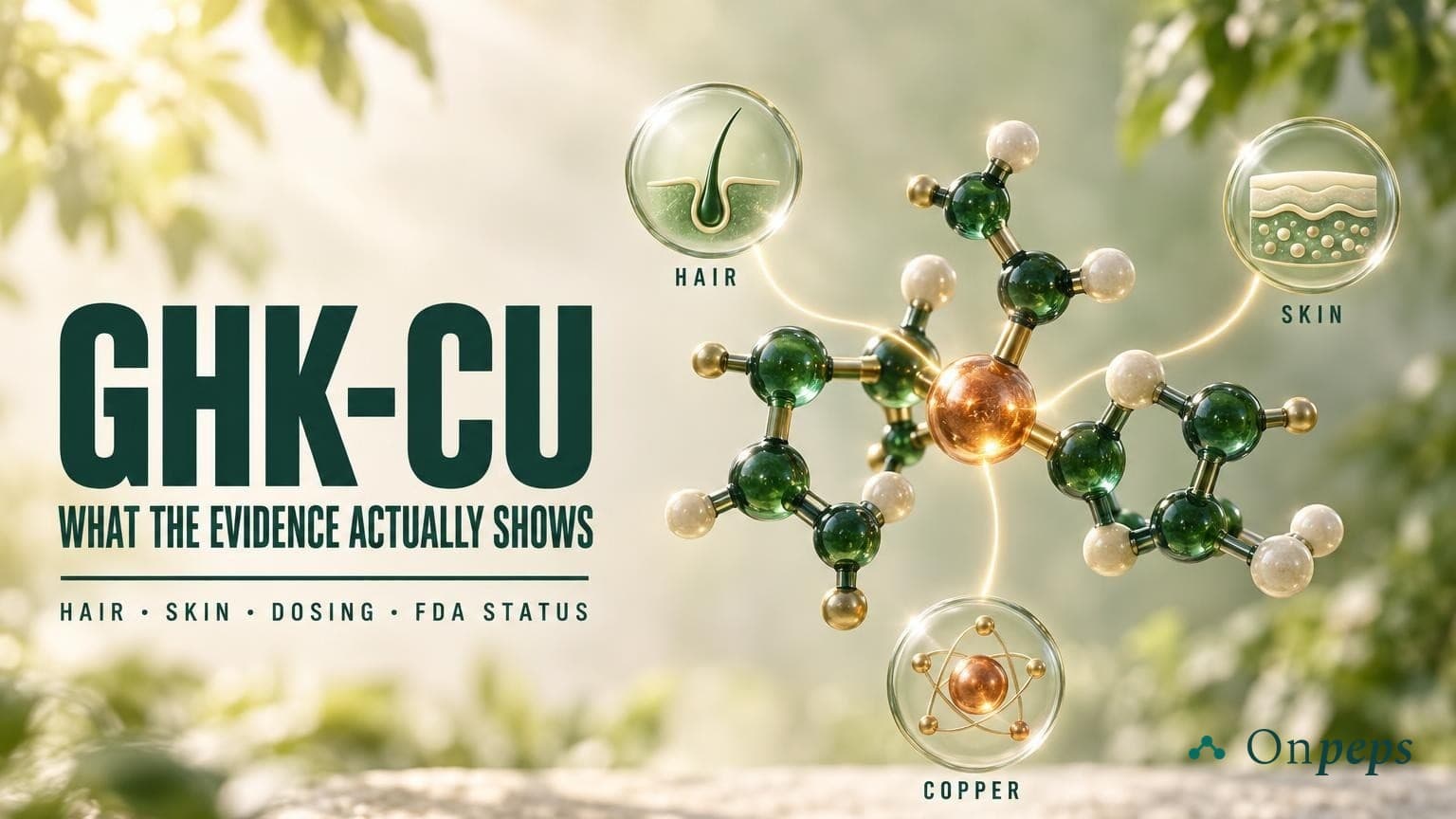
GHK-Cu is the only peptide most people meet twice: once in a face serum on a pharmacy shelf, and again as a lyophilized vial from a research vendor, where it is injected for skin, hair and "recovery." Searches for it have climbed steadily all year, and the fastest-growing question is a simple one: does it actually grow hair?
The honest answer is more interesting than yes or no. The molecule is real, the cell biology is real, and the human evidence is a handful of small trials, half of them null, none of them testing the injection people are buying. Let's dive in.
TLDR
What is it? A three-amino-acid peptide (glycine-histidine-lysine) that binds copper tightly. It occurs naturally in human plasma and is sold as "copper tripeptide-1" in skincare.
Results: Three controlled human skin trials, all topical: one positive (wrinkles, 40 women), two null on every objective measure. No controlled human trial has tested GHK-Cu alone for hair loss. No human trial of any kind has tested it injected.
Dosage: Community injectable protocols cluster at 1–2 mg a day for 4–8 weeks. A 50 mg vial with 5 mL of bacteriostatic water gives 10 mg/mL, so 1 mg is 10 units. No validated protocol exists.
Safety: Low irritation in a skin-cell model. The systemic signals (immunosuppression and liver changes in rodents) used copper-free GHK at high doses. Injecting it adds a copper load the gut never gets to regulate.
Legal Status (October 2026): Not FDA approved for anything. Topical GHK-Cu is a cosmetic ingredient and is under FDA evaluation for compounding, with an advisory committee review due before the end of February 2027. The injectable nomination was withdrawn, so injectable GHK-Cu is not before the FDA at all.
What Is GHK-Cu, and Why Is Everyone Searching for It Now?
GHK was identified in 1977 as the growth-modulating tripeptide in human serum (Schlesinger et al., 1977, Experientia, PMID 858356). Three years later the same group proposed in Nature that it works by ferrying copper into cells (Pickart et al., 1980, Nature, PMID 7453802). Add the copper and you get GHK-Cu, the form sold almost everywhere.
Two facts shape everything downstream. The GHK sequence sits inside type I collagen, so the original theory was that it gets released at a wound as a "damage happened here" signal. And its plasma level falls with age, from roughly 200 ng/mL at 20 to roughly 80 ng/mL at 60 (Dou et al., 2020, Aging Pathobiology and Therapeutics, PMID 35083444). That second number is the source of every "you lose 60% of your copper peptide" claim you've seen.
A falling biomarker is not automatically a deficiency. No human study has tested whether topping GHK back up does anything.
So why now? Three things landed in 2026. In April, the nominations to let compounding pharmacies make GHK-Cu were withdrawn, and in May one nominator reinstated the non-injectable route only, which put topical GHK-Cu on an FDA review clock. A systematic review of GHK-Cu in aesthetic medicine was published in August (Mokhtar et al., 2026, Aesthetic Surgery Journal, PMID 42619529). And GHK-Cu became the main ingredient of the GLOW and KLOW vendor blends, where it makes up most of the vial by weight. The rising searches follow: "does GHK-Cu help with hair growth" up 170% over 90 days, "what is GHK-Cu peptide used for" up 140%, "GHK-Cu dosing guide" up 60%.
How Does GHK-Cu Work?
In cell culture, GHK-Cu stimulates collagen and glycosaminoglycan synthesis by fibroblasts, nudges the enzymes that remodel tissue (the MMPs and their inhibitors), and promotes new blood vessel growth. Those are the effects every product page lists, and they are genuinely documented in the lab.
Here's the caveat that gets dropped: it is not clear the peptide is doing the work. A 1982 study found that three chemically unrelated copper carriers (ceruloplasmin, heparin and GHK) all triggered blood vessel growth in the cornea, and only when they carried copper (Raju et al., 1982, Journal of the National Cancer Institute, PMID 6182332). A 2000 study found an enzyme effect reproduced by copper ions but not by the peptide alone (Siméon et al., 2000, Life Sciences, PMID 11045606), while a 2012 Korean study found copper-free GHK worked about as well as the complex on skin stem cells (Choi et al., 2012, Journal of Peptide Science, PMID 23019153). The literature contradicts itself, and our GHK-Cu library entry lays out both sides.
The dose response matters too. In cell culture the collagen effect peaked at around 1 nanomolar (Maquart et al., 1988, FEBS Letters, PMID 3169264), and the glycosaminoglycan curve was explicitly biphasic, falling back to baseline at higher concentrations (Wegrowski et al., 1992, Life Sciences, PMID 1522753). One rat wound study ran the other way, rising with dose across the range tested (Maquart et al., 1993, Journal of Clinical Investigation, PMID 8227353).
"More is better" has no clean support for this molecule, and one clear counterexample.
Then there's the skin barrier. GHK-Cu is strongly water-loving and the outer skin layer is oily. A 2015 study using human skin models found almost no peptide or copper crossed intact skin in nine hours, and delivery only worked after microneedling (Li et al., 2015, Pharmaceutical Research, PMID 25690343). A 2010 study measured substantial copper getting through over 48 hours, but it measured the copper, not the intact peptide, under conditions nothing like a morning serum (Hostynek et al., 2010, Inflammation Research, PMID 20703511). How much of a serum reaches living skin is genuinely unknown.
GHK-Cu vs the Alternatives
| Option | What it is | Best human evidence | US status (October 2026) |
|---|---|---|---|
| GHK-Cu, topical | Copper tripeptide-1 in a serum or cream | One positive 40-person wrinkle trial; two null trials (ulcers, post-laser) | Cosmetic ingredient; under FDA compounding evaluation, committee review before end of Feb 2027 |
| GHK-Cu, injected | Same molecule, research-vendor vial, subcutaneous | None. No human study of injected GHK-Cu exists | Not approved; nomination withdrawn, so not under review |
| AHK-Cu | A different copper tripeptide (alanine instead of glycine) | Human hair follicles grown in a dish; no clinical trial | Not approved |
| Palmitoyl tripeptide-1 (Pal-GHK) | Copper-free GHK with a fatty tail to help it into skin; part of Matrixyl 3000 | Matrixyl 3000, which contains it, lost to GHK-Cu on wrinkle volume in the 2016 trial | Cosmetic ingredient |
| Minoxidil, topical | A vasodilator repurposed for hair | Decades of randomized trials | FDA approved for pattern hair loss, over the counter |
If your goal is hair, the last row is the one with the evidence. GHK-Cu is, at best, an add-on whose own contribution nobody has isolated.
What the Evidence Actually Shows
Let's separate what has been published from what is still running. Every human study below used a topical product or a complex that is not plain GHK-Cu.
| Study | What was tested | Result | Status |
|---|---|---|---|
| Bishop et al., 1992, venous leg ulcers | 0.4% GHK-Cu cream vs silver sulfadiazine vs placebo, 86 patients, blinded evaluators | Silver sulfadiazine won. GHK-Cu vs placebo: no difference | Published (J Vasc Surg, PMID 1495150) |
| Miller et al., 2006, after CO2 laser | Regimens with or without GHK-Cu, 13 patients | No objective improvement in redness, wrinkles or skin quality. Patients reported more satisfaction | Published (Arch Facial Plast Surg, PMID 16847171) |
| Badenhorst et al., 2016, facial wrinkles | GHK-Cu in a lipid nanocarrier vs control serum vs Matrixyl 3000, 40 women, 8 weeks, double-blind | Wrinkle volume down 55.8% vs control serum, depth down 32.8%; beat Matrixyl 3000 on volume | Published, not indexed in PubMed |
| Lee et al., 2016, male pattern hair loss | 5-aminolevulinic acid plus copper-free GHK, 45 men, 6 months | Hair count up 71.5 (lower dose) and 52.6 (higher dose) vs 9.6 placebo; no change in length or thickness | Published (Ann Dermatol, PMID 27489425) |
| Kuceki et al., 2025, hair "tattooing" | Minoxidil + dutasteride + 1.2% copper peptides driven into the scalp by tattoo machine, 7 men | Median 26.5% top-scalp regrowth; no control arm, retrospective | Published (JAAD Int, PMID 40225275) |
| NCT07437586, acute wounds | Topical GHK-Cu gel vs vehicle, 60 participants, quadruple-masked | No results yet; primary completion 14 February 2027 | Recruiting |
Does GHK-Cu help with hair growth?
This is the question driving the searches, so let's walk the evidence ladder rung by rung.
The animal rung: a copper-binding peptide coded PC1031 enlarged hair follicles on rats, with an effect the authors compared to topical minoxidil (Uno and Kurata, 1993, Journal of Investigative Dermatology, PMID 8326148). The abstract does not give PC1031's sequence. A 1991 mouse report on "peptide copper complexes" came from the company developing them, with GHK's discoverer as a co-author (Trachy et al., 1991, Annals of the NY Academy of Sciences, PMID 1809108).
The lab rung: the study most often quoted as proof that "GHK-Cu grows human hair" is Pyo et al. (2007, Archives of Pharmacal Research, PMID 17703734). It grew human hair follicles in a dish and they elongated. But read the methods: the molecule was AHK-Cu, alanine-histidine-lysine-copper. It is a cousin of GHK-Cu, not the same compound. The 2025 tattooing paper cites that study as its reason for adding copper peptides.
The human rung: Lee et al. (2016) is the only placebo-controlled hair trial with a GHK component, and it tested GHK without copper, bound to 5-aminolevulinic acid. Hair counts rose. The lower dose beat the higher one, and hair thickness didn't change. The 2025 tattooing study mixed copper peptides with two drugs that already work for hair loss, in seven men, with no control group.
No controlled human trial has tested GHK-Cu alone for hair loss. The hair claim rests on a cousin molecule in a dish, a different complex in one trial, and a cocktail in seven men.
That doesn't mean it does nothing for hair. It means nobody knows, and anyone telling you otherwise is quoting the wrong study.
What about the skin claims?
The single strong positive is the 2016 wrinkle trial, and it used a specific lipid nanocarrier built to get past the barrier problem described above. That result does not transfer to an ordinary serum, and it certainly does not transfer to an injection.
The largest trial GHK-Cu has ever had, 86 ulcer patients in 1992, was null. It almost never appears on product pages. The 2006 laser trial is the other half of the story: every objective measure was null and only patient satisfaction moved, yet it surfaces in reviews as "improved satisfaction after resurfacing." Each step is accurate on its own. The endpoint is not the one people think.
A note on who generates the evidence: much of the review literature on GHK-Cu, including a widely cited 2018 review, comes from authors affiliated with a company that sells copper peptide products (Pickart and Margolina, 2018, International Journal of Molecular Sciences, PMID 29986520). That isn't misconduct, but you should read it knowing who wrote it.
GHK-Cu Dosage: What Trials Used vs What the Community Reports
Let's be plain: no validated GHK-Cu protocol exists for any route. The trials were creams and gels. Nothing below comes from a human study of injected GHK-Cu, because there isn't one.
Topical: The 1992 ulcer cream was 0.4% GHK-Cu. The 2025 tattooing solution was 1.2% copper peptides. Cosmetic serums are applied once or twice daily. Concentration alone tells you little, because the vehicle decides how much gets through.
Injectable (community): Reported protocols cluster around 1–2 mg subcutaneously per day for 4–8 weeks, then a break. That range comes from vendor and forum protocols, not from any trial.
The arithmetic, for a 50 mg vial on a U-100 insulin syringe (100 units = 1 mL):
| Bacteriostatic water added | Concentration | 1 mg dose | 2 mg dose | Doses per vial at 2 mg |
|---|---|---|---|---|
| 2 mL | 25 mg/mL | 4 units | 8 units | 25 |
| 3 mL | 16.7 mg/mL | 6 units | 12 units | 25 |
| 5 mL | 10 mg/mL | 10 units | 20 units | 25 |
The 5 mL mix is the easiest to read, since every 10 units is 1 mg. Check your own numbers with the reconstitution calculator and the dosage calculator, and remember that the label on a research vial is only as good as the vendor's testing.
The copper math nobody does
GHK-Cu is about 16% copper by weight. A 2 mg daily injection carries roughly 0.3 mg of elemental copper, and a full 50 mg vial carries about 8 mg. For scale, the adult recommended intake is 0.9 mg a day and the upper limit is 10 mg a day (NIH Office of Dietary Supplements).
On paper that looks modest. The catch is the route. The gut is where your body controls how much copper it absorbs, and an injection skips it. No human study has measured what weeks of injected copper peptide do to copper status. Unknown, not reassuring.
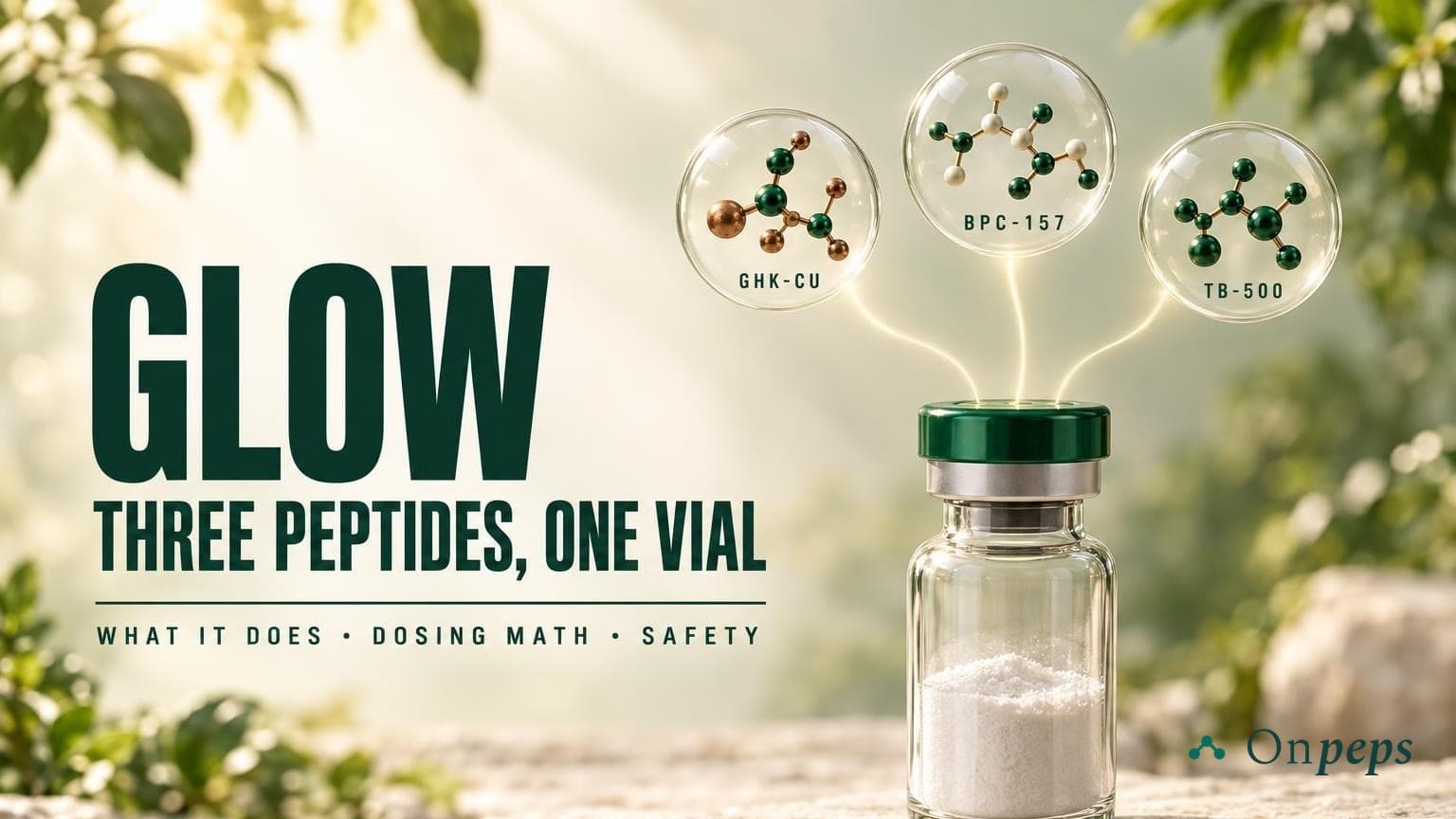
If you're running a GLOW or KLOW blend, the copper decides itself: GHK-Cu is most of the vial, so your copper dose rides along with whatever you dose the BPC-157 to. Our GLOW breakdown and KLOW breakdown run those numbers.
GHK-Cu Side Effects and Safety
On skin, the data are reassuring. In a cultured skin-cell model, GHK-Cu was not toxic and did not switch on irritation markers, while copper chloride and copper acetate at the same copper concentration did (Li et al., 2016, Scientific Reports, PMID 27892491). That's a dish, not a patch test on people, but it points the right way.
Injected, the picture changes. The FDA's own stated concern about compounded injectable GHK-Cu is that it "may pose risk for immunogenicity due to the potential for aggregation and peptide-related impurities," and that there are limited human data. That wording is about manufacturing quality as much as the molecule.
Then there are the rodent signals, with an important qualifier: they used copper-free GHK, not the complex. Ten injections at 1.5 to 450 mg/kg dose-dependently suppressed immune responses in rats (Smakhtin et al., 2002, Bulletin of Experimental Biology and Medicine, PMID 12447473), and a companion paper reported liver changes at the higher dose (Smakhtin et al., 2003, PMID 12838768). Those doses are far above anything a person injects. They are also the only systemic toxicity data that exist.
Two more threads worth knowing. GHK interacts with the angiotensin II AT1 receptor in rat liver cells, the same receptor that blood-pressure drugs like losartan block (García-Sáinz and Olivares-Reyes, 1995, Peptides, PMID 8545239). And GHK stimulated proliferation of a rat liver cancer cell line (Barra, 1987, Cytobios, PMID 3319436). Neither has been studied in people.
The mechanistic concerns are real, and the clinical evidence for harm is absent. Those are two separate facts, and the gap between them is a gap in research, not a safety record.
Who should skip it: anyone with Wilson's disease or another copper-handling disorder; anyone pregnant or breastfeeding, since no safety data exist; anyone with active or suspected cancer, given the pro-angiogenic biology. If you take blood-pressure medication, that AT1 finding is a reason to tell your doctor what you're using.
The gray-market record: we found no published case report or FDA warning letter tied specifically to injected GHK-Cu. That is not the same as safe. The bigger documented risk with research vials is what else is in them, which is why our GHK-Cu sourcing guide and the community ratings on ONPEPS vendor boards exist. The Paradigm Peptides case shows what "research use only" protects you from: nothing.
Is GHK-Cu Legal? The FDA Situation
GHK-Cu holds no FDA approval for any medical use. Beyond that, the topical and injectable forms are on two different tracks, and most coverage gets this wrong.
Topical (non-injectable). The FDA's list of substances nominated for pharmacy compounding, updated 14 May 2026, records that the GHK-Cu nominations were withdrawn on 22 April 2026. On 5 May one nominator clarified it only meant to drop the injectable route. So GHK-Cu "except for injectable routes of administration" went back into Category 1, under evaluation. The FDA says it intends to consult its Pharmacy Compounding Advisory Committee before the end of February 2027. Meanwhile, GHK-Cu remains an ordinary cosmetic ingredient. A cosmetic doesn't need FDA approval, but a product that claims to treat a condition, such as regrowing hair, is legally a drug.
Injectable. The FDA's Category 2 safety page now lists injectable GHK-Cu among the substances "withdrawn by the nominators," with its safety note kept. With no live nomination, injectable GHK-Cu is not before the committee at all. That isn't a ruling against it, but nothing is pending that could make it a legal compounded drug. It is not one of the six peptides the committee backed in July; see our July 2026 FDA update for that vote.
Sport. GHK-Cu is not named on the WADA Prohibited List. The list's S0 catch-all covers substances with no regulatory approval for human therapeutic use, so tested athletes should ask their federation before injecting it.
The Honest Take
GHK-Cu is a real molecule with fifty years of genuine biology behind it. It is not a scam ingredient. It is also far less proven than its marketing suggests.
For skin, a well-formulated serum has one decent trial behind it and costs little. That's a reasonable bet as long as you know it's a bet. For hair, the human evidence for GHK-Cu alone doesn't exist yet; it is an add-on to minoxidil, not a replacement. For injection, you are taking a compound whose only human trials were creams, adding a copper load your gut never sees, and relying on a research vendor's purity. The FDA has nothing pending on that route.
The study that will tell us most is the 60-person wound-gel trial due to finish in February 2027, the same month the FDA committee is due to look at topical GHK-Cu. Both will be about the cream, not the vial.
FAQ
What is GHK-Cu peptide used for?
Mostly skin: wrinkles, firmness and post-procedure recovery, as a cosmetic serum. Research-vendor vials are also injected for skin, hair and tissue repair, uses with no human trial behind them.
Does GHK-Cu help with hair growth?
Unproven. The famous follicle study used a different molecule (AHK-Cu), the one placebo-controlled human trial used copper-free GHK with 5-ALA, and no controlled trial of GHK-Cu alone for hair loss exists.
Is GHK-Cu FDA approved?
No, not for any medical use. Topical GHK-Cu is a legal cosmetic ingredient and under FDA compounding evaluation. Injectable GHK-Cu has no pending nomination.
GHK-Cu injection vs topical: which is better?
Topical is the only route with human trial data, and it's mixed. Injection has no human data at all. "Better absorption" is a theory, not a measured outcome.
What is the GHK-Cu dosage?
Community injectable protocols use 1–2 mg a day for 4–8 weeks. With 5 mL of bacteriostatic water in a 50 mg vial, that is 10–20 units. No validated dose exists.
Is GHK-Cu safe?
Topically it looks low-irritation in lab models. Injected, there are no human data; the rodent signals (immune suppression, liver changes) came from copper-free GHK at very high doses.
Is GHK-Cu the same as copper peptides?
It's the best known one. "Copper peptides" on a label can also mean AHK-Cu or blends with other copper complexes, which are different compounds with their own, even thinner, evidence.
Can I use GHK-Cu with vitamin C?
Many people separate them, and there's a chemical reason: in a test tube, copper-GHK plus ascorbate generated hydroxyl radicals (Guilloreau et al., 2007, ChemBioChem, PMID 17577900). Nobody has tested whether that matters on skin. Using them at different times of day is the cautious choice.
How long does GHK-Cu take to work?
The positive wrinkle trial measured at 8 weeks, and the hair trial with copper-free GHK at 6 months. Anything faster is anecdote.
Is GHK-Cu banned in sports?
It isn't named on the WADA list, but the catch-all for unapproved substances may apply to injectable use. Check with your federation.
Why is GHK-Cu in GLOW and KLOW?
Vendors pair it with BPC-157 and TB-500 for "skin plus repair." In the common 70 mg GLOW vial, 50 mg is GHK-Cu, so the copper peptide is most of what you inject.
Resources
Schlesinger, Pickart and Thaler (1977), Experientia, identification of GHK in human serum — https://pubmed.ncbi.nlm.nih.gov/858356/
Pickart et al. (1980), Nature, the copper-uptake hypothesis — https://pubmed.ncbi.nlm.nih.gov/7453802/
Dou et al. (2020), Aging Pathobiology and Therapeutics, the age-decline figure — https://pubmed.ncbi.nlm.nih.gov/35083444/
Mokhtar et al. (2026), Aesthetic Surgery Journal, systematic review in aesthetic medicine — https://pubmed.ncbi.nlm.nih.gov/42619529/
Raju et al. (1982), Journal of the National Cancer Institute, copper carriers and angiogenesis — https://pubmed.ncbi.nlm.nih.gov/6182332/
Siméon et al. (2000), Life Sciences, MMP-2 effect reproduced by copper alone — https://pubmed.ncbi.nlm.nih.gov/11045606/
Choi et al. (2012), Journal of Peptide Science, copper-free GHK on skin stem cells — https://pubmed.ncbi.nlm.nih.gov/23019153/
Maquart et al. (1988), FEBS Letters, collagen synthesis in fibroblasts — https://pubmed.ncbi.nlm.nih.gov/3169264/
Wegrowski et al. (1992), Life Sciences, biphasic glycosaminoglycan response — https://pubmed.ncbi.nlm.nih.gov/1522753/
Maquart et al. (1993), Journal of Clinical Investigation, rat wound dose response — https://pubmed.ncbi.nlm.nih.gov/8227353/
Li et al. (2015), Pharmaceutical Research, skin permeation with and without microneedles — https://pubmed.ncbi.nlm.nih.gov/25690343/
Hostynek, Dreher and Maibach (2010), Inflammation Research, copper penetration over 48 hours — https://pubmed.ncbi.nlm.nih.gov/20703511/
Bishop et al. (1992), Journal of Vascular Surgery, venous ulcer trial — https://pubmed.ncbi.nlm.nih.gov/1495150/
Miller et al. (2006), Archives of Facial Plastic Surgery, post-laser trial — https://pubmed.ncbi.nlm.nih.gov/16847171/
Badenhorst et al. (2016), facial wrinkle trial, not indexed in PubMed — https://www.researchgate.net/publication/312416949_Effects_of_GHK-Cu_on_MMP_and_TIMP_Expression_Collagen_and_Elastin_Production_and_Facial_Wrinkle_Parameters
Lee et al. (2016), Annals of Dermatology, 5-ALA plus GHK for male pattern hair loss — https://pubmed.ncbi.nlm.nih.gov/27489425/
Pyo et al. (2007), Archives of Pharmacal Research, AHK-Cu on human hair follicles in vitro — https://pubmed.ncbi.nlm.nih.gov/17703734/
Uno and Kurata (1993), Journal of Investigative Dermatology, PC1031 in rats — https://pubmed.ncbi.nlm.nih.gov/8326148/
Trachy et al. (1991), Annals of the New York Academy of Sciences, copper peptides in mice — https://pubmed.ncbi.nlm.nih.gov/1809108/
Kuceki et al. (2025), JAAD International, minoxidil-dutasteride-copper peptide tattooing — https://pubmed.ncbi.nlm.nih.gov/40225275/
Pickart and Margolina (2018), International Journal of Molecular Sciences, review by authors affiliated with a copper peptide supplier — https://pubmed.ncbi.nlm.nih.gov/29986520/
Li et al. (2016), Scientific Reports, skin-cell irritation markers — https://pubmed.ncbi.nlm.nih.gov/27892491/
Smakhtin et al. (2002), Bulletin of Experimental Biology and Medicine, GHK as an immunosuppressor in rodents — https://pubmed.ncbi.nlm.nih.gov/12447473/
Smakhtin et al. (2003), Patologicheskaia Fiziologiia, liver changes at high dose — https://pubmed.ncbi.nlm.nih.gov/12838768/
García-Sáinz and Olivares-Reyes (1995), Peptides, AT1 receptor interaction — https://pubmed.ncbi.nlm.nih.gov/8545239/
Barra (1987), Cytobios, hepatoma cell proliferation — https://pubmed.ncbi.nlm.nih.gov/3319436/
Guilloreau et al. (2007), ChemBioChem, hydroxyl radical generation with ascorbate — https://pubmed.ncbi.nlm.nih.gov/17577900/
US FDA (2026), Bulk Drug Substances Nominated for Use in Compounding Under Section 503A, updated 14 May 2026 — https://www.fda.gov/media/94155/download
US FDA (2026), Certain Bulk Drug Substances for Use in Compounding that May Present Significant Safety Risks, content current 22 April 2026 — https://www.fda.gov/drugs/human-drug-compounding/certain-bulk-drug-substances-use-compounding-may-present-significant-safety-risks
US FDA, Is It a Cosmetic, a Drug, or Both? — https://www.fda.gov/cosmetics/cosmetics-laws-regulations/it-cosmetic-drug-or-both-or-it-soap
ClinicalTrials.gov, NCT07437586, topical GHK-Cu gel for acute wounds — https://clinicaltrials.gov/study/NCT07437586
NIH Office of Dietary Supplements, Copper fact sheet for health professionals — https://ods.od.nih.gov/factsheets/Copper-HealthProfessional/
ONPEPS peptide library, GHK-Cu entry — https://www.onpeps.com/peptides/ghk-cu