Three months ago almost nobody in the United States was searching for survodutide. Between early August and this week, US search interest rose roughly twelvefold, from a small base, and one of the top related searches is now "survodutide vs retatrutide". Two Phase 3 papers in the New England Journal of Medicine in four months will do that.
Here's the problem. The number you'll see everywhere is 16.6% weight loss, and the same trial's headline analysis says 13.0%. Both are real. They answer different questions, and the gap between them is most of what you need to understand about this drug. So what is survodutide, what has actually been shown, and how does it stack up against retatrutide? Let's dive in.
TLDR
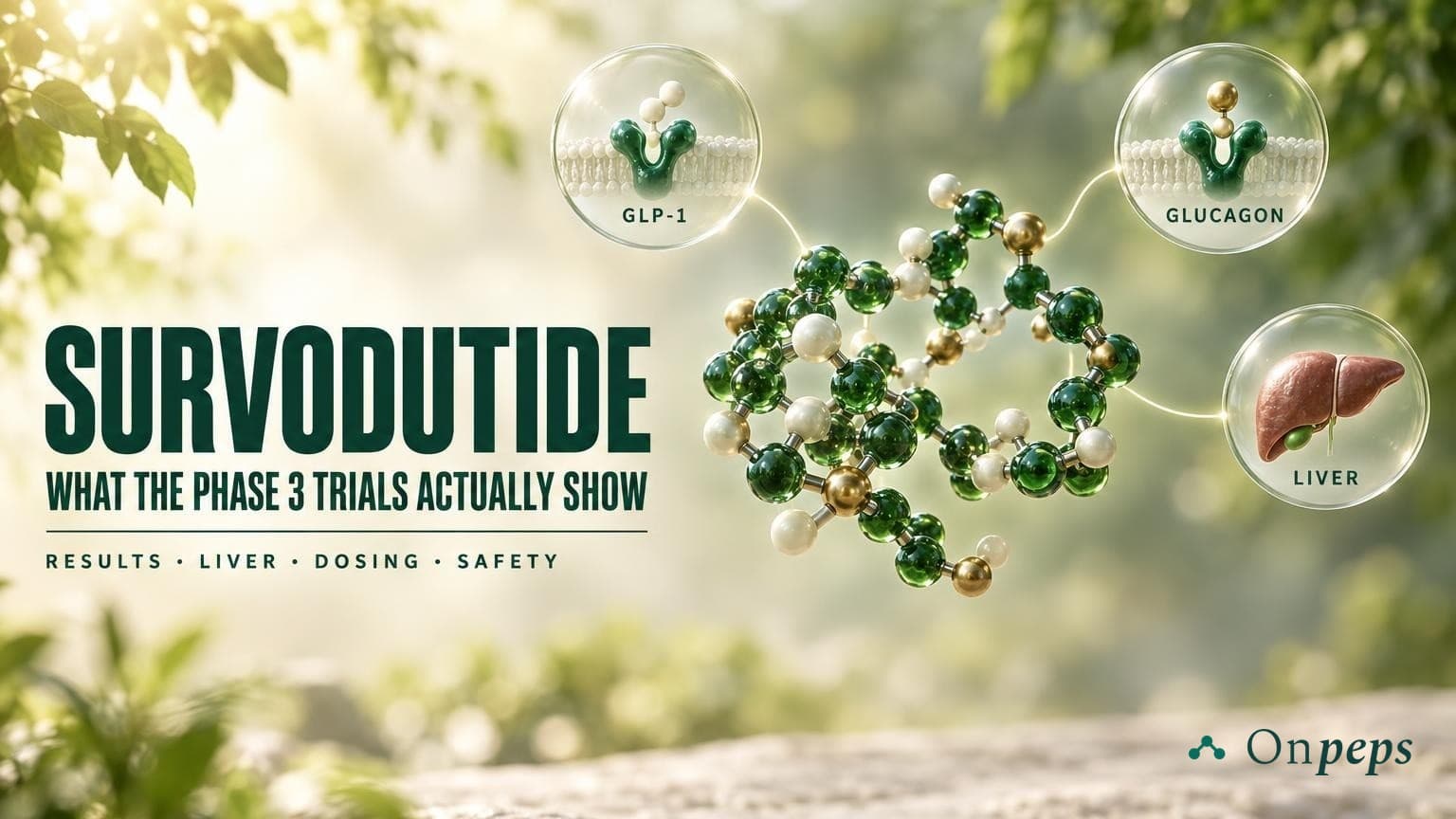
What is survodutide? An investigational once-weekly injectable (code BI 456906) from Boehringer Ingelheim, licensed from Zealand Pharma. It activates two receptors: GLP-1, which cuts appetite, and glucagon, which pushes energy use and acts on the liver.
Results: In SYNCHRONIZE-1, adults with obesity lost 13.0% of body weight at 76 weeks on 6 mg against 5.4% on placebo, counting everyone. If you count only time on the assigned drug, it was 16.6% against 3.2%. In people with type 2 diabetes the same two figures were 9.8% and 13.1%.
Dosage: Phase 3 used 3.6 mg and 6.0 mg once weekly, reached by slow dose escalation. No validated protocol exists outside a trial.
Safety: Gastrointestinal effects hit 81% to 90% of participants in SYNCHRONIZE-1, and about 18% to 20% stopped treatment because of them, against 2.9% on placebo. Heart rate rose by about 3 to 4 beats per minute.
Legal Status (November 2026): Not approved anywhere. Boehringer has not announced a filing. It is not one of the six peptides in the HHS compounding policy, and the FDA has named it in warning letters to online sellers.
What Is Survodutide, and Why Is It Trending Now?
Survodutide is a synthetic peptide with a C18 fatty acid attached, which is what stretches its half-life far enough for a weekly shot (Zimmermann et al., 2022, Molecular Metabolism, PMID 36356832). Its dual action echoes oxyntomodulin, a gut hormone that naturally activates both the GLP-1 and glucagon receptors.
Three things pushed it into the conversation this year:
- June 7: SYNCHRONIZE-1 was published in NEJM at the American Diabetes Association meeting, alongside the liver-focused SYNCHRONIZE-MASLD trial in Nature Medicine.
- August 24: the FDA sent a warning letter to NuScience Peptides that listed survodutide among its products. So it's already in the gray market.
- October 1: SYNCHRONIZE-2, the type 2 diabetes trial, was published in NEJM and presented at the European diabetes meeting.
The next event is close. SYNCHRONIZE-CVOT, the 5,530-person cardiovascular safety trial, is listed as completed on 30 June 2026 with no results posted. Boehringer expects to present it later this year (AJMC, October 2026). We found no sign it has been presented yet.
How Does Survodutide Work?
Think of it as two jobs handled by one molecule.
The GLP-1 side does what every drug in this class does. It slows the stomach and reduces hunger through the brain. A 2026 mouse and human tissue study found survodutide reaches appetite centres directly, through regions without a full blood-brain barrier. It also found glucagon receptors barely detectable there, while a glucagon-only drug cut body weight without cutting food intake (Zimmermann et al., 2026, Molecular Metabolism, PMID 41638399).
That points to a clean split, at least in animals. GLP-1 reduces what you eat. Glucagon raises what you burn, with the liver as a key site.
Glucagon sounds like an odd choice, since it raises blood sugar in the short term. But the GLP-1 arm counters that, and the liver is where this drug tries to set itself apart. In a post hoc analysis of the Phase 2 MASH trial, most of the improvement in liver fat tracked with weight loss, while most of the improvement in fibrosis did not: only 36.3% of the fibrosis effect was explained by weight (Noureddin et al., 2026, Hepatology, PMID 42545725).
Post hoc means it was done after the fact, on 170 people. It's a hypothesis with numbers attached, not proof.
The other difference from retatrutide is what's missing. Retatrutide adds a third target, GIP. Survodutide doesn't have it.
Survodutide vs Retatrutide, Tirzepatide and Mazdutide
Here's the caveat that gets dropped in almost every comparison: no trial has put survodutide head to head against any of these at obesity doses. Every line below comes from a separate trial, with different people, durations and analysis methods. Read it as context, not as a ranking.
| Compound | Targets | Status | Weight result, counting everyone randomised |
|---|---|---|---|
| Survodutide | GLP-1 + glucagon | Boehringer / Phase 3, not filed | 13.0% at 76 weeks (6 mg) |
| Mazdutide | GLP-1 + glucagon | Innovent / approved in China, June 2025 | 14.0% at 48 weeks in Chinese adults, mean BMI 31 (6 mg) |
| Retatrutide | GIP + GLP-1 + glucagon | Lilly / Phase 3, FDA filing planned Q1 2027 | 25.0% at 80 weeks vs 3.9% placebo (12 mg, TRIUMPH-1) |
| Tirzepatide | GIP + GLP-1 | Lilly / approved | 20.9% at 72 weeks (SURMOUNT-1) |
| Semaglutide | GLP-1 | Novo Nordisk / approved | About 15% at 68 weeks (STEP 1) |
On those numbers survodutide is not winning the weight-loss race. Using the same counting-everyone approach, its Phase 3 obesity result sits below tirzepatide's and about half of retatrutide's.
Its closest match is mazdutide, which has the same two targets. See our retatrutide guide for how the triple agonist's numbers break down, and tirzepatide and semaglutide in the library.
What the Evidence Actually Shows
Why there are two answers to "how much weight"
SYNCHRONIZE-1 reported two estimands, which is the statistical term for the exact question an analysis asks.
The treatment-regimen estimand asks what happens to everyone who was randomised, including people who quit the drug early or used other obesity medication. The efficacy estimand asks what the drug does while people actually stay on it as assigned.
| SYNCHRONIZE-1, week 76 | 3.6 mg | 6.0 mg | Placebo |
|---|---|---|---|
| Treatment-regimen (primary) | −12.2% | −13.0% | −5.4% |
| Efficacy | −15.3% | −16.6% | −3.2% |
Look at placebo. A 5.4% loss is high for a placebo arm, and part of the reason is that roughly one in six placebo participants reportedly went on to use GLP-1 drugs outside the trial (AJMC, pharmaphorum). The treatment-regimen analysis counts that weight loss in the placebo column.
So the gap over placebo is 7.6 points one way and 13.4 points the other.
16.6% is what the drug can do if you stay on it. 13.0% is what happened to the people who were offered it. Neither is the wrong number, but they aren't interchangeable.
Also notice the doses. On the primary analysis, 6.0 mg beat 3.6 mg by less than one point, and 71.9% against 72.6% reached 5% weight loss.
Published trials
| Study | Design | Result | Status |
|---|---|---|---|
| le Roux et al., 2024, Phase 2 obesity (PMID 38330987) | 387 adults without diabetes, up to 4.8 mg, 46 weeks | −6.2% to −14.9% by dose vs −2.8% placebo. Only 60% completed treatment | Published (Lancet Diabetes & Endocrinology) |
| Blüher et al., 2024, Phase 2 diabetes (PMID 38095657) | 413 adults with type 2 diabetes, 16 weeks, open-label semaglutide arm | HbA1c down up to 1.71 points; weight down up to 8.7%. Semaglutide 1.0 mg: 1.47 points and 5.3% | Published (Diabetologia) |
| Sanyal et al., 2024, Phase 2 MASH (PMID 38847460) | 293 adults with biopsy-proven MASH and F1 to F3 fibrosis, 48 weeks | MASH improved in 47%, 62% and 43% on 2.4, 4.8 and 6 mg vs 14% placebo. Fibrosis improved in 34%, 36%, 34% vs 22% | Published (NEJM) |
| SYNCHRONIZE-1, le Roux et al., 2026 (PMID 42253238) | 725 adults with obesity, no diabetes, 76 weeks | −12.2% and −13.0% vs −5.4% placebo | Published (NEJM) |
| SYNCHRONIZE-2, Wharton et al., 2026 (PMID 42820639) | 752 adults with obesity and type 2 diabetes, 76 weeks | −8.2% and −9.8% vs −3.9%. HbA1c −0.9 and −0.8 points vs −0.2 from a 7.4% baseline | Published (NEJM) |
| SYNCHRONIZE-MASLD, Kaplan et al., 2026 (PMID 42252333) | 216 adults with obesity and at-risk fatty liver, 6 mg, 48 weeks | At least 30% liver-fat drop: 68.5% vs 28.6% (treatment-regimen), 84.2% vs 24.3% (efficacy). Weight −8.7% vs −1.4% | Published (Nature Medicine) |
The type 2 diabetes figures you may see quoted, up to 13.1% weight loss and up to 1.21 points of HbA1c, are the on-treatment versions (Boehringer Ingelheim). The published primary figures are the ones in the table.
Reported or unpublished
| Item | What's claimed | Status |
|---|---|---|
| SYNCHRONIZE-1 MRI substudy | Visceral fat down 34.0% vs 11.8%; liver fat down 63.1% vs 24.5% on 6 mg, about 25 people per arm | Conference data, reported by AJMC and CCJM |
| Muscle share of weight lost | About 10%, but coverage differs (9.8% vs 10.8%, and one report says "no more than 10%") | Conference data; treat as approximate |
| SYNCHRONIZE-CVOT | Heart safety in 5,530 people | Completed; no results public |
| LIVERAGE and LIVERAGE-Cirrhosis | Whether liver benefits hold on biopsy and clinical outcomes | Recruiting; estimated completion 2031 and 2029 |
Reading the liver data honestly
This is the strongest part of survodutide's case, and it needs two caveats.
First, the 2024 dose response was odd: 6 mg did worse on MASH than 4.8 mg. Second, the 2024 fibrosis improvement was only 34% to 36% against 22% on placebo in a Phase 2 trial, and SYNCHRONIZE-MASLD measured liver fat by MRI, not scarring by biopsy.
The FDA did give survodutide Breakthrough Therapy designation for MASH with fibrosis. That's a signal of interest, not of proof. The trials that can settle this aren't estimated to finish until 2029 and 2031.
Survodutide Dosage: Trials vs the Community
Let's be plain. No validated protocol exists for anyone outside a clinical trial. There is no approved dose and no label.
What the trials used
- Phase 3: once-weekly subcutaneous injection, up to 3.6 mg or 6.0 mg, for 76 weeks.
- Escalation: SYNCHRONIZE-MASLD took 24 weeks to reach 6.0 mg. The Phase 2 obesity trial took 20 weeks to reach its doses, with steps every two weeks, and the investigators later called that rapid (Wharton et al., 2025, Obesity, PMID 39495965).
- Flexibility: the same design paper says SYNCHRONIZE-1 and -2 used slower steps with one or two re-escalation attempts after GI symptoms. Coverage from ADA still described the regimen as rigid.
The exact week-by-week Phase 3 schedule isn't in the public material we could read, so we aren't printing one. A cirrhosis Phase 1 study started at 0.3 mg and reached 6.0 mg over 24 weeks (Lawitz et al., 2024, Journal of Hepatology, PMID 38857788). That confirms the start and finish, not the steps between.
What the community reports
Very little you can trust. Protocol sites list 0.3 mg to 6 mg weekly, which is just the trial range copied over, and one of them concedes there is no community consensus and that most discussion is analytical rather than personal use. We found no reliable body of user reports.
The vial math
If you're trying to understand what a dose means in practice, this is the arithmetic for a 10 mg vial. It's a calculation, not a recommendation or a schedule. Use the reconstitution calculator and dosage calculator for other sizes.
| Dose | 10 mg + 1 mL water (10 mg/mL) | 10 mg + 2 mL water (5 mg/mL) | Doses per vial |
|---|---|---|---|
| 0.3 mg | 0.03 mL (3 units) | 0.06 mL (6 units) | 33 |
| 0.6 mg | 0.06 mL (6 units) | 0.12 mL (12 units) | 16 |
| 2.4 mg | 0.24 mL (24 units) | 0.48 mL (48 units) | 4 |
| 3.6 mg | 0.36 mL (36 units) | 0.72 mL (72 units) | 2 |
| 4.8 mg | 0.48 mL (48 units) | 0.96 mL (96 units) | 2 |
| 6.0 mg | 0.60 mL (60 units) | 1.20 mL (two draws) | 1 |
Units assume a U-100 insulin syringe. Three units is hard to measure accurately, which is one reason the 5 mg/mL column is easier at low doses. Our retatrutide dosage chart explains the 28-day vial rule, which applies the same way to any peptide mixed with bacteriostatic water.
Survodutide Side Effects
Gastrointestinal: the headline issue
In SYNCHRONIZE-1, GI events occurred in 80.9% on 3.6 mg and 89.7% on 6.0 mg, against 47.9% on placebo. No deaths were reported.
The discontinuation numbers are what set this drug's debate. GI events ended treatment for 17.8% on 3.6 mg and 20.2% on 6.0 mg, against 2.9% on placebo. SYNCHRONIZE-2 reported 18% against 1.2%, and SYNCHRONIZE-MASLD 19.9% against 4.3%.
Around one in five people stopped because of their gut, in three separate trials. That's a big part of why the 16.6% and the 13.0% sit so far apart.
The clearest open-access breakdown comes from SYNCHRONIZE-MASLD at 6 mg:
| Event | Survodutide 6 mg | Placebo |
|---|---|---|
| Nausea | 56.2% | 14.3% |
| Vomiting | 42.5% | 7.1% |
| Diarrhea | 29.5% | 10.0% |
| Constipation | 28.1% | 10.0% |
| Serious adverse event | 9.6% | 11.4% |
Most of these occurred during dose escalation and were mild to moderate. The SYNCHRONIZE-MASLD authors note that other ongoing studies allow more dose flexibility, so it's fair to ask whether a gentler schedule would bring dropouts down. Nobody has shown that in Phase 3 yet.
Heart rate
Heart rate rose 3.2 to 3.5 beats per minute at week 76 in SYNCHRONIZE-1, and 3.6 against 0.8 in SYNCHRONIZE-MASLD at week 52. That's modest and in line with the wider class. Whether it matters over years is what the unreported cardiovascular trial exists to answer.
Pancreas, gallbladder and liver
SYNCHRONIZE-1 reportedly had no confirmed acute pancreatitis, pancreatic cancer or thyroid cancer, though asymptomatic rises in pancreatic enzymes were slightly more common on the drug. SYNCHRONIZE-MASLD had no adjudicated drug-induced liver injury, plus one case each of gallstones and gallbladder inflammation among 146 participants.
One limit to flag. The full safety tables for the two NEJM papers sit behind a paywall, so per-symptom rates for SYNCHRONIZE-1 and -2 aren't in this article. We'd rather leave a gap than guess.
The gray-market record
We found no published case reports of harm tied specifically to gray-market survodutide. That isn't reassurance, because nobody is tracking it. Every safety figure above was measured on pharmaceutical-grade drug under medical supervision, not on an unverified vial.
Is Survodutide Legal?
It is not approved in any market, and as of June, Boehringer and Zealand had not revealed filing plans. Outside forecasts of a filing in late 2026 or early 2027 are estimates, not company statements.
There's no clear compounding route either. It isn't one of the six peptides covered by the HHS draft enforcement-discretion policy published on 30 October, which are BPC-157, KPV, MOTS-c, Semax, TB-500 and epitalon. For more on what that policy does and doesn't do, see our breakdown of the temporary sale plan.
The "research use only" label offers no protection either. The FDA named survodutide in its December 2024 letter to Xcel Research and again on 24 August 2026 to NuScience Peptides, treating these products as unapproved new drugs.
The Honest Take
Survodutide is a real drug with real data. Three Phase 3 papers in major journals is a serious published record. That's worth respecting.
It's also not the strongest weight-loss drug in its pipeline, and the number on the headlines flatters it. On the primary analysis, adults without diabetes lost about 13%, with a placebo arm at 5.4%, and about one in five people stopped because of GI effects.
The case for it is the liver. If LIVERAGE confirms a fibrosis benefit beyond weight loss, survodutide has a reason to exist that a stronger pure weight-loss drug wouldn't automatically take away. If not, it's a mid-pack option arriving late.
If you're considering a vial: the molecule you'd buy isn't the one tested, the trials show this drug is hard to tolerate even under supervision, and approved options exist with stronger published weight-loss numbers. We can't see a good case for it.
FAQ
What is survodutide?
An investigational once-weekly injectable peptide from Boehringer Ingelheim that activates the GLP-1 and glucagon receptors. It's being studied for obesity, type 2 diabetes and MASH.
Is survodutide a peptide?
Yes. It's a synthetic peptide with a fatty acid attached to extend its half-life, which is why people search for it alongside research peptides. That doesn't make it legal to buy as one.
Is survodutide FDA approved?
No, and it isn't approved anywhere else. It holds FDA Breakthrough Therapy designation for MASH with fibrosis, which speeds review but isn't approval.
How much weight do you lose on survodutide?
In SYNCHRONIZE-1, 13.0% at 76 weeks on 6 mg counting everyone, or 16.6% counting only time on treatment. With type 2 diabetes, the figures were 9.8% and up to 13.1%.
Survodutide vs retatrutide: which is stronger?
Retatrutide's weight loss is much larger, 25.0% in TRIUMPH-1 against 13.0% in SYNCHRONIZE-1, but no trial has compared them directly. Retatrutide has a third target, GIP, while survodutide's main distinction is its liver programme.
Survodutide vs tirzepatide: which is better?
Tirzepatide reached 20.9% at 72 weeks in SURMOUNT-1 and is approved. Survodutide's numbers are lower, though those trials differ, and there's no head-to-head data.
Survodutide vs mazdutide: what's the difference?
Both target GLP-1 and glucagon. Mazdutide comes from Lilly and Innovent, was approved in China in June 2025, and reached 14.0% at 48 weeks in Chinese adults with a lower average BMI (Ji et al., 2025, NEJM, PMID 40421736).
What dose of survodutide was used in trials?
Phase 3 used 3.6 mg or 6.0 mg once weekly, after months of gradual escalation. There is no approved or validated dose outside a trial.
What are the side effects of survodutide?
Mainly nausea, vomiting, diarrhea and constipation, especially during dose escalation, plus a small heart-rate rise. About one in five participants stopped because of GI events.
Does survodutide help fatty liver?
In SYNCHRONIZE-MASLD, liver fat fell by at least 30% in 68.5% against 28.6% on placebo over 48 weeks. Whether that prevents liver scarring or cirrhosis is what the LIVERAGE trials are testing.
When will survodutide be available?
Nobody knows. Boehringer hasn't announced a filing date, and even a late-2026 filing would suggest a decision around 2027 at the earliest.
Can you buy survodutide online?
It's sold as a "research peptide", and the FDA has issued warning letters over those sales. There's no legal consumer source, and nothing guarantees what's in the vial.
Resources
le Roux CW et al. (2026), New England Journal of Medicine, SYNCHRONIZE-1 — https://pubmed.ncbi.nlm.nih.gov/42253238/
Wharton S et al. (2026), New England Journal of Medicine, SYNCHRONIZE-2 — https://pubmed.ncbi.nlm.nih.gov/42820639/
Kaplan LM et al. (2026), Nature Medicine, SYNCHRONIZE-MASLD — https://pubmed.ncbi.nlm.nih.gov/42252333/
le Roux CW et al. (2024), Lancet Diabetes & Endocrinology, Phase 2 obesity trial — https://pubmed.ncbi.nlm.nih.gov/38330987/
Blüher M et al. (2024), Diabetologia, Phase 2 type 2 diabetes trial — https://pubmed.ncbi.nlm.nih.gov/38095657/
Sanyal AJ et al. (2024), New England Journal of Medicine, Phase 2 MASH trial — https://pubmed.ncbi.nlm.nih.gov/38847460/
Noureddin M et al. (2026), Hepatology, post hoc mediation analysis — https://pubmed.ncbi.nlm.nih.gov/42545725/
Lawitz EJ et al. (2024), Journal of Hepatology, Phase 1 in cirrhosis — https://pubmed.ncbi.nlm.nih.gov/38857788/
Zimmermann T et al. (2022), Molecular Metabolism, discovery and preclinical pharmacology — https://pubmed.ncbi.nlm.nih.gov/36356832/
Zimmermann T et al. (2026), Molecular Metabolism, central site of action — https://pubmed.ncbi.nlm.nih.gov/41638399/
Wharton S et al. (2025), Obesity, SYNCHRONIZE-1 and -2 design — https://pubmed.ncbi.nlm.nih.gov/39495965/
Ji L et al. (2025), New England Journal of Medicine, mazdutide GLORY-1 — https://pubmed.ncbi.nlm.nih.gov/40421736/
Jastreboff AM et al. (2026), New England Journal of Medicine, retatrutide TRIUMPH-1 — https://pubmed.ncbi.nlm.nih.gov/42814954/
Jastreboff AM et al. (2022), New England Journal of Medicine, tirzepatide SURMOUNT-1 — https://pubmed.ncbi.nlm.nih.gov/35658024/
Wilding JPH et al. (2021), New England Journal of Medicine, semaglutide STEP 1 — https://pubmed.ncbi.nlm.nih.gov/33567185/
AJMC (June 2026), SYNCHRONIZE-1 safety and body-composition reporting from ADA — https://www.ajmc.com/view/survodutide-phase-3-data-signal-metabolic-gains-beyond-weight-loss
AJMC (October 2026), SYNCHRONIZE-2 reporting and CVOT timing — https://www.ajmc.com/view/dual-agonist-survodutide-delivers-up-to-13-1-weight-loss-in-t2d
pharmaphorum (June 2026), ADA coverage, filing plans and tolerability — https://pharmaphorum.com/news/ada-safety-data-offset-efficacy-survodutide
Cleveland Clinic Journal of Medicine, ADA 2026 summary — https://www.ccjm.org/page/ada-2026/survodutide-weight
Boehringer Ingelheim (2026), SYNCHRONIZE-2 data — https://www.boehringer-ingelheim.com/us/human-health/metabolic-diseases/new-phase-iii-data-people-obesity-and-diabetes
ClinicalTrials.gov, SYNCHRONIZE-CVOT, NCT06077864 — https://clinicaltrials.gov/study/NCT06077864
ClinicalTrials.gov, LIVERAGE, NCT06632444 — https://clinicaltrials.gov/study/NCT06632444
ClinicalTrials.gov, LIVERAGE-Cirrhosis, NCT06632457 — https://clinicaltrials.gov/study/NCT06632457
HHS (2026), Federal Register, draft enforcement-discretion policy — https://www.federalregister.gov/documents/2026/10/30/2026-22192/enforcement-discretion-policy-regarding-503a-compounding-using-certain-peptide-bulk-drug-substances
FDA (2026), warning letter to NuScience Peptides — https://www.fda.gov/inspections-compliance-enforcement-and-criminal-investigations/warning-letters/nuscience-peptides-llc-733652-08242026
FDA (2024), warning letter to Xcel Research — https://www.fda.gov/inspections-compliance-enforcement-and-criminal-investigations/warning-letters/xcel-research-llc-694608-12102024
BioSpectrum Asia (2025), mazdutide approval in China — https://www.biospectrumasia.com/news/48/26268/china-approves-worlds-first-dual-gcg-glp-1-receptor-agonist-for-weight-loss.html